How to Grow Stupendous Sunflowers
by Wendy Priesnitz
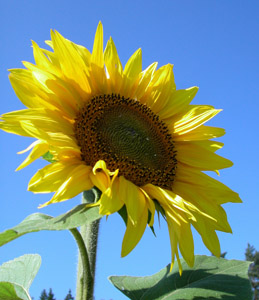 Last year I didn’t have to plant my garden of sunflowers; a family of chipmunks sowed more seeds than my garden could accommodate. But whether planted by design or by small furry mammals, sunflowers are rich and diverse native plants. Last year I didn’t have to plant my garden of sunflowers; a family of chipmunks sowed more seeds than my garden could accommodate. But whether planted by design or by small furry mammals, sunflowers are rich and diverse native plants.
Sunflower remains have been found in North American archaeological sites dating from as early as 3,000 BC. The centre of origin for wild sunflowers is considered to be the Western Plains of North America, but the ancestors of the cultivated type have been traced to the American southwest or the Missouri-Mississippi River valley areas.
The sunflower and our indigenous people shared the land and had close contact in early North American history. For most Indians, the primary use of the sunflower was for food. The seeds were lightly roasted, then ground into flour and used in breads or cooked with vegetables.
Spanish explorers, while looking for gold and other treasures, collected many of the New World’s flora, introducing the sunflower to Europe for its ornamental qualities. By 1616, the sunflower was common in gardens in England. The sunflower spread quickly throughout most of Europe.
|
Help Your Child
Grow A Sunflower
The easy-to-grow sunflower can be a child’s first exploration into the world of gardening. Parents or grandparents, use your gardening knowledge to share the thrill of accomplishment with your children. Sunflowers are perfect for children, as the large seeds can be easily handled by small fingers, and the plants grow quickly.
A game can be played, measuring the growth of the plant to your child: First the plant is ankle high, then to the knees, and soon reaches the child’s shoulder. Share the responsibility of nurturing by watering the plants together.
The simple act of growing a sunflower can impart a sense of wonder for the green world surround us, as the stalk seems to take on giant proportions. The seed head is the child’s ultimate reward. With flowing pride, your child will be able to say, “I grew it myself.” So sow seeds with your children and observe their awe as they watch the miracle of life and growth from one small seed.
|
But it is in Russia that the European success story really starts. The Holy Orthodox Church of Russia forbade the use of many foods during Lent and Advent, including many that were rich in oil. So the Russians eagerly accepted the sunflower, recognizing it as a source of oil that could be eaten without breaking the church laws. Russia soon became the foremost producer of sunflower seed, breeding the plant for high oil content and improved resistance.
The sunflower is a member of the Compositae family, the second largest flowering plant family, and one of the most highly developed from an evolutionary standpoint. Other members of the Compositae family include the aster, marigold, dandelion, black-eyed susan and lettuce. Sunflowers are of the genus Helianthus, coming from the Greek words helios – sun, and anthos – flower.
The simple beauty of a sunflower becomes more complicated with closer inspection. The sunflower head contains two types of flowers: the ray flowers and the disk flowers. The ray flowers – or petals – are broad-based and ring the outer edge of the flower head. They serve as attention getters, waving to nearby insects, luring them to the flower centre. The centre flowers, called disk flowers, are tubular in shape and require pollen from another sunflower plant to be fertilized. The insects cross-pollinate the disk flowers, which then develop into seeds.
The height of the common sunflower ranges from three to 12 feet, with some reaching 18 feet. The most widely grown variety for edible seed is Mammoth. First offered in the 1880s by a U.S. seed catalogue, it was listed as Mammoth Russian. One of the tallest sunflowers, Mammoth is most often used to produce prize-winning seed heads.
Sunflowers will grow in almost any type of soil, tolerate most variations of wetness, and require little pest control. However, they must have lots of direct sun, with little shade. While good, fertile soil will yield the largest flower heads and meatiest seeds, sunflowers are not picky. The only thing they really don't like is standing water.
Start your sunflower garden with good soil preparation. Prepare the soil by tilling to a depth of eight inches. Incorporate compost into the soil, then rake smooth and even. If planting in rows, stake rows three to four feet apart. Use the handle of a rake or shovel to trace a straight line and make an indentation in the soil that’s one-quarter to one-half inch deep. Sow seeds in this furrow, six inches apart. Cover with a one-eighth inch layer of fine soil.
Germination will take from five to 10 days. The seeds and young seedlings can take very light frosts, but might die after a hard freeze.
When the first true leaves appear, thin the sunflowers to stand a couple of feet apart. Stake tall plants to help hold up the seed head. Sunflowers thrive in hot, dry weather, and tolerate droughts. But they benefit from large quantities of water applied as deep soakings.
The sunflower is a very vigorous growing plant, reaching six feet in four or five months. To keep up with this growth, a booster application of organic fertilizer or compost is recommended when the flower head begins to appear.
The sunflower has few enemies to contend with. Most common are the stem borer and stem maggot, rust and powdery mildew. The stem borer and stem maggot can both be quite destructive as they burrow into the stem, killing off all vegetation above the point of entry. Clean garden practices are the best prevention.
The initial harvesting of the sunflower heads is quick and easy. In some cases, a ladder may be necessary! Sunflowers may be harvested when fully matured or when two-thirds of the seeds are mature. Watch the birds; when they are visitors to the seed heads, it’s time to cover the heads with cheesecloth to protect the seeds. The covered seed heads will be ready to harvest when their backs are brown and dry and no traces of green remain.
To harvest, remove the seed head with a few feet of stem attached. If you haven’t covered them before harvest, use cloth or a paper bag to catch falling seeds, and hang in a warm, well-ventilated location to cure. After curing, when the backs are entirely brown and papery, remove the seed for final storage. To do this, merely brush with your hands or a stiff brush and the seeds will fall right out. Do not wash the seeds before storage, as this may cause rot or mold. Store in an air-tight container in the refrigerator to help retain the most vitamins and food flavor.
The seeds are very high in many minerals, vitamins and essential acids. The main nutrients are protein, thiamine, vitamin E, iron, phosphorous, potassium, calcium and the essential fatty acids linoleic acid and oleic acid. In fact, sunflowers are in the same protein league as beef and are higher in iron than any other food except egg yolks and liver. Here is an article about the nutritional benefits of sunflower seeds.
Wendy Priesnitz is the co-founder and editor of Natural Life Magazine and a journalist with over 40 years of experience. She has also authored thirteen books.
|