The Herb Garden
The Joy of Growing and Using Herbs
Lavender
by Rachel McLeod
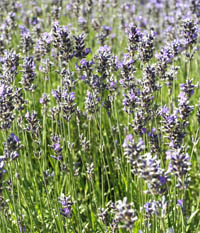 Is there any herb more popular than lavender? Its clean fragrance has been with us from earliest times. The Romans used it in their baths and the name lavender comes from lavare meaning to wash. So in the days when soap was a luxury, and for the rich only, other people washed in water made fragrant by the addition of lavender which grew in every cottage garden. Is there any herb more popular than lavender? Its clean fragrance has been with us from earliest times. The Romans used it in their baths and the name lavender comes from lavare meaning to wash. So in the days when soap was a luxury, and for the rich only, other people washed in water made fragrant by the addition of lavender which grew in every cottage garden.
In the 16th and 17th centuries, lavender was used extensively not only for its scent but in cooking. As Gerard in his herbal advises “the young and tender sproutings are kept in pickle and reserved to be eaten with meat”. Queen Elizabeth I liked lavender with her meat and her favorite was a lavender conserve. She also drank lavender tea as a cure for her migraines.
Using lavender for cooking could well be done by anyone with a mature lavender bush. The flowers can be put in sugar and sealed tightly for a couple of weeks then the sugar can be substituted for ordinary sugar for a cake, buns or custards. And of course the desserts can be decorated with crystallized lavender flowers.
Lavender is not only for sweet dishes. It is also a savory herb. I always add lavender when I am making Herbs Of Provence, the wonderful French spicy mixture of rosemary, savory and thyme often with lavender and basil added. Lavender has a particular affinity for lamb; in fact, in France lambs were grazed on lavender whenever possible. This may not be possible in Canada but adding lavender stems to the barbeque and sprinkling the flowers on to the roast will help to impart the flavour to the meat.
Be careful when cooking with lavender only to use a few flowers, as too many will make the food bitter. Always wash them first and do not use if there is any danger of them having been sprayed with insecticide.
There are different species of lavender. The one we know best are various varieties of Lavendula angustifolia. A seed catalogue will list them but Hidcote purple and Dwarf Munstead are two small, attractive ones that I like; some of the others grow rather tall and wide – maybe a metre in both directions. The French lavender – L.stoechas and L. dentata – are both very attractive and sweetly scented but are not hardy here so would have to be grown as a house plant in winter.
If it is given the right conditions lavender is easy to grow. It is most important to plant it where it is well drained. It will winterkill for certain if it has damp feet. Also it prefers a slightly alkaline soil. Wherever it is in the garden its scent and purple spikes will be attractive. I have a small hedge of lavender leading to the front door and in addition there are clumps scattered in areas throughout the garden. Although it prefers full sun it will take some hours of shade.
Pruning lavender is always a subject of discussion. When it is young, the lavender will not need more than a gentle trim in spring to tidy it up and remove dead stems. As the bush grows bigger and older it needs more drastic cutting so that it will form new growth which will over-winter much better than very old wood. My hedge is about eight years old and I keep the back of it well clipped so that it does not invade other plants in the bed. I also remove any old, woody and straggly stems. Both of these operations promote new growth and take place in the spring and again after flowering. The smaller lavenders such as Hidcote and Munstead need less pruning. Although lavenders can live for many years, a very cold winter without snow cover could kill an old plant so it is a good idea to propagate some young ones to substitute if necessary.
This can be done either by collecting seed (if you are fortunate, the plant may self-seed) or by taking cuttings, which root quite easily, or by burying a plant in sandy soil and leaving for some months when the stems will have grown roots and can be severed to make new plants. This is just a rather exaggerated way of layering and of getting a lot of young new plants without much trouble.
As an herb, lavender has many uses. The flowers scent our closets and keep moths away from our clothes but also they have medicinal uses. Queen Elizabeth I was quite right to use lavender tea for her migraine. It is a nerve tonic and lavender tea will help with any headaches, faintness and sunstroke. The spikes of lavender should be collected just as the florets are opening and hung to dry. When the spike is completely dry the flowers can be rubbed off and stored for use. The leaves can be dried too but they are not as fragrant.
Rachel McLeod founded Kiln Farm Herb Garden in Puslinch, Ontario in 1974.
|