The Herb Garden
The Joy of Growing and Using Herbs:
Juniper and Jacob's Ladder
by Rachel McLeod
When I planted my first silver and gray bed of herbs, more than 20 years ago now, I was back to the books and soon discovered that the silver and grays needed a dark background to be really effective; the most successful plantings were in front of tall dark yew hedges. This was not really possible in our herb garden so I looked around for other dark evergreen trees and found the solution in a blue columnar juniper. It still stands in the silver and gray bed surrounded by plants such as artemesia, lamb’s ears and silver thyme – all brilliant in contrast with the juniper.
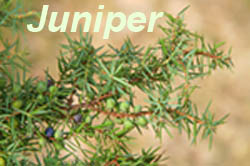 Juniper is a very useful plant in the herb garden, where it adds texture and color. As it is evergreen, the rich blue green of its foliage is attractive throughout the year. It grows in a variety of forms, from the vertical that I used, to the prostrate, creeping types such as Blue Rug and many intermediate bushy shrubs. There is indeed a juniper for every situation. The flat ones are particularly good as a ground cover if they are planted about 30 cms apart. Juniper is a very useful plant in the herb garden, where it adds texture and color. As it is evergreen, the rich blue green of its foliage is attractive throughout the year. It grows in a variety of forms, from the vertical that I used, to the prostrate, creeping types such as Blue Rug and many intermediate bushy shrubs. There is indeed a juniper for every situation. The flat ones are particularly good as a ground cover if they are planted about 30 cms apart.
The foliage of junipers is very aromatic. A lovely, clean, resinous scent arises if you brush against them or are weeding around them. The berry or “cone” is even more aromatic than the foliage and this is the part used for its oil and for flavoring. The berries take two to three years to mature. They are green in their first year or two but will turn blue then black when they are ripe. They are usually harvested in the autumn of the second or third year.
They are used for culinary and medicinal purposes and are especially good used as a seasoning for fish, game, venison and sauerkraut. The fruit collected from Mediterranean countries is more flavorful than that from northern countries such as Sweden or Scotland. Usually they are bought in packets showing their origin. They can be added in a marinade or a stock so that the flavor will permeate the meat before cooking.
Medicinally, juniper is a very useful herb. For problems with the urinary tract, it has a diuretic effect. It is also used for arthritis and rheumatism, to stimulate digestion and to dispel mucus and relieve coughs and bronchitis. It is usually taken as a tea made from the berries. However, it should not be used on a long-term regular basis as prolonged use might irritate the kidneys.
Finally, one of the most important uses of juniper is hardly in the medicinal realm but certainly fulfils the definition of a herb being a plant useful to humankind. Juniper berries are the source of the flavor of gin. The name gin is derived from the French for juniper...jenever and genievre. Gin as an alcoholic drink has been made since before the 17th century. Initially, it was a harmful drink but the process of redistillation has removed the harmful characteristics. Now British and American gins are made from a colorless and tasteless neutral spirit which is then redistilled with juniper berries and possibly other flavorings such as angelica, coriander, fennel, caraway or anise to name a few; each maker has his secret recipe in which herbs play an important part. 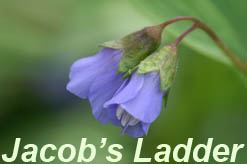
This seems like a good opportunity to write about a delightful plant often seen in gardens – Jacob’s Ladder. Polemonium caeruleum and P. reptans are both candidates for the herb garden. The plant gets its name from the ladder-like formation of its leaves, which grow up the stem like rungs on a ladder. Both plants have lovely sky blue flowers in the spring. P. reptans is the earliest and makes a small clump with a mass of blue flowers only about 12 cms high. Then it disappears for the season, hopefully to return the following year. But as it is a short-lived perennial, one can never be certain. Also I have not yet been able to find viable seed and it has never self-seeded in my garden. In spite of that drawback, it is one of the loveliest spring flowers and a wonderful companion to the early bulbs.
P. caeruleum is later to flower and much taller, up to a metre high. It will grow in semi-shade and has either blue or white flowers. Instead of disappearing after flowering like its cousin, it retains fresh green foliage all summer making a handsome clump even without flowers.
Both plants were listed as a herbal medicine until the nineteenth century, when they fell out of use. P. caeruleum was also called Greek valerian because of the similarity of its leaves to those of valerian but the similarity ends with the leaves. Culpepper says it is “useful in malignant fevers and pestilential distempers; it helps in nervous complaints, headaches, trembling, palpitations of the heart, vapors etc.”.
The root of P. reptans was used as an astringent and for fevers, coughs and colds and is still listed in modern books but it would be sad to dig up such a pretty plant for its roots when other remedies are available.
There are other Jacob’s ladders on the market, in particular a variegated form of P. caeruleum which is very handsome and rather difficult to find. Also a variety with apricot flowers which I have grown from seed and now in its third year is making an attractive clump. All these polemoniums are attractive additions to the herb garden or any garden area and though they are not now in use they are valid additions to a herb collection if only for their historical value and their beauty.
Rachel McLeod founded Kiln Farm Herb Garden in Puslinch, Ontario in 1974.
|