The Herb Garden
The Joy of Growing and Using Herbs:
Ivy
by Rachel McLeod
Common, traditional or folk names of plants are delightful to use; they vary from country to country and within countries from place to place, and are easy to remember. But to be sure of the identity of a plant and to find out about its characteristics, it is wise to use the botanical name.
The confusion that common names may produce is well illustrated by plants described by name as different kinds of ivy. It was earlier in the year that I wrote about the true English ivy and its use as a herb. I omitted to mention that many years ago when visiting a French herb farm I was interested to see them making up bales of ivy which they told me was used as a catalyst in their herbal cosmetics. This was apparently a secret operation and they did not vouchsafe any further information and I have never since seen any reference to such use.
As well as English or common ivy there are at least two plants with herbal qualities, which are listed in many herb books as ivy.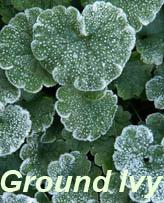 Neither bears any real resemblance to the true ivy (Hedera helix) and probably it is their creeping stems and the rather vague ivy look of the leaves that gave rise to the common name. The first is a modest plant known as Ground Ivy, Creeping Charlie, Gill-over-the-ground and many more popular names. Its botanical name is Glechoma hederacea. Almost certainly you will have met it, probably as a nuisance weed insinuating itself among the grass blades in the lawn almost without being noticed until the small flowers appear. The leaves grow in pairs opposite each other and are dark green, rather soft and hairy, and evergreen under the snow. The flowers are blue. They appear in early spring in whorls of three or four at the base of the leaves. The plant was brought to North America from Europe by the early settlers and has naturalized. It is now found throughout the continent. The whole plant is very aromatic and a bit spicy. Neither bears any real resemblance to the true ivy (Hedera helix) and probably it is their creeping stems and the rather vague ivy look of the leaves that gave rise to the common name. The first is a modest plant known as Ground Ivy, Creeping Charlie, Gill-over-the-ground and many more popular names. Its botanical name is Glechoma hederacea. Almost certainly you will have met it, probably as a nuisance weed insinuating itself among the grass blades in the lawn almost without being noticed until the small flowers appear. The leaves grow in pairs opposite each other and are dark green, rather soft and hairy, and evergreen under the snow. The flowers are blue. They appear in early spring in whorls of three or four at the base of the leaves. The plant was brought to North America from Europe by the early settlers and has naturalized. It is now found throughout the continent. The whole plant is very aromatic and a bit spicy.
Although Ground Ivy may be a nuisance as an invasive weed, it is useful as a home remedy, usually as a pleasant tea if honey is added. It is used for nervous headaches, coughs and indigestion. It is also a diuretic and a stimulant. In addition, the plant was used before hops were grown to clarify and flavour ale which gave it still another name....Alehoof.
The second plant has a bad reputation. Poison Ivy (Rhus radicans) is well known, perhaps because 70 percent of the population are allergic to it and there is no doubt it produces a very painful rash in those who are sensitive to its oil. For them it is well named poison ivy. I can only guess the early settlers decided it was a suitable name as its habit of crawling along the ground and then climbing the nearest trees is similar to the way ivy grows in warmer climates.
Poison ivy, however, is hardier than true ivy and is able to climb high to reach the sun, where it flowers, the fruit ripens, and it provides food for migratory birds in the fall. Research has shown that its berries are one of the ten most important food sources for birds. I have eradicated all that I can find in and around our garden and now feel guilty. I wonder where I could safely allow it to grow and climb and provide food for wildlife. It is very beautiful in the fall with red leaves and gray berries.
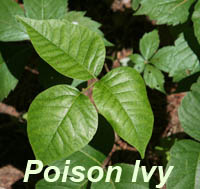 In spite of its poisonous properties, poison ivy has herbal qualities. An extract was prepared from the leaves and used to treat chronic skin problems, acute rheumatism and paralysis. It is now only used in homeopathic preparations and is considered one of the best treatments for nettle rash. There are also records that the juice used to be used as an indelible ink and, of all things, in shoe polish. In spite of its poisonous properties, poison ivy has herbal qualities. An extract was prepared from the leaves and used to treat chronic skin problems, acute rheumatism and paralysis. It is now only used in homeopathic preparations and is considered one of the best treatments for nettle rash. There are also records that the juice used to be used as an indelible ink and, of all things, in shoe polish.
Finally, a suggestion for dealing with the effects of poison ivy. I personally find that washing with a strong soap as soon as possible after contact works well for me. But there are plants whose juice may counteract the effects of poison ivy. Jewelweed (Impatiens capensis) is one of these and the juicy yellow flowered plant is often found growing near stands of poison ivy. Crushed leaves from this plant can be spread on the area affected. Also sweet fern (Comptonia asplenifolia) has an ingredient which seems to act on the poison ivy oil and lessens its effect.
Lastly, Mugwort (Artemesia vulgaris) has been used for the same purpose. I have not been able to test either of the last two. Aloe vera will also alleviate the itch over small areas. However for widespread exposure, which can make people very ill, it is best to consult a doctor to find an antidote. Best of all is to watch for the plant, even in winter....my family got a rash by tobogganing over a patch of “dead” poison ivy!
Rachel McLeod founded Kiln Farm Herb Garden in Puslinch, Ontario in 1974.
|