The Herb Garden
The Joy of Growing and Using Herbs
Hyssop and Horehound
by Rachel McLeod
Towards the end of summer, a dark corner of my herb patch is transformed by the flowering of an unobtrusive plant, which suddenly is covered with blue flowers. The hyssop is blooming. It flowers with the white Greek oregano, bright orange and yellow calendulas all interspersed with the clear sky blue of borage flowers and blended together with the green and gold of the ginger mint.
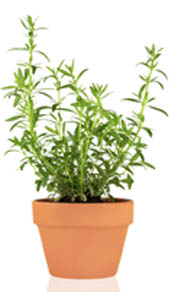 Hyssop (Hyssopus officinalis) is an evergreen perennial with spikes of usually blue flowers, but sometimes pink or white forms can be found. It grows about 30-50 cms high. Straggly stems should be trimmed to make the plant bushy or it can be clipped more heavily to form a low hedge, which is attractive but will not flower as profusely. If the plant gets very woody it is best to divide it and start new plants with small pieces. New plants can also be started from cuttings or from seed. It grows best in a well drained warm place in the garden with a light soil. Hyssop (Hyssopus officinalis) is an evergreen perennial with spikes of usually blue flowers, but sometimes pink or white forms can be found. It grows about 30-50 cms high. Straggly stems should be trimmed to make the plant bushy or it can be clipped more heavily to form a low hedge, which is attractive but will not flower as profusely. If the plant gets very woody it is best to divide it and start new plants with small pieces. New plants can also be started from cuttings or from seed. It grows best in a well drained warm place in the garden with a light soil.
Hyssop is a bitter herb and very aromatic. It is the young flower shoots and leaves that are used both for cooking and medicinally. For culinary uses it should be used for soups, stews and stuffings and even salads; but only sparingly at first because it is very hot and spicy and the flavor could be too dominant.
Medicinally it can be used as a tea for coughs, to relax tensions and as a stimulant for the appetite. In the past in castles, monasteries and churches it was used as a strewing herb and for purification. There is some controversy about the translation of the hyssop mentioned in the Bible. Some scholars think it was probably a marjoram and not the hyssop we know.
In the garden, the hyssop is an excellent landscape plant; as I have already mentioned it adds color in August. But it is also a favorite of bees and butterflies and provides plenty of honey.
As the true hyssop fades another herb named anise hyssop (Agastache foeniculum) starts to flower. This is no relation of hyssop, but is a handsome plant with columns of purple flowers, which vary in length each year. Last season was a very good one, and some of my plants had spikes eight cms long. Anise hyssop is also known as Korean mint and, like all mints, the leaves are used for flavoring teas. Also it is important as a bee plant because it produces a great deal of nectar. It is one of the easiest plants to grow and although it would be a more handsome plant in rich soil, it is not fussy and even manages in dry situations and part shade. It is excellent for naturalizing as it self seeds freely. It could be a nuisance except that the seedlings are easy to pull and it does not form runners like the other invasive mints. 
A much more modest member of the herb patch is horehound (Marrubium vulgare). The white horehound makes a spreading patch of greyish white leaves. The inconspicuous flowers are carried in whorls on stems rising above the leaves. The plant likes sunny, dry, even rocky situations but will not tolerate poor drainage, damp soils and shade. It has been used medicinally for centuries almost entirely to relieve coughs and colds. It is made into a tea and even an ale as well as a cough candy. Its taste is bitter and a lot of sugar is needed to make it palatable.
Here is a recipe...
Bring a good handful of horehound and a cup of water to the boil. Remove from the heat, cover and infuse for ten minutes. In a large pan put 2 cups of sugar, 25 grams of butter and half a cup of the horehound infusion. Stir well as it comes to the boil and boil for five minutes to hard ball stage. Pour into a greased dish and as it sets cut into squares and store in a tin or jar until needed for a cough or cold.
There are two other species of horehound. One is the black horehound, which has an unpleasant smell and is generally unattractive and not recommended as a garden plant. But there is also a silver horehound (M.incanum). From its description, this sounds to be a very ornamental plant and I hope I can find seed and try to grow it.
Rachel McLeod founded Kiln Farm Herb Garden in Puslinch, Ontario in 1974.
|