Cucumber Power
How to Grow This Prolific, Versatile Veggie
by Wendy Priesnitz
Cucumbers love warm weather and sandy soil. Whether you have a big, country garden or a few pots on an urban balcony, this prolific producer will provide you with salad and soup fixings all summer long, with enough left over for pickles to last the winter.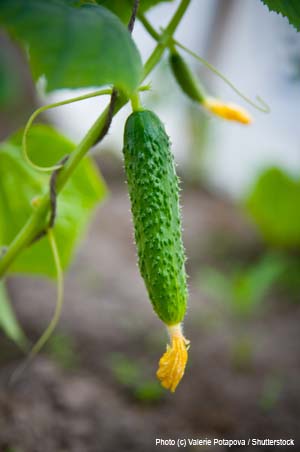
Cucumbers are Cucurbits, or members of the cucurbitaceae family, which includes cucumbers, melons, and squashes. These veggies all love warm weather and sandy soil. They all grow poorly in cool, damp climates and are sensitive to frost. Cucurbits, in descending order of frost tolerance, are squash, pumpkin, cucumber, cantaloupe, and watermelon.
Cucumber (Cucumis sativus) is a warm-weather vine or bush crop, which is a favorite in salads, fresh from the vine, or when preserved as pickles. A native to southern Asia, cucumbers come in all shapes and sizes. Pickling cukes are short and stubby; slicers are long and slender; apple or lemon cucumbers are spherical and yellow. The Armenian cucumber is really a long, slender melon that grows up to three feet in length.
Each type of cucumber has its own distinctive flavor. The short pickling varieties are bitter when eaten fresh, and when used to make pickles should be picked when only a few inches long. Some slicing varieties possess a tough, bitter skin that is peeled before eating the sweet creamy flesh within. Since cucumbers are mostly water, many commercial growers cover them with a thin layer of wax after harvesting to retain moisture – something you can avoid when you grow your own. To enjoy the peak flavor of cucumbers, they should be eaten within a few hours of harvest.
Basic Facts
Germination time for seeds is six to ten days. Soil temperature for germination should be a minimum 60 F (16 C). The optimum is 95 F (35 C) with a maximum of 105 F (40 C). The yield per 10-foot row is 40 to150 fruits. The yield per four- by four-foot raised bed is 100 to 300 fruit; this volume of cucumbers must have a trellis for support.
Stored seed has a life expectancy of five to six years. The estimated time between sowing and first picking is 48 to 60 days for the pickling variety and 52 to 72 days for slicing cucumbers.
|
Healthy Fruit
The cucumber is an amazingly healthy fruit.
* contains sterols, which can reduce bad cholesterol;
* reduces puffiness, dark circles and bags under your eyes;
* heals diseased gums, cleanses your mouth and improves bad breath;
* provides lots of B vitamins;
* a good source of potassium, magnesium and fiber,which regulate blood pressure;
* there are many more apparent benefits being researched, including joint health, cancer fighting, and skin care.
|
Climate
The cucumber is an annual plant in all zones. It needs full sun and warm weather, above 70 (21 C). Cold temperatures slow vine growth, and stop flowering and fruit set.
Soil
Prepare soil in early spring or the previous fall. Incorporate plenty of compost and manure. Add dolomite lime to neutralize the pH to 7.0 and keep cukes from “bubbling” and turning pithy on one end. Add an organic fertilizer or rich compost. Soil should hold moisture, but drain well.
Seed Sowing and Planting
Do not plant where cucumbers, melons or squash grew the previous two years.
To start plants indoors, plant seeds 1/2-inch deep in small containers of fine potting soil. Transplant to mounds or rows after all danger of frost is past. Build mounds of soil on flat beds to warm sooner. Mound soil at least 12 inches high and 12 to 24 inches across. Pile compost about four feet high incorporating manure. Place a three- to six-inch layer of topsoil on the top of the mound. Now the mound is ready to plant. The soil temperature must be at least 60 F (16 C) for germination and strong growth.
In mounds: Sow four to six seeds 1-1/2 inches deep. Drench the mound with water and do not water again until after sprouting.
In rows: Sow seeds 1-1/2 inches deep, 1 to 2 inches apart. Thin to 6 inches apart when seedlings are 4 to 6 inches tall.
Plant several dozen plants of pickling varieties, so that many become ripe at the same time, and an entire batch can be processed at once.
Build a trellis or support for vining types to climb on. This saves precious garden space and keeps the fruit off the ground, which discourages insects and rot. The fruit develops straight and makes it easier to spot when picking. Trellised fruit, when shaded by leaves, is protected from sunburn, which causes bitterness.
Replant seeds if the first sowing does not germinate rapidly, or is slowed by spring rains. Grow about one to four slicing plants or four to six pickling plants per person.
Cucurbits develop separate male and female flowers. Male flowers develop first and are easily distinguished as a plain flower on a long stem, having only stamens. The female flower forms large ovaries that look like small fruit. After the first female flowers are pollinated, the vines develop both male and female flowers.
Some melons, many squashes, and all cucumbers cross-pollinate with one another. When cultivating a seed crop, grow only one variety of each type. Hand pollinate by removing a male flower and shaking it inside a female flower on another plant to ensure vigorous seed. To prevent further pollination, close the female bloom with a piece of string, or twist tie for a few days.
Crop Care
Keep seedlings moist enough to avoid wilting, but be careful not to over water, which promotes damping-off. Mulch with dark, heat absorbing mulch or black plastic for heat after soil is well warmed. Deep-water as needed to encourage a long taproot. The crop consumes more water when fruit sets, and surface watering is necessary. Fruit is over 90 percent water and must have adequate irrigation to form large fruit. Water stress will cause deformed cucumbers, and a smaller crop.
Side-dress with low-nitrogen soluble fertilizer or compost as soon as flowers set, and twice a month thereafter until the end of the season. Removing side or lateral shoots will send all the nutrients to remaining fruit, which makes them larger and helps them mature faster.
Pinch off the end of vines about two weeks before the first frost so all of the fruit that has set will mature.
Harvesting
For maximum production, harvest cucumbers as soon as they become ripe. When left too long on the vine, they yellow, become sour and slow other fruit from ripening.
Pickling varieties should be harvested when they are three to six inches long. When longer, they preserve poorly and become mushy. Slicing varieties are picked when they are from six to ten inches long. If slicers get too long, or start to yellow, they become bitter and pithy. Apple or lemon cucumbers should be picked when they are the size of a small lemon.
|