The Herb Garden
The joy of growing and using herbs
Garlic
by Rachel McLeod
It is surprising to realize that about fifty years ago garlic was used mostly for cooking and then only by those who were interested in European cooking or who had a tradition of using it regularly. In fact, it was at about the same time that we realized that garlic would grow well in Canada and were discovering how to grow really good cloves. Nor was garlic generally recognized for its wonderful medicinal qualities at that time. Now of course it is different; stores, not only health stores but supermarkets too, are full of such a bewildering choice of garlic pills and capsules that it is hard to know which to buy.
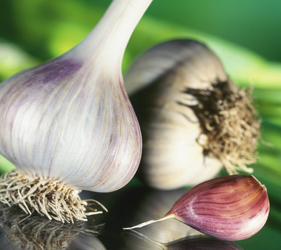 Garlic has been used for centuries. It has been mentioned in records dating back to 2000 BC from China and even earlier from the Middle East. A daily ration of garlic was given to the builders of the pyramids by the Pharaoh Cheops, and according to other papyrus records, garlic had a variety of uses. These included determining if a woman was fertile and putting a garlic clove in a snake's hole to prevent it from emerging. Garlic has been used for centuries. It has been mentioned in records dating back to 2000 BC from China and even earlier from the Middle East. A daily ration of garlic was given to the builders of the pyramids by the Pharaoh Cheops, and according to other papyrus records, garlic had a variety of uses. These included determining if a woman was fertile and putting a garlic clove in a snake's hole to prevent it from emerging.
Garlic bulbs contain an odorless substance containing amino acid derivatives called allicin; when a garlic clove is crushed this is converted to allicin. It is this substance which is a powerful anti bacterial agent but also is the origin of the strong odor, which many find offensive. It has been demonstrated that garlic does protect us from infection, normalizes blood pressure and decreases high blood pressure. Also that small quantities increase the action of the peristaltic muscles thereby helping digestion. (Some people however do find that garlic is indigestible – a problem that may be alleviated by taking it in conjunction with parsley).
As I said earlier, there are many garlic products on the market. It is like a maze for the consumer trying to find the way to the best garlic product through a multitude of capsules and pills. Also it is generally agreed that processing garlic tends to weaken the action of some of its qualities. In view of this, there is no doubt that it is best to grow garlic in your own garden to supplement any garlic pills you may take. As well as being unprocessed, home grown garlic has a much better taste than garlic bought from a store.
It is not difficult to grow garlic and it does not need much attention. The garlic bulb is divided into sections called cloves. Each of these will grow into a full sized garlic bulb in a season. Once you have started a bed of garlic you will always be able to keep some of the best cloves to plant the following year. Try to buy your first garlic cloves from a herb farm or farmers' market. The garlic sold in stores may have been treated so that it will not sprout and so would be a disappointment in your garden.
Garlic needs a rich, well composted soil and plenty of moisture. In its native habitats it grows in lush meadows. However it will produce in less than perfect conditions as well. I manage, on my shallow soil and in a rather shady west facing bed, to grow enough for us for the year. The cloves should be planted in October or November about four centimetres deep and about 15 centimetres apart. If you were not able to plant the garlic in the fall it is a good idea, in the winter, to pot some cloves up in individual pots and grow them in a cool place in the house, transplanting them into the garden as soon as the frost is out of the ground. This way the roots will have grown and the garlic should mature by the end of summer.
Garlic shoots will appear in very early spring and the bed should be kept weeded and mulched. Then in early summer the flowering stems will appear. It is important to cut all these off so that they do not take the strength from the plant that is needed to form the bulb. After this the garlic can be left to grow until August. Then when the leaves start to wither, it is time to dig the corms up. This is the time to make the braids of garlic and hang them to dry. Braiding is hard and skillful work so my garlic is stored loose. However both the loose and the braided garlic should be set to mature in a warm, dry place such as a porch or shed for three or four weeks. If this drying is done thoroughly the garlic will not sprout in storage.
In addition to its culinary and medicinal uses, garlic is also proving to be useful in the garden as an insecticide. It is often grown in the company of roses to prevent black spot. Valuable as garlic is – especially to our health – there is no doubt that when it is absorbed into our bodies its odour is unacceptable to many people. Herbs such as parsley and mint seem to help to mitigate this problem and it is a good idea always to use fresh garlic with parsley in cooked dishes and in salads.
Rachel McLeod founded Kiln Farm Herb Garden in Puslinch, Ontario in 1974. This article was published in 1997.
|