The Herb Garden
The Joy of Growing and Using Herbs
Elder
by Rachel McLeod
It is not always recognized that many of our most important herbs may be trees or shrubs – Mountain Ash, Prickly Ash, Mahonia and Linden to name only a few. In this column we will look at the Elder (Sambucus canadensis).
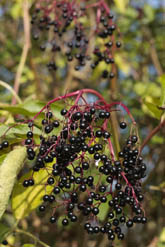 The Elder is one of the most interesting herbs. It is found all over the world in temperate regions and where ever it grows it is surrounded by magic and myths and legends. It has been extensively used throughout history, originally by the ancient Britons and Celts and almost certainly by many prehistoric tribes. Later it was used medicinally by the Romans, and by healers and housewives through the centuries until the present day. The Elder is one of the most interesting herbs. It is found all over the world in temperate regions and where ever it grows it is surrounded by magic and myths and legends. It has been extensively used throughout history, originally by the ancient Britons and Celts and almost certainly by many prehistoric tribes. Later it was used medicinally by the Romans, and by healers and housewives through the centuries until the present day.
It is a bush which grows in a vigorous but rather undisciplined manner. There are a number of different species in Canada but the two that are most common are the black berried elder (S.Canadensis) and the red berried elder (S. pubens). The latter is considered poisonous to humans so it is wise not to use it though I sometimes wonder when I see how much wildlife love it. There is no plant in my garden that will attract so much attention when the bright red berries are ripe as this elder. It flowers in late May – much earlier than the black berried species – and has a conical inflorescence, whereas the black berried form has flowers in June/July and has a flat flower head often as much as six inches across. The black berries ripen in the fall and also have to be shared with the birds.
It is this black berried elder which is so useful. Early in the year some of the young leaves can be used to make a tea for a spring tonic and the young stems and buds can be made into a pickle. But it is the flowers that are the first real harvest. Used fresh the flower heads are made into delicious fritters or pancakes or even used with rhubarb in a pie. Perhaps the best known recipe – at least in England – is the Boy Scout Champagne or Elderberry flower fizz. This is a delightfully refreshing summer drink made from elder flowers, sugar and lemon. Quite recently, a bottled line of this drink is being offered in Canadian stores; you are probably most likely to find it in a health food store rather than the supermarket.
Not only are the beautiful flowers useful for cooking but they do have a medicinal use. They are astringent and if made into a tea will relieve the pain of sore eyes. I always keep a bottle of dried flowers for this purpose. In the 18th Century, every lady possessed a bottle of elder flower water made into a lotion with glycerine and used it to keep her complexion clear and her hands soft and white. It is important to harvest the flowers very early in the season in order to dry them a creamy white; if the flowers are older they tend to go brown when they are dried and lose some of their potency.
Always leave enough flowers for the next harvest of the berries in the fall. Elderberries are used to make wine, to make pies and also to make elderberry rob which is a wonderful cordial for coughs and colds and made from the elderberry juice simmered with sugar until it is as thick as honey. This can be bottled and stored and then one or two tablespoons are mixed with soda water and lemon to make a refreshing summer drink or in winter mixed with hot water to ward off or give relief from coughs and colds.
There is no part of the elder bush that isn't used...the young leaves are used to make a tea for a spring tonic or an ointment for cuts and bruises. The leaves at any time can be crushed and used as a mosquito and fly repellent. The stems can be hollowed out by removing the soft pith and then used as whistles or peashooters. Early musical instruments, flutes and pipes and even the pipes of Pan were probably made from elder branches with the pith removed.
The value of this tree is so great that Roma (Gypsies) will never burn it on their fires because that would bring bad luck or it may be that they honor the legend that says that Christ's cross was made from an elder tree and from that time on the elder only grew as a weak and straggly bush. There is so much superstition around this plant that it is impossible to list all its magical qualities. I can only recommend that you find a place in your garden for it. Not only will you be able to use the flowers and fruit, it will most certainly keep witches away from your home as well as lightening and other evil influences!
Rachel McLeod founded Kiln Farm Herb Garden in Puslinch, Ontario in 1974.
|