The Herb Garden
The joy of growing and using herbs
Dill and Dandelions
by Rachel McLeod
Everyone knows dill (Anethum graveolens) and its delicious flavour, which I find impossible to describe but which among many other things adds a special excitement to the first new potatoes of summer.
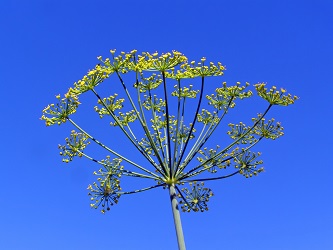 Dill is in the same family as parsley, chervil and coriander – a family of plants where the flowers and seeds are held in umbrella like shapes called umbels. The family is Umbelliferae, named after this formation. Dill is in the same family as parsley, chervil and coriander – a family of plants where the flowers and seeds are held in umbrella like shapes called umbels. The family is Umbelliferae, named after this formation.
Dill needs full sun, a fairly rich soil and more moisture than most other herbs. When it is happy in its position, it will self seed prolifically, and these are usually the strongest plants. Like the rest of the family, dill seedlings have tap roots and will not transplant successfully. Planting seed should be done after all danger of frost is over. It is always a good idea to plant a second crop of dill during the summer to use in the fall.
There are two special kinds of dill in the seed catalogues now. One is a giant...Dill Dukat can grow to 76 cm and will make large umbels and provide large seedheads for pickles. The other is a dwarf form...Dill Fernleaf, which is a much shorter plant and will grow about 46 cm. It is more branching and slow to go to flower so, it is a useful plant for those of us who want a steady supply of dill leaves throughout the summer.
Leaves should be harvested for dried dill before the flowers form; once it is flowering there are very few leaves to harvest. Later in the summer the seedheads can be harvested and used in bread and in pickles.
Dill leaves are delicious in salads, casseroles, as a garnish for appetizers and in cream cheese; herbed cream cheese is wonderful and easy to make with your own herbs, homemade mayonnaise and cream cheese...I use dill, chervil, parsley and chives but you can create your own mix.
Although dill is most usually used for culinary purposes, it has excellent medicinal qualities. It is especially helpful for digestive problems. Flatulence in babies has long been helped by infusions of dill seed in warm water. Gripe water – the universal panacea for babies for many years – is made of dill and fennel. But not only babies benefit. Dill is rich in minerals and improves the condition of hair and fingernails. Using dill weed or seed as frequently as possible in your menus will be both a delight to your taste but also a help to your digestion. 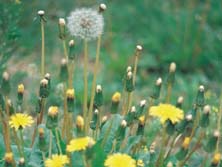
Dandelions (Taraxicum officinale) are a problem to the gardener. But if the dandelion was an endangered species, how much it would be appreciated with its bright yellow flowers, dark toothed leaves and its beautiful seedhead! Fortunately, the dandelion is not endangered and let us hope that, in spite of herbicides, it never will be. The dandelion is one of our most useful plants and a powerful herb. Young leaves are used in salads and it is a good idea to blanch them to make them more tender and less bitter. This can be done by covering the plant for a day or two before picking. The leaves are good when steamed and used like spinach.
Dandelions are specially cultivated for these dishes and quite often can be found in the supermarket. The flowers are used to make delicious wine and can also be fried or made into fritters. The root is probably the most useful part. It should be dug in the fall and cut into small pieces and roasted. When they are dry and brittle they can be ground into a powder and made into a drink similar to coffee or chicory. Dandelion is a blood cleanser and tonic with a high content of potassium, phosphorus and calcium and Vitamin A. It is a diuretic and helps to remove toxins from the body.
Our dandelions are kept well under control in the spring but I am afraid they go to improve the compost and I have not tried cooking the flowers. We do however have a salad of the leaves when I remember to blanch them and I always enjoy a daily cup of dandelion root at my “coffee” break!
Rachel McLeod founded Kiln Farm Herb Garden in Puslinch, Ontario in 1974.
|