The Herb Garden
The joy of growing and using herbs:
Chamomile
by Rachel McLeod
“..... Peter was not very well during the evening.
His mother put him to bed, and made some chamomile tea
and she gave a dose of it to Peter.”
from The Tale of Peter Rabbit by Beatrix Potter
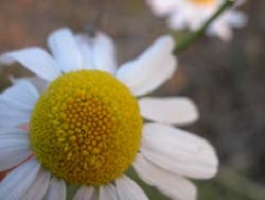 I wonder how many of the children who have had the story of Peter Rabbit read to them have had any idea what chamomile tea is. Do they conjure up a picture of a nasty medicine given to Peter almost as a punishment for Peter's wild adventures in Mr. McGregor's garden? After all Flopsy, Mopsy and Cottontail had bread and milk and blackberries for supper. I wonder how many of the children who have had the story of Peter Rabbit read to them have had any idea what chamomile tea is. Do they conjure up a picture of a nasty medicine given to Peter almost as a punishment for Peter's wild adventures in Mr. McGregor's garden? After all Flopsy, Mopsy and Cottontail had bread and milk and blackberries for supper.
Of course we all know now that far from being a punishment the chamomile tea was going to give Peter a quiet night's sleep and a comfortable tummy the next day.
There are two different plants, both belong to the same plant family – Compositae – and both have small, daisy-like, white petalled flowers with yellow centers, both have a similar fragrance like sweet apples. A tea made from either of the flowers is soothing, with sedative, tonic and stomachic properties.
German Chamomile (Matricaria recutita – until relatively recently its botanical name was Matricaria chamomilla which was much easier and is still used in many books but taxonomists love change and this is probably more botanically correct! ) is an annual which will self-seed freely. It grows about 15 to 30 centimeters tall and is a delicate, much branched plant covered with flowers if grown in full sun.
The flowers should be harvested just before they are fully open. This is a time consuming and somewhat tedious job but the tea made from the flowers is delicious and for many people a sure recipe for a good night's sleep. It is important to dry the small flowers very well and leave them in a paper bag for a bit even after drying. The solid yellow centers are difficult to dry out and will mould easily if put into an air tight container too soon.
Roman Chamomile (Anthemis nobilis) is a very useful plant in the herb garden. Not only is it a perennial but it is low growing and forms beautiful mats of ferny leaves. It produces fewer flowers and they are not as sweet as the annual chamomile so it is not used as much for teas, though its medicinal qualities are the same. The plant's low, mat-forming growth of fine, dark green leaves make it attractive in the garden. Garden seats have been grown made of chamomile plants and there is a chamomile lawn at Buckingham Palace. This is said to be very soft and springy and lovely to walk on. In fact, it is said that if you are the proud owner of a well established chamomile lawn you would be able to throw a raw egg over the roof of your home and if it landed on the lawn it would not break.
For many years, one of my ambitions was to grow a chamomile lawn and, if that was not possible, then I would settle for a chamomile path.
The chamomile lawn was tried first when we carved up our lawn to renew the septic system. I grew hundreds of small chamomile plants and spent the summer planting them out. Chamomile is hardy so I was not worried about cold and snow in the winter, However, in those days we all had our own backyard skating rink and the chamomile could not survive the ice and repeated flooding and freezing. (It is amazing that grass could!) In the spring there was a mud patch and unanimous agreement that a chamomile lawn was not a success. However, later for a few years, I did have a successful chamomile path in the herb garden. It needed a lot of weeding and was rather sensitive to traffic but when our guests walked on it the scent was wonderful.
I am still growing Roman chamomile but not as a lawn or a path. I am delighted to see it making patches wherever it chooses and they grow larger every year. Each summer after it has flowered it is best to cut the flower stalks off to keep the cushiony look. There is a strain called Trenague which does not flower at all so makes a neater groundcover but sadly I have found this a slower grower and more liable to winterkill.
There seems to be some confusion on the spelling of chamomile or camomile ...with an H or without. The botanical spelling is definitely with an H, which probably accounts for the small sampling I took from my herb library. Out of 15 herb books and The Tale of Peter Rabbit, eleven spelt it Chamomile, four used Camomile, and Beatrix Potter made a fifth.
However you decide to spell it, do plant both chamomiles in your garden. They take up little space and will reward you greatly with lovely fragrance and pleasant teas. As well as drinking the tea you may find it useful to use on your seedlings as it is recommended for preventing damping off.
Rachel McLeod founded Kiln Farm Herb Garden in Puslinch, Ontario in 1974.
|