The Herb Garden
The joy of growing and using herbs
Bergamot & Borage
by Rachel McLeod
Bergamot, Beebalm and Oswego Tea...so many names for the same plant that it can be confusing. This is one reason for being familiar with the botanical name, which is Monarda didyma.
All the names have significance and refer to the plant's history and properties. The botanical name arose from the plant being described in an early herbal by a Dr. Nicholas Monardes. The name oswego tea was acquired because the plant was native to the swamps of the Oswego region of New York and was introduced to the settlers by the Oswego Indians. It was generally used as a tea after the Boston Tea Party, when the pioneers were protesting against a tax on Indian tea.
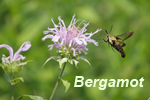 The names bergamot and beebalm came from the herbal qualities of the plant. The name bergamot is because its scent is reminiscent of the Bergamot Orange. Finally, the name beebalm comes from the fact that the flowers attract bees, especially bumble bees and hummingbirds. The names bergamot and beebalm came from the herbal qualities of the plant. The name bergamot is because its scent is reminiscent of the Bergamot Orange. Finally, the name beebalm comes from the fact that the flowers attract bees, especially bumble bees and hummingbirds.
Above all, bergamot (Monarda didyma) is a marvellous perennial plant for our gardens. This is one of the few herbs that has really showy flowers. Its flaming red flowers appear in mid summer and last for weeks. As well as the original red, there are cultivars of magenta, pink and white and more are being added. There are 12 listed in a local perennial plant catalogue. I find the magenta and pink cultivars are taller and much more vigorous than the red, but this may be the soil conditions.
Bergamot is a member of the Mint family and like mints, spreads by runners, though fortunately it is not as aggressive. It needs a loose soil with lots of leaf mold and compost. It is shallow rooted so whether it grows in sun or shade it does need plenty of moisture. Propagation is easy both by division and by taking cuttings of the runners. An established plant should be divided every three or four years to prevent the centre from dying out and leaving an ugly gap. Use the outer, younger shoots to start a new clump and throw away the older and more woody stems.
Both leaves and flowers are used for tea, either fresh or dried. Because of its scent, the tea is slightly reminiscent of Earl Grey tea, which is flavoured with the oil from the bergamot orange. It either can be used on its own or included in a mix of herbs such as lemon balm, mint or costmary. If the flowers are used, the red will color the tea.
It is hard to harvest a herb that looks so lovely, but if you do cut down the first flowers to dry for teas, the plant may well flower a second time before fall – if well watered and composted.
Although the red beebalm is the one most often seen in our gardens, there is a native beebalm – Monarda fistulosa – which is a much smaller plant with lavender blooms. It grows in abandoned fields and is an excellent choice for a meadow setting. It can stand much drier conditions and more competition than the garden beebalm.
Flowering at about the same time as bergamot is our next herb, borage (Borage officinalis). Borage is as blue as the bergamot can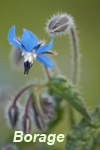 be fiery red. However, borage is an annual and during the course of its short life it will grow into a large, untidy, rough-leafed plant with sky-blue flowers. I find borage too messy and “scrubbly”, ( a word I coined many years ago to describe the rough, prickly texture of its leaves and stems) to allow much space for it in the herb garden. One or two plants that have self-seeded and grown from the previous summer are allowed to stay in my garden. I use the blue flowers as a decoration for cold soups, open-faced sandwiches or to float in a punch. The petals are joined and surround a cone of black stamens. With care, but quite easily, the whole corolla can be lifted off its receptacle and laid out as an edible decoration. be fiery red. However, borage is an annual and during the course of its short life it will grow into a large, untidy, rough-leafed plant with sky-blue flowers. I find borage too messy and “scrubbly”, ( a word I coined many years ago to describe the rough, prickly texture of its leaves and stems) to allow much space for it in the herb garden. One or two plants that have self-seeded and grown from the previous summer are allowed to stay in my garden. I use the blue flowers as a decoration for cold soups, open-faced sandwiches or to float in a punch. The petals are joined and surround a cone of black stamens. With care, but quite easily, the whole corolla can be lifted off its receptacle and laid out as an edible decoration.
Borage has a large seed and if it is not already in your garden, it is easy to start. It will germinate and grow fast, so it is best to wait until the danger of frost is over. Choose a place where it can self-seed each year. Although it prefers full sun, it will manage with less. The whole plant is edible and the leaves taste slightly of cucumber. Very young leaves can be used in salads; older leaves can be cooked like spinach or used for tea. The tea, according to Pliny and many other herbalists, will be cheering and stimulating. Maybe I should grow more of it!
Rachel McLeod founded Kiln Farm Herb Garden in Puslinch, Ontario in 1974.
|