The Herb Garden
The joy of growing and using herbs
by Rachel McLeod
Groundcovers
At the beginning of winter, we look back with nostalgia to the days of high summer when the garden was full of the scents of our herbs. Now that the weather drives us indoors, the same herbal scents may come from the twigs of dried herbs burning on the fire – and from the leaves as we enjoy a cup of herb tea and dream of Christmas, which is so near – and of our garden further away in the spring.
Seed catalogues are here already. They seem to come earlier each year to remind us that spring will surely come and soon we will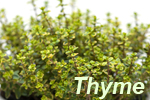 be planning for next year's garden. But now is the time to look back and see what we would like to change to improve our garden or to make it easier to maintain. be planning for next year's garden. But now is the time to look back and see what we would like to change to improve our garden or to make it easier to maintain.
Groundcovers are the secret of successful low maintenance gardens. They will prevent weeds, preserve moisture in the soil and once established will remain neat and tidy with the minimum of care. The reason I am writing about this in a herb column is because many herbs make excellent ground covers and can be used anywhere in the garden. There is a suitable herb for almost any location.
A grass lawn is a great deal of work with regular time consuming mowing. One alternative is a thyme lawn which we have as part of our front garden. It has taken time to establish but is now doing well. We used a mixture of very low creeping thymes, both white and purple and allowed some slightly taller patches of mother of thyme to grow for contrast. As a result the lawn has flowers from June to September. And it is always a joy to sit or lie and relax with the thyme scent rising with every movement. However a thyme lawn needs full sun so it is not suitable for every situation.
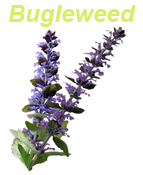 For partially shady areas where I need a quick, tough ground cover I have found the bronze Ajuga or Bugleweed (Ajuga reptans) very useful. There are different varieties with coloured leaves varying from plain green through a dark greenish purple to cultivars with purple, green and cream markings. All have a short spike of blue flowers in spring. It was used in the past as an astringent and the leaves were crushed and applied to cuts and bruises. Now new work is being done on it because it is thought to have some of the properties of digitalis. It spreads by runners and will form a thick, weed resistant glossy carpet in a year if given a partly shady slightly damp situation. For partially shady areas where I need a quick, tough ground cover I have found the bronze Ajuga or Bugleweed (Ajuga reptans) very useful. There are different varieties with coloured leaves varying from plain green through a dark greenish purple to cultivars with purple, green and cream markings. All have a short spike of blue flowers in spring. It was used in the past as an astringent and the leaves were crushed and applied to cuts and bruises. Now new work is being done on it because it is thought to have some of the properties of digitalis. It spreads by runners and will form a thick, weed resistant glossy carpet in a year if given a partly shady slightly damp situation.
Also for shady areas is the very attractive Sweet Woodruff (Asperula oderata) which enjoys the shade of trees and covers the ground in a woodland setting with whorls of attractive dark green leaves. In spring it is starred with glistening white flowers. It is not scented until it is dried; then it can be made into sachets to scent drawers and linen or added to a pot-pourri. One of its most interesting uses is to flavor the white wine used to make the May cup traditionally drunk on the first of May in Germany. But the dried herb can be used for tea at any time to relax tensions and relieve headaches or depression. Woodruff needs lots of leaf mould. My failures have been because I was trying to make it happy in ordinary garden soil, but it is a woodland plant and needs dead leaves, good compost and leaf mulches to be successful.
There are two low growing mints which make wonderfully scented ground covers. Cunningham mint is a sort of pennyroyal and has 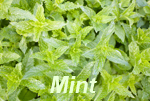 the same very clean, minty aroma. It makes a bright green carpet but tends to die back in the winter and is a bit slow to recover. But by July it is as green as ever. Pennyroyal is not a herb to be taken internally as it has toxic properties but over many years it has been found to repel fleas and other unwanted insects. It is used in flea collars for cats and dogs and is probably effective as a moth repellent. the same very clean, minty aroma. It makes a bright green carpet but tends to die back in the winter and is a bit slow to recover. But by July it is as green as ever. Pennyroyal is not a herb to be taken internally as it has toxic properties but over many years it has been found to repel fleas and other unwanted insects. It is used in flea collars for cats and dogs and is probably effective as a moth repellent.
The second mint is one of my favorite herbs. Corsican mint (Mentha requiens) is the smallest herb, with leaves like those of Baby Tears. It will form an incredibly strongly scented, tight little mat of dark green leaves and minute purple flowers. It is used as one of the ingredients of creme de menthe. Corsican mint is a little fussy. It grows strongly under a drain spout pipe near the hose so it must like some damp, but then it spreads to cracks in the brick walk which must be dry! I think it prefers partial shade; mine gets morning sun and no over-hanging plants. It is completely hardy in my garden but in other places it will need some protection. I am not the only grower who finds much joy in this tiny plant. Allen Paterson in his book Herbs in the Garden writes “This is a plant to be cherished...it is worth every care.”
These are only a few of the herbs that can be used as ground covers to enhance your garden.
Rachel McLeod founded Kiln Farm Herb Garden in Puslinch, Ontario in 1974.
|