The Herb Garden
The Joy of Growing and Using Herbs
by Rachel McLeod
Sweet Bay
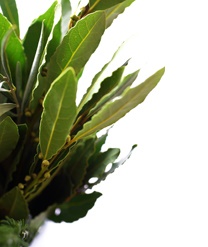 “Add a bay leaf.” How often have we read these instructions, and always I wonder what size? My bay leaves vary from leaves an inch (2.5 cm) long to monsters as much as five-and-a-half inches (14 cm) from tip to stem. And of course, there are all sizes in between as well as all the broken bits. Dried bay leaves are very brittle. “Add a bay leaf.” How often have we read these instructions, and always I wonder what size? My bay leaves vary from leaves an inch (2.5 cm) long to monsters as much as five-and-a-half inches (14 cm) from tip to stem. And of course, there are all sizes in between as well as all the broken bits. Dried bay leaves are very brittle.
Then, some hours later, “...remove the bay leaf and serve.” Why did we always have to remove the bay leaf and not all the other herbs we have included? Is it because the bay leaf, like the bouquet garni (which is also removed before serving and in which the bay leaf is a vital ingredient) is not particularly beautiful if it lands on your plate, and might be a source of embarrassment to a guest who felt they should eat everything in front of them? No, the reason is safety. Although a bay leaf will release its oil and flavors into the stew or soup slowly over many hours, it does not actually disintegrate and it has been known to cause choking. Also, it is wise to use whole leaves, as chopped or broken bay leaves have sharp edges which have been known to cause cuts and scratches in sensitive throats. It is a precautionary habit to remove the bay leaf from any dish before serving.
It occurs to me as I write this that although I know the sweet, spicy aroma of the bay leaf and associate it with lovely soups and stews, I could not really pick out its particular taste. So I have made a cup of bay leaf tea and will sip it and try to analyze the flavor. This is a good way of learning what flavors different herbs contribute to your dishes, and it will help to gauge the amounts needed for the perfect dish.
Sweet bay (Laurus nobilis) is not hardy in Canada and has to be grown in pots so that it can be protected in winter. Fortunately, it is a fairly slow grower. Even then, a 25-year-old bay tree is too large and heavy to lift without mechanical help. In its native Mediterranean environment, and even in the south of England, it will grow to 40 feet (25 meters). We once stayed on a cliff edge in the Dordogne where there was a young bay tree clinging to the crevices in the rock. I have never smelled such aromatic leaves and even when dried they were far superior to the pot grown ones. The best solution here would be to plant a cutting in the soil floor of a greenhouse where it would receive more nutrients than in a pot. If it was kept well pruned, it would be many years before it outgrew the greenhouse.
Bay trees can be grown from seed but the germination may take six months or a year. The most usual method of propagation is by cuttings. These are slow too and may take three months to root. Using a rooting hormone will help and the cutting must never be allowed to dry out.
Although the greatest use for bay leaves is probably in savory dishes such as soups and stews, they are also recommended to give flavor to custards and dishes such as rice pudding. Historically, though, the bay leaves were important to both the Greeks and the Romans; they were used in wreaths to honor poets, scholars and athletes. In fact, the leaves are used today to decorate the winners of the Boston Marathon. The bay leaves are seen as wreaths on most statues or effigies of Roman Emperors. This was not necessarily because of the eminence of these individuals, but because the leaves ensured protection from lightening. The flower and herb wreaths and decorations which have been so popular in the last few years are greatly enhanced by the use of bay leaves, especially at Christmas. They are an excellent addition to Christmas potpourri and their spicy scent will last for weeks.
There is also a growing interest in the use of herbs as preservatives instead of chemicals. Bay leaves are recommended for use in canisters of flour or grains to keep moths and weevils away.
As I write this, I have been sipping the bay leaf tea I made and still find it difficult to describe the flavor. It has a slight astringent taste and does make a very pleasant tea. It reminded my husband of Chinese tea. Further research tells me that the tea is good for all the organs of digestion and will promote appetite and act as a tonic. I shall certainly make bay leaf tea from time to time now. It is quick, easy, healthful and has a touch of mystery to its flavor.
Rachel McLeod founded Kiln Farm Herb Garden in Puslinch, Ontario in 1974.
|