Macrobiotics
A Guide for the Perplexed
by Charles W. Moore
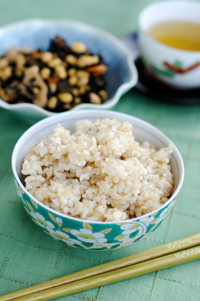 Macrobiotics is a difficult-to-define and often misunderstood term. Is it an adjective or a noun? Should the “m” be upper or lower case? Doesn't macrobiotics have something to do with Eastern religions? Isn't it that diet where you only eat brown rice? To alleviate the confusion, here's a concise overview of what macrobiotics is and isn't. Macrobiotics is a difficult-to-define and often misunderstood term. Is it an adjective or a noun? Should the “m” be upper or lower case? Doesn't macrobiotics have something to do with Eastern religions? Isn't it that diet where you only eat brown rice? To alleviate the confusion, here's a concise overview of what macrobiotics is and isn't.
Modern macrobiotics dates from the late 19th century, when a Western-trained Japanese Army doctor named Sagen Ishizuka became frustrated by allopathic medicine's ineffectiveness treating his own chronic illness. He researched traditional Oriental medicine, and developed a therapy he called shoku-yo (“food-cure”). This treatment proved so successful that Ishizuka left the army and set up a private clinic.
When Ishizuka died in 1910, the shoku-yo torch passed to a young man named Yukikazu Sakurazawa, who had been cured of terminal tuberculosis. Sakurazawa, who later Westernized his name to George Ohsawa, integrated Ishizuka's shoku-yo theories with elements of Eastern and Western philosophy and called the resulting amalgam macrobiotics – which is Greek for “large or great life”.
Although shoku-yo/macrobiotics incorporates certain cosmological concepts common to several Eastern religions, it is not and never was religious in nature. Ohsawa's incorporation of Zen in the title of his first English-language book in 1960 caused no end of misunderstanding, but the prosaic truth is that he was attempting to coat-tail popular interest in Zen Buddhism on U.S. college campuses at the time. Serious Buddhists were not amused.
Ohsawa defined macrobiotics as a dietetic medicine-philosophy, which is as good a description as I've run across. His protégé, Michio Kushi, simply calls macrobiotic diets “a sensible way of eating”.
There are several prominent macrobiotic teachers and leaders, but no formal, official, organization or hierarchy. Macrobiotics encompasses a broad spectrum of theoretical and practical interpretations. There is no macrobiotic diet per se. Ohsawa proposed ten different diets (idiosyncratically numbered -3 to 7), ranging from one including 30 percent animal-derived foods, to the legendary 100 percent whole grain Diet #7. The latter was intended only as a short-term healing diet for serious illnesses – preferably administered under supervision.
In North America the two main schools of macrobiotics are based in Massachusetts and California respectively. The west coasters tend to be laid-back and intuitive in their approach, while the larger, eastern faction, led by Mr. Kushi, is more systematic and formulaic, although these are broad generalizations. The late George Ohsawa would no doubt be pleased, since his vision of macrobiotics was as a philosophic approach to eating, healing, and living, rather than a rigid orthodoxy.
The macrobiotic view is that eating proper varieties and proportions of foods helps us achieve balance and harmony. Therefore, appropriate food choices depend on variables like an individual's health, age, sex, geographic location, physical activity, ancestry, the season, etc. Theoretically, there are as many definitions of a macrobiotic diet as there are people practicing it.
Diets of traditional peoples were essentially macrobiotic, typically based on locally-grown, seasonably available, organically cultivated foods. Arctic-dwelling Inuit subsisting mainly on meat and fish are completely macrobiotic relative to their extreme climatic environment. So are South Pacific islanders living on fruit, roots, and vegetables.
For persons living in a four-season climate, diets based on cereal grains with minority proportions of vegetables, legumes, and seaweeds are ideal. Macrobiotic dietetics is predominantly, but not absolutely, vegetarian. As Ohsawa put it: “Do not make the mistake of considering macrobiotics to be merely another variety of puritanism or dogma; it is neither pro-vegetarian or anti-carnivorism. We do not deny one kind of food or praise another .”
Macrobiotic theory makes general dietary recommendations, particularly that 40 to 60 percent of caloric intake should come from whole grains, including rice, millet, barley, wheat, oats, rye, corn and buckwheat. A comprehensive outline of macrobiotic dietary suggestions is beyond the scope of this article. Michio and Aveline Kushi's Standard Macrobiotic Diet represents a good point of departure for macrobiotic eating (see accompanying reading list).
Besides basic foods, macrobiotics makes several other diet recommendations:
- No processed, sugared, dyed, canned, bottled, or otherwise adulterated food.
-
No foods produced using pesticides, chemical fertilizers or preservatives.
-
No imported foods from a long distance – especially North-South.
| The macrobiotic view is that eating proper varieties and proportions of foods helps us achieve balance and harmony. |
-
No vegetables or fruits out of season.
-
No extreme yin vegetables, such as potatoes, tomatoes or eggplant.
-
No spices, chemical seasonings or processed table salt.
-
No coffee or black tea.
-
Avoid flesh and dairy foods except for occasional fish and game birds.
-
No refined flour products, yeasted foods or foods containing baking soda.
-
All foods must be chewed thoroughly (at least 30 times – preferably more).
-
Cook over a gas or wood fire. Electricity creates chaotic energy patterns, and microwaves are considered a “brazen death trap”.
-
Avoid plastic coated cookware like Teflon; use earthenware, glass, cast iron, or stainless.
Macrobiotic teachers usually recommend a gradual transition to macrobiotic eating, rather than the cold-turkey approach. Viewed from the standard North American diet perspective, macrobiotics seems pretty austere. I know it did to me back in 1987. Macro people are sometimes accused of being preoccupied, even obsessed, with food. However, in another sense macrobiotics is freedom from the tyranny of food. You grow beyond eating to merely satisfy appetite, and ideally make your food choices from a higher level of judgment. Food is no longer part of a system of rewards and punishments, desire and guilt; it is just your food, which you eat with gratitude.
Macrobiotics enjoys a remarkable anecdotal history of curing various illnesses, including cancer. Mr. Kushi has developed specific healing diets for various diseases. It is best to consult a certified macrobiotic teacher.
In this short article, it's impossible to touch more than lightly on non-dietary aspects of macrobiotic philosophy. The objective is to achieve balance and harmony in all areas of life. General lifestyle suggestions include:
- Maintain an active spiritual focus with daily prayer and meditation in accordance with one's own religious beliefs.
-
Cultivate appreciation for nature and the beauty of creation. Try to be environmentally responsible.
-
Make loving, harmonious, family relationships a priority.
-
Be grateful for difficulties; remember that “what has a front has a back”, and “the bigger the front, the bigger the back”.
-
Be good-humored, joyous, alert and appreciative.
-
Learn a form of exercise, martial art, or massage to help strengthen and balance energy flows in your body.
-
Develop an appreciation of fine art and quality music. Learn to express your own artistic and creative talents.
-
If possible, work at an enjoyable and fulfilling vocation rather than chasing after material wealth.
-
Learn new things continually. Read as much and as widely as possible. Become actively knowledgeable about things that affect you rather than passively taking them for granted. Have a vision and a dream, and work to fulfill it.
Learn More
Our Kitchens As Wellness Centers by David Snieckus from Natural Life Magazine, January/February 2010
Zen Macrobiotics by George Ohsawa (1965, George Ohsawa Macrobiotic Foundation) Ohsawa's problematically misnamed first English-language book. Should be read in conjunction with later works by Kushi, Aihara, and others.
The Book Of Judgment by George Ohsawa (1980, George Ohsawa Macrobiotic Foundation) Comprehensive exposition of macrobiotic philosophy.
The Book Of Macrobiotics by Michio Kushi with Alex Jack (1986, Japan Publications) Comprehensive macrobiotic theory according to Kushi.
Macrobiotic Dietary Recommendations by Michio and Aveline Kushi (1982, Pamphlet) Basic diet primer.
Basic Macrobiotics by Herman Aihara (1985, George Ohsawa Macrobiotic Foundation) The California perspective.
Acid and Alkaline by Herman Aihara (1986, Goerge Ohsawa Macrobiotic Foundation) Macrobiotics and Western theory compared.
Food and Healing by Annemarie Colbin (1986, Ballantine) Ms. Colbin studied with George Ohsawa in the 60s. This isn't a macrobiotic book, but some may find the approach more accessible.
The Cure Is In The Kitchen by Sherry A. Rogers, M.D. (1992, Prestige Publishing) The macrobiotic book for environmentally ill people especially.
The First Macrobiotic Cookbook Revised Edition (1985, George Ohsawa Macrobiotic Foundation) This is George Ohsawa's Zen Cookery updated.
Complete Guide To Macrobiotic Cooking by Aveline Kushi (1985, Japan Publications)
Charles W. Moore is a freelance writer who lives in Nova Scotia.
Photo (c) Yoko Bates/Shutterstock Images
|