The Herb Garden
The Joy of Growing and Using Herbs
by Rachel McLeod
Basil
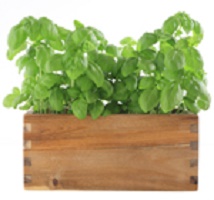 Basil (Ocimum basilicum) is a Mediterranean herb which loves hot weather and will sulk in our gardens if we plant it too early. It cannot abide temperatures under 55C. However gardeners who are prepared to wait until the soil is warm and plant seedlings out in June will be rewarded by strong leafy plants which will thrive in the hot summer days and yield an abundance of leaves for drying or making into pesto, oils or vinegars. Basil (Ocimum basilicum) is a Mediterranean herb which loves hot weather and will sulk in our gardens if we plant it too early. It cannot abide temperatures under 55C. However gardeners who are prepared to wait until the soil is warm and plant seedlings out in June will be rewarded by strong leafy plants which will thrive in the hot summer days and yield an abundance of leaves for drying or making into pesto, oils or vinegars.
There are a great many varieties of basil. Counting them in a herb seed catalogue I find about 23 different scented and flavored basils. Some of these I have grown once or twice, some I grow without fail every year and some are new and I hope to try them next year.
My favorites and my indispensable plants for use throughout the year – fresh or dried – are three. Sweet Basil is the ordinary green leafed type used for making pesto and for soups, salads and casseroles especially with tomatoes. There is a choice here between Sweet Basil, Lettuce Leafed, Mammoth, Genovese and this year Green Ruffles. The catalogues are rather confusing and all these plants will have the sweet basil aroma and flavor. The Mammoth has enormous leaves and the Green Ruffles will be more decorative. However my personal choice is for the plain sweet basil, not big and not fancy.
Secondly I like to have as many plants as possible of the smallest leafed bush basil. There are a great many small leafed basils listed such as Spicy Globe, Green Globe, Green Bouquet and Piccolo. Fortunately they are all excellent for flavor and aroma but they do vary in leaf size. These bush basils grow well in containers and it is fun to grow a small plant in a pot for a table centerpiece at an out door meal. Even though the leaves are very small the bush basils dry well and keep their green color. I especially like them for salads as there is no chopping of leaves. Just give the little bush a trim and let the pieces fall into the salad.
My third personal choice is always Dark Opal Basil. This is, as the name implies, a very dark red basil. Usually there are some plants that don't come true and will show dark green leaves, but their flavor will be the same and it is good. This basil makes a beautiful vinegar, looking like claret. Also, I find it is easier to dry successfully than the sweet green basils which tend to go brown if not harvested very carefully.
There are now other dark purple basils listed in the catalogues. One is Purple Ruffles Basil, which is a very dark ruffled and fringed plant used mostly for decoration and it does make a lovely contrast with grey leafed plants. However I have tried for three years now and have had no success in growing really large and healthy plants. Another new one is Rubin Basil which I hope to try; it is said to be an improvement on Dark Opal.
There is almost any flavor or aroma in the basil family and it is a good idea to try one or two each year until you find your favorites.
Lemon Basil is a narrow leafed basil with an open branching habit. It grows about 18 inches tall and has a surprisingly strong lemon scent. It is delightful just to rub and smell in the garden, but it can be used in the kitchen on salads – especially a tossed green salad with fruit, or cooked with fish. When dried, it is useful in pot-pourri.
Liquorice Basil and Cinnamon Basil are both fun to grow and experiment with. They have distinctive scents as indicated by their names and are often used in Vietnamese cooking.
Camphor Basil (Ocimum Kilimandsharicum) is a different species It smells strongly of camphor and is useful in anti-moth mixtures.
One of the most interesting basils is the Holy Basil (O. Sanctum). It is a sacred herb and found beside Hindu temples. It is used in courts of law in place of the Bible. Both in India and Thailand it is used in cooking. Its aroma is musky and some people find it unpleasant. But very often the aroma has no connection with the flavour and what seems to be a rather unpleasant smelling herb will in fact add an interesting flavour to a dish. Using Holy Basil with garlic and hot peppers and chicken in peanut oil makes an interesting Thai dish.
Rachel McLeod founded Kiln Farm Herb Garden in Puslinch, Ontario in 1974.
|