The Herb Garden
The Joy of Growing and Using Herbs
by Rachel McLeod
Harvesting Herbs for Winter Use
 Most years, by the time late Spring arrives, I realize that I did not dry enough herbs the previous summer to last me until they grow again...particularly herbs for tea. It is very annoying to have to buy herbs when, with a bit more planning and energy, I could have my own delicious herb teas for no cost but my labor! Most years, by the time late Spring arrives, I realize that I did not dry enough herbs the previous summer to last me until they grow again...particularly herbs for tea. It is very annoying to have to buy herbs when, with a bit more planning and energy, I could have my own delicious herb teas for no cost but my labor!
This year, I resolved to collect the herbs regularly through the spring and summer. With this in mind, in very early Spring, I collected leaves from some very handsome chervil plants which had self-seeded in a protected corner. Then I harvested chervil continually until the hot weather made the plants set seed and disappear until the fall. The plants I collected were in their prime – lots of bright green leaves and just a suspicion of a lengthening stem, which signals the development of flower buds and the gradual cessation of leaf growth.
The best time to collect green leafy herbs is when the plant is preparing to set flower buds. At that time, all the goodness is in the leaves so that they can help to supply the energy required to flower and seed. This stage will vary with every herb and in every garden. A good rule is to collect the leaves when the plant looks really healthy, when the weather is warm and dry, and when you have time to process them. On the whole, it is better to collect earlier in the season rather than later. Worn out leaves collected in the fall will not have the flavor or the quality of leaves from the same plant collected when the plant was growing vigorously in the summer. Herbal roots and seeds are harvested in the fall when all the nutrients have left the leaves and are concentrated in the seeds or the roots.
| Spring and mid-summer are the best times to harvest herb leaves for drying. |
When harvesting in the spring and summer, choose a dry day and try to collect the leaves in the late morning, when the dew is off them. Usually about a third of the plant can be harvested at a time. If this is done early in the summer and the plant is strong, very often a second growth can be harvested later. This is quite safe with annual herbs such as chervil and basil, which can be harvested steadily until either they go to seed or the frosts kill them in the fall.
However, perennial herbs must not be over harvested. Again, if the plants are strong and vigorous like mint or lemon balm, you can take as much as you want and the plant will not suffer. French tarragon, however, needs more care. Here in southern Canada, I harvest my tarragon in June when it dries a beautiful green and is very aromatic. If left until later in the summer, it tends to be more brown when it is dried. Also, I never harvest French tarragon after mid-summer, as it needs to build up its own strength for the winter.
There are many ways of storing herbs for use in the winter. I find that bottled, dried herbs are generally the most useful for cooking and for teas. The secret of a high quality dried herb is to dry the leaves as quickly as possible in a warm, airy place with only dim light. Strong light bleaches the herb and not only spoils it appearance but ruins the flavor and aroma.
Often when I am weeding, I may collect small quantities of herbs as I work. Now that I have a microwave oven, I find it is marvelous for drying these bits. Just put the leaves on a paper towel, cover with another paper towel and process at high for two minutes. After that, turn them and continue one minute at a time until they are crisp. It doesn't usually take more than two or three minutes for a thin layer.
For larger quantities, when we have spent a lovely bright morning collecting all the mint, lemon balm, sage, and oregano, there is too much for the microwave method. (Or you might not want to have a microwave in your home.) A dehydrator will give the best results, even though some time should be spent on stripping leaves from the stems so that they will spread more easily on the screens and dry more quickly.
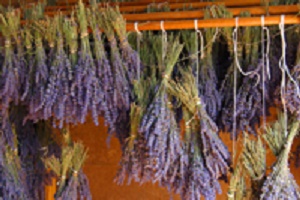
Without a dehydrator, excellent results can be achieved by hanging the herbs in bunches or laying out on screens. A warm, airy, dark place should be found where the herbs can be hung, such as a shed or garage (without the car), or an airy cupboard or attic. A friend of mine always refused company in mid-summer, pulled the drapes in her spare bedroom, and turned it into a drying room until she had completed her harvest.
If you have no suitable dark place, the bunches can be dried in paper bags, open at the bottom so that they are protected from the light. But the drying will be slower and the air will not be able to circulate as easily. Bunches should be kept small so that the inner stems dry quickly.
The herb should be crisp and completely dry before it is bottled. Storage bottles always should be kept in the dark. If the dried herb does not have a good color and aroma, it will not have good flavor.
July is the time to make herb vinegars and oils, and in August the basil plants will be big enough to use for pesto – probably one of the best ways to store basil.
By harvesting steadily all summer, you will find you have herbs for every use. Dry as many herbs for tea as you can. Later in the winter you can mix them together and make delicious blends. Then invite family and friends to tea and enjoy a taste of summer!
Here are some approximate northern hemisphere harvesting dates for some culinary and tea herbs...
Chervil — April to May
Mint, Thyme, Winter Savory, Lovage, French Tarragon — June to July
Angelica (for candying) — June
Lemon Balm — June and July
Dill, Basil, Summer Savory, Oregano, Sage, Bergamot — July and August
Costmary — June to August
Fennel seed — September or later
Rachel McLeod founded Kiln Farm Herb Garden in Puslinch, Ontario in 1974.
|