The Herb Garden
The Joy of Growing and Using Herbs
by Rachel McLeod
Winter Survival for Potted Indoor Herbs
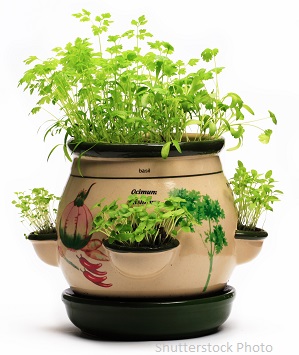 Perhaps it is the lack of air circulation, too dry air, too high temperatures and relatively low light levels; but herbs grown in the home through the winter must be inspected frequently, so that any disease can be controlled before it develops into a serious infestation. Perhaps it is the lack of air circulation, too dry air, too high temperatures and relatively low light levels; but herbs grown in the home through the winter must be inspected frequently, so that any disease can be controlled before it develops into a serious infestation.
I find that the main problems are with aphids which are very commonly found on chervil, basil, marjoram and occasionally dill; white fly which is particularly fond of the scented geraniums; spider mite which attacks the lemon verbena as soon as it comes indoors (and there is never a sign of it in the herb garden); and very occasionally the scale insect will try to become established on sweet bay or myrtle.
The best protection against insects is to grow healthy plants, because strong, sturdy plants seem to have an immunity; it is the weaker ones that are attacked. To grow healthy plants indoors, it is very important to see that they are potted in a lighter soil than they would have in the garden. They need to have plenty of water, but must have good drainage at all times. The mixture of three parts soil, one part peat moss and two parts sand is reliable, but I would put at least one part compost in for every one part of soil. It is a good idea to sterilize the soil if you are using it from the garden by heating it to 200 degrees. (I put mine in an old roasting pan in the oven.) This will ensure that you are not importing any insects from the garden.
Also, for the best health, herbs need a situation with good air circulation, as much light as possible, and temperatures about 15 C. This winter, I am moving all my herbs into an area in the basement where they will grow under fluorescent lights. The temperature can be kept as much as ten degrees less than the rest of the house, and as it is built of old limestone walls, there is greater humidity than upstairs. I hope to have much healthier plants.
Regular hygiene is the next important step. It is best to inspect your herbs daily. If this is not practical, then make a point of checking each one at least once a week. In this way, any insect infestation can be dealt with before it becomes a problem. It is even better if at the same time, you wash each plant in soapy water. If you cover the soil with aluminum foil, you can dip small pots upside down in a bowl of soapy water, and rinse them off with a gentle, tepid spray from the tap. Larger plants would have to be sprayed with a soap solution, but they can be rinsed off by standing them in a shower stall. The shower comes down like rain and the plants love it.
This treatment will prevent most insects from spreading, but sometimes even the regular check misses a plant, and aphids and white fly can spread at phenomenal speed, and before you know it, they are reproducing all over the place. On these occasions, it is best to segregate the plants and take more drastic action. I do not like to use any poisons at all. In case of a severe infestation, I usually add garlic to the soap solution, wash them more frequently, or in desperate cases, dispose of the infected plants. However, some gardeners will use rotenone, others nicotene.
I hope that all your herbs will be so clean and well kept that there will never be a need for a closer acquaintance with the insects which we have mentioned. But in case there is, here are a few guidelines to help you recognize what may be attacking your plants.
Aphids are small insects, either green, red, brown, or black. I find the green ones are the most common. They weaken the plants by sucking the sap, and if you see any of your plants looking sad, check the tips of the branches for aphids. They seem to attack the weaker, or less healthy plants, particularly ones which may have been kept too short of water. Regular checking will guard against them, and washing with soapy water dislodges them.
White flies float up in a cloud when you disturb the plants. Like aphids, they are sap suckers, but this time, it is the nymph or non-adult form which does the damage. It has been shown that the white fly is attracted to shiny yellow surfaces. Cards painted bright yellow, and covered with "tanglefoot" or other sticky substances will lure the flies away from the plants and catch them.
Spider mites are more difficult to see since they are so small. But if the plants are dropping leaves, or turning brown at the edges, turn the leaves over and look for minute little insects, which may be spinning fine webs at the tips of the branches. Rinsing with a jet of water will dislodge the mites, but the eggs are probably untouched, so to remove the whole population, wash again in seven to ten days. By that time, the eggs will have hatched, and the young mites will be cleaned off.
The scale insect is not often found on herbs, but it does occur on the more woody plants such as sweet bay and myrtle. A bad infestation will cover the plant with a shiny varnish, but the insect itself will appear as small brown scabs. Unfortunately, the weekly wash, although it will protect the plant, will not remove the insect, which must be scraped off with a fingernail or a toothbrush. As well as insects, we do get some problems with fungus diseases on plants grown indoors. Herbs, fortunately, are fairly free of these, and the only one which is at all serious is mildew.
Mildew appears as a whitish gray fuzz on the leaves and stems. It is almost always caused by poor air circulation in too damp surroundings. So, although we want a humid atmosphere, we must see that there is a steady supply of fresh air. Young rosemary plants are particularly prone to mildew if they are over-watered, or left in a place that is too damp. I have also seen mildew on basil plants, too.
I have not had any problem with the fungus that causes "damping off" of small seedlings; perhaps herbs are immune to this too. In fact, they can protect other plants. A tea made from chamomile is said to prevent damping off if young seedlings are watered with it.
Rachel McLeod founded Kiln Farm Herb Garden in Puslinch, Ontario in 1974.
|