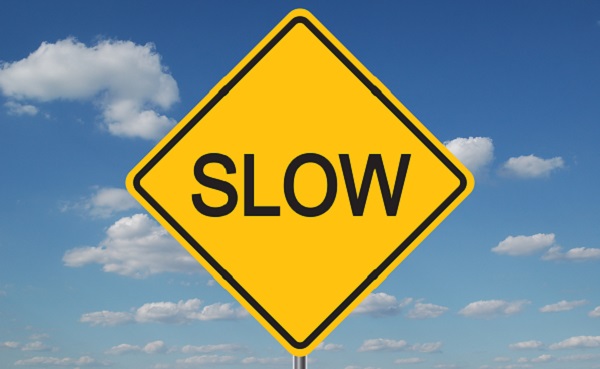
Embracing Slow
by Wendy Priesnitz
Our world has been operating on high speed and manic growth. And until the recent slowdown due to a worldwide pandemic, the pace seemed to be increasing. Some people thrive on that, at least for awhile. But that speed leaves most of us feeling frustrated, perpetually tired, and unable to do our best, both at work and in our family life. And sometimes, when something or someone gets in our way and slows us down, the age of speed becomes the age of rage.
Aside from its massive death toll and economic destruction, the pandemic – or what I like to call “The Great Pause” – has demonstrated that slowing down can have its positive side effects. Our environment is demonstrably cleaner due to the economic slowdown (including fewer people traveling and commuting to jobs). But beyond that, more people have begun to enjoy what those in the vanguard of the Slow movement (sometimes called “downshifting”) already know: It is possible for many of us to radically reorganize our lives in order to embrace wholeness, balance, and well-being.
Some people have been voluntarily forced to adjust the rhythm of their days. They have moved from high-powered careers to self-employment, from commuting to a city office to working at home, or to making do with less income because their former source of livelihood was a victim of the efforts to cope with a highly contagious virus.
In his 2004 book In Praise of Slow, author Carl Honoré heralded the growing movement of people dedicated to slowing down the pace of their lives. “Slow” in this context does not mean operating at a snail’s pace; it means living at the right speed. As Honoré puts it, “That implies quality over quantity; real and meaningful human connections; being present and in the moment.” The concept can be applied to all aspects of life, from sports, parenting, and sex to finances, business, and, of course, food, which is where it all started.
Slow Food
The Slow Food movement began in 1986 with the launch of the Italian Slow Food association by Carlo Petrini, a writer upset by the opening of fast food chains in Rome. His manifesto complained that we “are enslaved by speed and have all succumbed to the same insidious virus: Fast Life, which...forces us to eat Fast Foods, which diminish opportunities for conversation, communion, quiet reflection, and sensuous pleasure, thus shortchanging the hungers of the soul. In the name of productivity, Fast Life has changed our way of being and threatens our environment and our landscapes. Our defense should begin at the table with Slow Food.”
Since then, Slow Food chapters have sprung up around the world and the focus includes sustainable production by small, local producers as well as Fair Trade, in effect recognizing “the strong connections between plate, planet, people, and culture.” That, of course, is something many of us are exploring during this pandemic, by growing food, supporting local farmers, and spending some of our extra time cooking, baking, and preserving.
Slow Money
Connected to Slow Food is Slow Money. Leading the charge to slow our money down is American venture capitalist and entrepreneur Woody Tasch who wants to design capital markets built around preservation and restoration rather than extraction and consumption. For Tasch, what that means in practice is investing in local food systems and other small food enterprises.
Slow Travel
Travel and tourism can have a high environmental impact and make a major contribution to climate change. Slow Travel, on the other hand, has a concern for locality, ecology, and quality of life. It is vacation travel where airplanes and cars are replaced by more environmentally benign forms of transport such as cycling, hiking, and train travel – which take much longer and are part of the experience. Slow Travel also includes exploring natural features of the destination, seeking out Slow Food opportunities, swapping homes or staying with local residents instead of chain hotels, and generally savoring the experience. And it is also about staycations, or finding ways to enjoy our local neighborhoods and towns/cities without traveling far from home.
Slow Families
Carl Honoré coined the term “Slow Parenting” a few years ago with the publication of his book Under Pressure, although others, like me, have recognized the problem for decades. Our culture of speed and success-at-all-costs has led many parents to over-schedule, over-stimulate, and generally over-manage every detail of their kids’ lives. Slow Parenting says: Don’t push kids to grow up too fast; rather, trust your instincts and your children.
Slow Cities
Like Slow Food, the Slow Cities movement originated in Italy and, in fact, includes promotion of local food and culture in its reason for being, along with environmental initiatives that might, for instance, involve promotion of walking and cycling over automobile use, as well as green space development.
I’m a big believer in mindfulness, a Buddhist concept that can be described as awareness. Author and meditation teacher Jon Kabat-Zinn defines it as a way of paying attention so that “you don’t wind up getting entrained into being a human doing rather than a human being.” Slowing down provides us with the ability to pay attention and be human.
Learn More
In Praise of Slow: How a Worldwide Movement Is Challenging the Cult of Speed by Carl Honoré (Vintage Canada, 2004)
Slow Food Nation: Why Our Food Should Be Good, Clean, and Fair by Carlo Petrini (Rizzoli Ex Libris, 2007)
Inquiries Into the Nature of Slow Money: Investing as if Food, Farms, and Fertility Mattered by Woody Tasch (Chelsea Green, 2010)
Under Pressure: Rescuing Our Children from the Culture of Hyper-Parenting by Carl Honoré (Harper, 2007)
Slow Travel and Tourism by Janet Dickinson and Les Lumsdon (Earthscan Publications, 2010)
Radical Simplicity: Small Footprints on a Finite Earth by Jim Merkel (New Society Publishers, 2003)
The Power of Slow: 101 Ways to Save Time in Our 24/7 World by Christine Louise Hohlbaum (St. Martin’s Press, 2009)
Wendy Priesnitz is the co-founder and editor of Natural Life Magazine, a journalist with over 40 years of experience, and the author of 13 books. This article was originally published in 2011 and updated in 2020.
Photo (c) copyright Carlos E. Santa Maria/Shutterstock Images
|