Thrifty, Greener Clothes
By Kelly Hogaboom
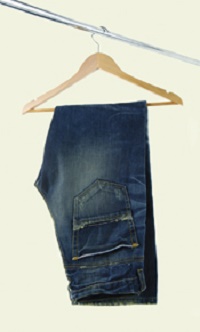 I buy from thrift stores not to augment my wardrobe but out of familial necessity. That is, we can afford some items new but we could not come near clothing all four of us completely that way. There’s also the matter of how often I want to have to buy things, too, because the “new” we can afford is often something that will need to be replaced soon. I’d rather spend an hour hunting through a good thrift store than commit to repetitive trips to buy from the retailers in our price point for two reasons: One, I buy used when it is no loss of quality to do so, to lessen the environmental impact of consumerism and production, and two, I can often find more durable items than anything that would be otherwise affordable. I buy from thrift stores not to augment my wardrobe but out of familial necessity. That is, we can afford some items new but we could not come near clothing all four of us completely that way. There’s also the matter of how often I want to have to buy things, too, because the “new” we can afford is often something that will need to be replaced soon. I’d rather spend an hour hunting through a good thrift store than commit to repetitive trips to buy from the retailers in our price point for two reasons: One, I buy used when it is no loss of quality to do so, to lessen the environmental impact of consumerism and production, and two, I can often find more durable items than anything that would be otherwise affordable.
Outfitting oneself in clothes when there aren’t enough financial resources to make it easy is a bit of an art. New clothes can be very cheap at some retailers (competition with sweatshops is one reason my sewing skills aren’t instantly a major source of income) but there is often a risk of poor construction, poor performance, poor longevity – or all the above. Case in point: last winter I bought a coat originally marked $130 but showily price-slashed to $49. I was pretty happy to have a “warm” coat but as it’s turned out, even though there is wool content in the coat it’s not very warm at all; it’s also showing rather threadbare only a year later. In contrast, the Pendleton wool I bought my husband a dozen years ago (when I was working as an engineer), even with his very rough and frequent usage, looks almost brand new and performs wonderfully.
Why not just save up and buy the good stuff? Yeah, right. When it comes to clothing and a single and/or limited income, procuring well-made items is quite tricky or impossible when several members of the family have simultaneous needs. For example, during a recent period of clothing deprivation – I was down to two shabby bras, a pair of too-small jeans and a pair of torn jeans for pants, my husband needed pants and socks, and the kids needed socks and underwear – I purchased our son’s new sock supply from Walmart. They’ve not lasted six months, but it was all I could do at the time. I remember a few years ago buying the kids higher quality socks which lasted years.
In recent months, I’ve had even more interest in self-educating regarding fabric and clothing construction. I’ve observed after years and years of purchasing or making clothing, mending it (or not), and passing it along (or not), that the clothes I make (by knitting and sewing) are uniformly much longer-lasting than anything I’ve purchased new. If you include the wear they receive by both my children and then in other homes, they are a good investment indeed. Not that I particularly need to justify my deeply-loved craft, but it feels good to know I’ve got something you can’t buy just anywhere. And most importantly to me at least, it feels like the mystery of “well made” is something knowable and workable. This is exciting for me.
I am painfully aware that many people lack for clothing. I remember a snowy bus day a couple years ago when I was rather shocked at what everyone else on the bus was wearing – soggy, cold jeans with holes in the knees; many layers of polyfill coats; and cheap or bedraggled footwear, while I sat in my waterproof Keens with homeknit balaclava pulled low. In other words, “making do” means different things to many people, and in describing our process and our clothing I don’t mean to pull my mouth down about it; we are certainly in a relative position of ease and privilege.
Thrift stores are poor pickings for sturdy children’s clothes. (This is one reason I tend to sew a lot for the kids). Nevertheless, I had good luck in my most recent foray. At our local Thrift City, I purchased the following: for our daughter Phoenix, an Italian merino sweater, a cotton zip-hoodie, pair of striped slacks, and a pair of dragon-screen printed Converse sneakers; for our son Nels, two t-shirts and a Patagonia shirt that will be sacrificed for a home-sewn present (shh!); for myself, four t-shirts, a pair of jeans, a pair of Ralph Lauren 100 percent wool trousers, and a 100 percent wool blazer.
I bought all of this for a little under $40. The Converse, Patagonia shirt, three of my t-shirts, and the striped slacks were all brand new; the rest were in excellent condition. The coat is a particular thrill for me – yes, it’s a bit “elderly gentleman” in style, but if I’ve said good yet inexpensive clothes are hard to find they are very hard to find if you’re a lady of a certain height or larger than about a size 10. This coat buttons across my ample chest and is light and tailored and toasty warm. It shows signs of well-made as well: the undercollar is understitched at collar seam and handstitched at neckline and the expertly-applied satin tag reads: Daniel’s Department Store Inc. Moscow Idaho. The wool trousers, too, fit perfectly and are delightfully wool-itchy. The two seriously winter-savvy garments were about ten dollars together and I certainly couldn’t have sewn them for less (and it would have taken me hours).
Cheered by our thrift store purchases, which will help us for now, I’m looking forward to a lot more comfort out in the cold and wind.
Kelly Hogaboom was raised by hippies in a bus that had planets painted on the side. She now lives in a much-beloved semi-urban ex-logging town nestled in a windswept harbor in the Pacific Northwest. She lives with her partner and their two children Phoenix and Nels, four kitties, a dog, and five laying hens. She loves to sew, to cook, to write, and to stay up too late watching B-movies with her kiddos.
|