Crafting for a Greener World:
Crafting Villages
The International Market in Recycling
by Robyn Coburn
 Doesn’t the phrase “Craft Village” sound charming? One can easily imagine a cross between Santa’s workshop and a Renaissance Fair, where people dress in traditional clothing and expect visits from cobbling elves. Or perhaps a Craft Village is more like an intentional community, people choosing to unite for creative purpose. Everyone would be an artisan of some kind, reveling in the glorious making and the opportunity to gather with other creative folk to swap techniques and inspiration – a kind of prosperous medieval utopia. It’s very appealing…but not realistic. Doesn’t the phrase “Craft Village” sound charming? One can easily imagine a cross between Santa’s workshop and a Renaissance Fair, where people dress in traditional clothing and expect visits from cobbling elves. Or perhaps a Craft Village is more like an intentional community, people choosing to unite for creative purpose. Everyone would be an artisan of some kind, reveling in the glorious making and the opportunity to gather with other creative folk to swap techniques and inspiration – a kind of prosperous medieval utopia. It’s very appealing…but not realistic.
Many of the women in Guatemalan crafting communities still wear gorgeous traditional traje, but most of the time the inhabitants of Craft Villages, some of which are more accurately cities, wear modern clothing. Mayan descendants seated on the ground using traditional back strap looms (which, by the way, cause extreme discomfort over time) are the exception.
The Craft Village industrial model is a small scale, home-based cottage industry where the entire family participates to some degree. They are a traditional part of many cultural landscapes. In a Craft Village, the whole community is involved in the production, from design to manufacture to selling, of single types of products. Some focus on traditional regional arts and handicrafts. Others manufacture handmade foodstuffs for domestic and international markets. Still others manufacture household goods, like plastic coat hangers.
The Craft Village industrial model is a small scale, home-based cottage industry where the entire family participates to some degree. Today the newest, and growing, Craft Villages are centered around recycling – plastics, paper, metals, and most serious of all, electronic waste, much of it imported from the West.
Today the newest, and growing, Craft Villages are centered around recycling – plastics, paper, metals, and most serious of all, electronic waste, much of it imported from the West.
In some villages, they don’t manufacture anything locally, but are entirely focused on reclaiming raw materials, like plastic nurdles, which are then sent on, even exported internationally. The work is inspired not by the personal desire to create beauty, but by economic need and the pragmatism of market forces.
Many countries have few environmental regulations around Craft Villages, which nonetheless face the same challenges as other industrial systems. These include sourcing raw materials, using energy wisely, and dealing with increasing levels of industrial waste and effluent. It seems like the attitude has been that these small producers, working in many cases in their homes and gardens, are essentially self- regulating. Perhaps historically they have been perceived as too small to have a serious impact on the wider environment. However, in the modern world, both the scale of village crafting and the type of products are changing. Handmade goods are being supplanted by factory machine made.
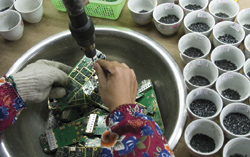
One problem is that because the manufacturing occurs in or close to people’s homes and gardens, so does the appalling toxic pollution. Some of these people are driven by poverty to continue with manufacturing practices, and to live with egregious hazards, which would never be legal in many other countries. Photos tell the heartbreaking story. Children play amongst mounds of plastic garbage. Miasmas of acrid, black smoke from the waste plastic incinerators wreath village homes. Women and youngsters hold ordinary kitchen skillets over open fires to recapture the precious metals from circuit boards while breathing in the fumes - rarely wearing dust masks, let alone respirators.
Meanwhile, back at my house, I wish I could believe that I have a positive connection with people in Craft Villages. After all, I make things with my hands and my home is my workshop. My whole family participates in crafting of one sort or another, and some of my happiest times with my daughter Jayn are when we sit together to work on some project, like our recycled materials space station. It’s very cozy when we are all contributing – I’ll be beading a doll; Jayn chooses the yarns for the hair, while sometimes James makes a PMC (precious metal clay) charm adornment.
I count myself very fortunate. When I craft, I get to do it for the love of making. Whilst it is true that I would be happy to sell more of my work (actually it’s pretty much all for sale or gifting), my livelihood, my safe home, my well-being, my family’s very future, does not depend on my art. If my back gets stiff from sitting at my sewing machine, I have the choice to stop and take a break. I have the glorious freedom to choose my art forms, choose my media, and follow my muse. I am bound neither by pressing commercial concerns nor by traditions that demand formal adherence.
I am able to create my vibrant community of like-minded folk, other doll makers, other mixed media and textile artists, even other writers. Online clubs abound, with challenges and swaps. I can attend classes and studio nights at craft centers, or just meet up informally with other crafty moms to sit and chat while we make. I have the whole wonderful experience of support and constructive criticism, and the joy of helping others learn skills from my expertise.
When I work, I am safe. ACMI ratings are clearly stamped on the packaging of my art supplies. (See this column in Natural Life January/February 2010.) I have clean water and a sound waste water system that can certainly handle the small amounts of non-toxic leftovers from washing my brushes and hands. Plus I get to place my trash into recycling bins and it all goes happily out of sight and mind to …someplace else.
Ah. Here we are back at Craft Villages. The truth is that my real connection with these folks is more likely to be that somewhere some impoverished person eked out their subsistence from recycling something that once was mine.
The good news is that compassionate, clever minds are working on solutions. International conferences, ongoing attempts to legislate against exporting our hazardous materials to those least able to manage them safely, people helping to set up environmental protections and cleaner machinery, accountability watchdogs, college courses, even the relatively new concept of micro loans to help individuals rise up out of poverty – all will help. Here’s what we can do.
First for the most toxic items – the Electrical and Electronic Equipment (EEEs) – we can keep our electronic devices a little longer. Then we can donate our older electronic devices to programs that refurbish them and pass them on. There are programs that give limited use cell phones to women escaping domestic abuse, and others that donate computers to schools.
Ideally, we should keep our reclamation processes local, where infrastructure, environmental and occupational health laws protect both the environment and the workers. Additionally, there is less energy used in transport if the material doesn’t have to travel so far.
But there are loopholes in the laws through which less than scrupulous companies push defunct computer and cell phone stuff onto the Third World, by mis-characterizing it as working equip- ment. If the company information includes the idea of auctioning the stuff in bulk, beware. It’s more than likely on its way to somewhere like Guiyu, China or Agbogbloshie, Ghana.
Instead, go to http://e-stewards.org/find-a-recycler to find a certified recycler that pledges not to export irreparable gear overseas.
If you don’t make it yourself, buy locally made household items and support local-to-you artisans and crafters, wherever you are. One good way is to patronize craft fairs that are juried and specifically state that the vendors offer only locally handmade goods without including mass market imports. If I am looking for imported international handicrafts, I like to buy Fair Trade folk art from museum stores. That way I can support two worthy causes at once.
Donate to micro-loan banks that lend to artisans. At our house, the same $25 keeps recycling itself.
Learn More
The World’s Scavengers: Salvaging for Sustainable Consumption and Production by Martin Medina (Alta Mira Press, 2007)
http://ourworld.unu.edu/en/e-waste-not-your-normal-trash/
http://ourworld.unu.edu/en/a-look-at-vietnam%E2%80%99s-plastic-craft-villages
More links will be on my Making, Mothering, Musing blog, www.robyncoburn.blogspot.com.
After a long career designing for theater and independent films, Robyn Coburn finds her joy as an unschooling mother who also writes and crafts. She has been a confirmed greenie since working for Greenpeace during her college years in Australia. Robyn is currently working on two crafty books, a fairy tale screenplay and a TV series about doll making and collecting. A past speaker and funshop presenter at Live and Learn Unschooling conferences, she contributes regularly to unschooling e-lists. She lives in Los Angeles, California with her husband James and ever inspiring daughter Jayn. Contact Robyn by email at dezignarob@gmail.com or visit her at www.robyncoburn.blogspot.com and www.Iggyjingles.etsy.com.
|