|
Ask Natural Life:
What is Seed Swapping?
by Wendy Priesnitz
Q: For the past month or so, I’ve been seeing posters advertising a seed swap in our area this Spring. What is that all about? Why not just buy seeds from a local nursery or seed catalog?
A: Seed swap days – sometimes known as “Seedy Saturday” or “Seedy Sunday” – are simply events where gardeners can trade seeds they have collected from their previous year’s garden. There are also websites that serve a similar function.
Saving seed from your own vegetable garden to plant next year is a great way to save money. But it’s also a way to preserve heirloom and open-pollinated varieties of plants and thus contribute to the stability of both your personal and our collective food system.
Plants that reproduce through natural means tend to adapt to local soil and climate conditions over time, and evolve as reliable performers in that locale. They will naturally become more disease and insect resistant over the years.
However, the messiness (and un-profitability) of the natural way has led corporate-funded scientists to develop cloned and otherwise genetically modified seeds. In the past, selective breeding has led to plants that are more disease resistant and hardy. But corporations have spun out of control in recent years, creating seeds that are reliant on chemicals that they also produce, and removing or adding genetic material in ways that are impossible in Nature.
In order to protect their investment in researching and producing these seeds, governments have allowed corporations to patent the varieties they create – and prevent them from being saved. In this manner, thousands of varieties of vegetables and flowers are being lost, eroding the gene pool and actually resulting in less hardy, more vulnerable plants. The process is also putting a few large corporations in charge of our food supply, with a lot of experimentation and little independent testing or consultation!
In an attempt to safeguard their food supplies, many countries have, in the past, set up seed banks. Journalist Fred Pearce notes that seed saving is crucial to the future of plant breeding: “The genes found in millions of crop varieties contain vital traits that plant breeders need to improve modern varieties, raising yield, protecting them against new diseases, and adapting them to climate change.”
Saving seed from your own vegetable garden to plant next year is a great way to save money. But it’s also a way to preserve heirloom and open-pollinated varieties of plants and thus contribute to the stability of both your personal and our collective food system.
Unfortunately, political events in places like Cambodia, Peru, and Iraq have led to the ransacking or shutting down of these seed banks, resulting in the loss of thousands of varieties.
So seed saving and swapping can be thought of as a political act. Here’s how Patrick Mulvany, Senior Policy Advisor at the UK development charity Practical Action describes seed swapping: “It exudes innovation, creativity, and common sense. It shows up the idiocy of draconian seed laws and the Gene Giants’ restrictive practices. In this warming world we need to exchange more diversity of uncontaminated plants to secure future food. Seedy Sunday builds solidarity among all of us who respect our collective rights to save, sow, swap, and sell seeds grown in our gardens and farms: It gives strength to seed law busters.”
Seed saving and swapping also provide a great science lesson for children… helping them learn more about where their food comes from and how it’s produced, as well as about the cycle of life. Very young kids can begin by growing a few gourd vines. Simply allow them to dry out and store in a dry place. Next Spring, simply open the gourd and shake out the seeds. They can then progress to collecting other vegetable and flower seeds, and sharing them with other gardeners.
So seed saving and sharing is truly an activity for anyone who really cares about their food and wants to protect its diversity. Caring for a self-perpetuating garden is fun and rewarding. And swapping seeds with other gardeners at your local seed swap can be a great social experience.
Saving seeds from your garden isn’t difficult. And you can begin right now. The first step is to be sure you’re planting open-pollinated varieties rather than hybrids. As the plants grow, select a few healthy specimens from which you will harvest the seeds. There are good books about how to harvest and store your seeds (two are listed below). We also published a very helpful guide in Natural Life Magazine’s March/April 1995 issue, which provides tips for harvesting seeds from specific vegetable plants.
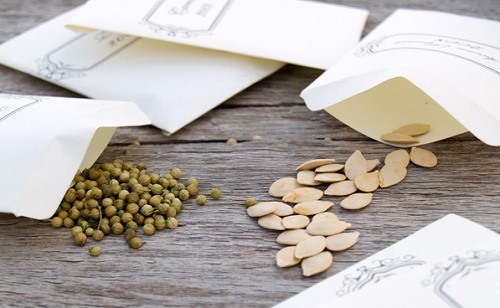
Some seeds (like the gourds mentioned above) can be stored in their own protective pods; store the rest loose in labeled paper envelopes inside lidded jars, never plastic. The main thing is to dry them thoroughly before storing and to keep them dry until planting time. Happy sharing!
|