Crafting for a Greener World -
Plastic Part 2: Recycled Plastic Crafts
by Robyn Coburn
Last time, I promised to write more on plastic recycling. The time has come to give credit where it is due and kudos to the truly unsung heroes of the recycling movement: Homeless dudes.
Seriously, in order for you to understand where I’m coming from, I’m going to back up a bit and share with you some of my research for this series of columns about plastic recycling.
Modern landfills are not really the problem. These days, landfills – at least in the developed world – are designed by engineers, and constructed for long term stability. When properly managed, there’s layering with covering to minimize windblown litter, leachate collection (eww!) and processing to protect groundwater, and long term planning for future land use. Energy generated from methane collection means landfills can, and perhaps should, be seen as renewable energy resources.
However, there are things we want to keep out of landfills. These include industrial waste and consumer products with toxic and heavy metal components, like cell phones, computer parts, and batteries. There are community recycling programs to deal with these, and this is outside of the scope of this article. Don’t use old batteries for crafting purposes! Instead try www.e-stewards.org for your local ethical e-waste processor.
The other things that we would, ideally, like to keep out of landfills are – obviously – recyclables. In my neighborhood, we have a “single stream” curbside collection program where we put all our recyclables together into one bin. Single stream recycling seems like a good idea. Since their mandate is to remove certain percentages of volume from the waste stream, local counties or cities generally find single stream programs cheaper to implement than multiple or dual stream curbside recycling programs. And both the authorities and householders assume their material is going to its “best use.” I know I did.
"I want to redouble my efforts in several directions. First, clearly, I want to minimize the plastic coming in to my house. Second, I can make life a little easier for the folk scavenging by sorting (and washing) my recyclables more thoroughly. Third, I will search even more assiduously for recycled content in my purchases. Finally, I want to do even more art and crafting with recycled products and find or design even more projects to inspire others to view their discards as raw materials – including plastics."
You know how when you bite into an éclair the cream tends to squeeze and billow out of the other end? The Container Recycling Institute (CRI) describes what happens with single stream recycling: Costs and problems shift to the materials recovery facilities that process the used paper, plastics, glass and metals prior to the materials going to mills for remanufacturing.
Put simply, mills pay more for well sorted single material lots and they also prefer material that is undamaged and clean.
Concurrently they are increasingly rejecting altogether lower quality stock, called “outthrows,” which ends up trucked back to landfills, just as if we put it in the trash at home. Even China, one of the largest buyers of our Western recyclables, has become picky about which raw material it will accept and how much it will pay for the stuff.
Plus, according to the CRI, the most effective strategy for increasing yields from recycling is to implement “bottle bills” – that is, legislation mandating deposits for individual containers paid to consumers when they return them to a collection center.
That brings me back to our heroes of the hour – people going through the mixed material bins and public trash cans pulling and sorting the cans, glass bottles, and PET containers before taking them to the collection points where they are kept pretty much sorted and the glass especially suffers minimal damage. These folk are actually providing a great service and deserve our respect and gratitude, rather than ever more prevalent anti-scavenging laws.
For me, all this means that I want to redouble my efforts in several directions. First, clearly, I want to minimize the plastic coming in to my house. Second, I can make life a little easier for the folk scavenging by sorting (and washing) my recyclables more thoroughly. Third, I will search even more assiduously for recycled content in my purchases.
Finally, I want to do even more art and crafting with recycled products and find or design even more projects to inspire others to view their discards as raw materials – including plastics.
"I do not want to design a goofy crafting project just for the sake of cleverly using the recycled material in some contrived way. The end product must be genuinely artful or pretty or useful – and sensible."
My lack of imagination around reusing the darn stuff bothers me. I cut up one soda bottle for a funnel. I’ve made scoopers from the handle end of milk containers. I use and reuse small containers for paint mixing and holding water for painting or small amounts of beads. None of these are particularly interesting or original. So I’ve been scouring the Internet.
Bird/squirrel feeders, fly traps, and boating aside, the uses for multitudes of PET bottles seem limited to either toys, like small boats and “tornadoes,” or items somewhat inaccessible for the home crafter. Artists make them into beautiful pop art lighting fixtures, taking advantage of the most obvious features – transparent clarity and rigid strength.
Other ideas seem awkward, more like creativity exercises (hey, I’m all for those generally). I’m thinking of projects like a clam shell change purse from the bottoms of two soda bottles. Really? Are there not better things to use for change purses...more practical, more sensible, more efficient for the end use?
This has been my mental stumbling block. I do not want to design a goofy crafting project just for the sake of “cleverly” using the recycled material in some contrived way. The end product must be genuinely artful or pretty or useful – and sensible. I’m pragmatic too. Costly tools or extra materials for making it from a recycled source can doom a design idea. The project design should take advantage of the qualities of the source material as a good way to achieve the final result, rather than displaying an uncomfortable union of wishful thinking and imposed manipulation.
But most of all, especially in light of what I have learned about the recycling industry, I don’t want my crafting project to be a less green use for the plastic item than placing it intact into the collection bin. So multiple use is important.
Here is an insight into my intentional design process:
- I examine the material and list the qualities. For plastics: Generally unbreakable. Somewhat flexible, yet largely rigid – the shape is inherent to the object. Often soft enough to cut with ordinary scissors or X-Acto blades – but still retains shape. Impermeable – at room temperature – to water but may be susceptible to some solvents or dyes. Often transparent or translucent. Reactive to heat in a variety of ways and temperatures (caution required). Slick or shiny surfaces – may or may not accept paint, markers. Usually very lightweight for the size. Sometimes can be folded and retain fold. Lasts and lasts.
- I will often sketch ideas and, usually with recycled things, I’ll cut up a couple for experiments.
- I make a prototype or examples.
- If necessary, I test the instructions, patterns, and fun quotient by inviting friends – child or adult – to try out the project with my supplies. If need be, I make changes based on the success of the lab.
Here are a couple of the projects I’ve come up with.
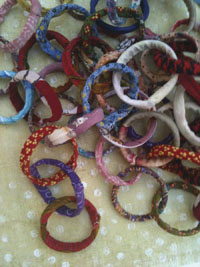 Colorful Chain Garland Colorful Chain Garland
Gather coffee pods or yogurt containers. Starting on a diagonal, trim off no more than 1/8 inch below the lip with scissors. You will have a split ring that will retain its shape very well. Set the rest of the container aside for another use.
Cut strips of pretty scrap fabric into 1-1/2 to 1-3/4 inch wide strips (on straight grain, not bias). Anything longer than 18 to 24 inches becomes hard to turn. With right sides together, sew a tube with a ¼ inch seam allowance, closing one end. Snip the corner. Turn to the right side using a turning tube.
Feed the split end of the ring into the fabric tube until the plastic is covered. Cut the fabric off with a very small allowance. Continue with the next ring until the fabric tube is too short.
Link rings together – I like to alternate random color combinations – and hand sew the joins closed, finessing the raw edges under.
Don’t sew? Go ahead and use white glue but you might need to clamp (clothes pins or paper clips work fine) until the glue is set.
If desired, stitch some beads around some or all of the links for a festive result. For a shabby chic look, use tea dyed muslin and repurposed lace for the garland, and some pearls.
Mixed Media Cuffs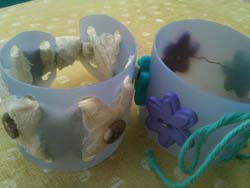
HDPE 2 plastic is flexible and soft enough to be cut with scissors and punched with regular hole punches. I have started making cuffs from food jars and milk jugs.
Cut a piece about 6 or 7 inches long and something around 1-1/2 inches wide. Punch holes of different sizes to accommodate ribbons, strips of fabric or yarns in decorative patterns.
For a romantic lace one, I wove strips of lace in crisscross pattern and knotted the hanging ends as ties to fasten my cuff. I sewed on vintage buttons for an added touch. For one with buttons strung on brass wire, I punched 10 tiny holes in pairs and wove the wire back and forth and through my fun, colored buttons. I created a “corset lacing” fastening with yarn.
This plastic also takes commercial fabric dye rather well, although the results are unpredictable. After dyeing some cloth for another purpose, I thought I’d see if the plastic would take. After waiting until the dye bath had cooled to tepid, I popped the plastic in, pushing it to the bottom with my wooden tool, and waited a while. I found that some flower “sequins” I cut from a milk jug turned a very pale tint of pink from overnight in a bright pink dye bath. But the container I set into Kelly Green turned the pretty pale periwinkle that you see in the photos, within a couple of hours.
I’m looking forward to experimenting with food coloring and stitching many pastel cut out flowers as embellishments on my figurative sculptures and art dolls, and as decorative elements on gift packages and labels.
Happy Crafting!
Learn More
www.container-recycling.org/assets/pdfs/reports/2009-SingleStream.pdf
www.bottlebill.org
After a long career designing for theater and independent films, Robyn Coburn finds her joy as an unschooling mother who also writes and crafts. She has been a confirmed greenie since working for Greenpeace during her college years in Australia. Robyn is currently working on two crafty books, a fairy tale screenplay and a TV series about doll making and collecting. She lives in Los Angeles, California with her husband James and ever inspiring daughter Jayn. Contact Robyn by email at dezignarob@gmail.com or visit her at www.robyncoburn.blogspot.com and www.Iggyjingles.etsy.com.
|