Real Food, Real Kids, Real Love
Ten (surprising!) ways to raise a healthy eater
By Liz Snyder
Photo by Lilia Schwartz, Babymoon Photography
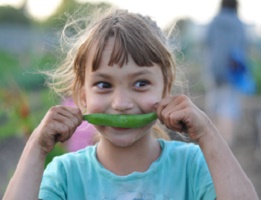 Almost nothing troubles us more than what our kids will (or won’t!) eat. Whether you fear you are raising a carb-junkie, picky eater, or veggie-phobe, the root of that parental fear is all the same: Somehow we can control our kids’ tastes if only we have the right advice and food on hand. So then we invest in advice books, cookbooks, kitchen gadgets (Slap Chop, anyone?), and most notably in our time, stress, and energy. We kill ourselves in the kitchen, guilt ourselves over “failures,” and chide our partners and relatives for undermining our carefully thought out efforts. Sound familiar? Almost nothing troubles us more than what our kids will (or won’t!) eat. Whether you fear you are raising a carb-junkie, picky eater, or veggie-phobe, the root of that parental fear is all the same: Somehow we can control our kids’ tastes if only we have the right advice and food on hand. So then we invest in advice books, cookbooks, kitchen gadgets (Slap Chop, anyone?), and most notably in our time, stress, and energy. We kill ourselves in the kitchen, guilt ourselves over “failures,” and chide our partners and relatives for undermining our carefully thought out efforts. Sound familiar?
The truth is, all kids are different. Just like they mature and grow at different rates, so do their palates. Without further ado, here are ten (surprising!) ways to raise a healthy eater:
1. Real kids need real food.
Whether you’re an omnivore or a vegan, it pays to eat real with your kids. This is the part that’s pretty much covered by Michael Pollan’s new book Food Rules. It’s pretty simple stuff – the closer to the plant, the better the food. Raw ingredients trump processed stuff. If someone is really trying to sell it to you on TV or it’s covered in shiny plastic and cartoon characters, probably don’t buy it. If you can’t pronounce the ingredients, then don’t put it in your mouth. Red food dyes are labeled and/or banned in the EU for causing ADHD behaviors – yet almost everything in a crinkly package here has the stuff. ‘Nuf said.
2. Real kids have nothing added.
This is an idea that troubles some parents. So many moms I know spend considerable money on supplements and pride themselves on everything they sneak into their kids’ diets, from spinach in spaghetti sauce to protein powder in the smoothie. I’m not one hundred percent opposed to this practice (in fact, we absolutely love to sink a bunch of beets into a pot of chili) but I want to stress that if it’s stressing you (or your pocketbook) out, it is totally not worth it. After the lead-laced gummi bear vitamin scare, I’d be entirely more cautious with any supplements – although, in the interest of full disclosure, fish oil “chewies” are a daily treat for my daughter Helen. But in the end, it’s much more about the feeling you create around food than the actual nutritional content of the food itself. So do what you can within reason, and call it a victory.
The other thing “added” to an insane number of kids’ food products is sugar. And by sugar I mean corn syrup, cane sugar, beet sugar, rice syrup, tapioca starch – the list goes on and on. In even supposedly “natural” products for kids, the amount of sugar is astounding. Take for example, Stonyfield’s YoBaby yogurt products. Those cute little cups have three teaspoons of sugar in four ounces. And the drinkables? A shocking six teaspoons! So buyer beware. On my website you’ll find a list of kids’ “natural” foods and their sugar content, as well as a new campaign called “All Sugared Up” that’s working to get progressive, mission-driven companies like Stonyfield to change the sugar content in their foods.
Looking for inspiration in the kitchen? The cookbook Real Food for Healthy Kids by fabulous foodie moms Tanya Wenman and Tracey Seaman is a great resource, with many kid-created recipes!
3. Real kids go on “food jags.”
For the past four weeks, my daughter has wanted nothing to eat but applesauce. Before that, it was hummus. Avocados. Gummi bears (I don’t like to talk about those days). From toddlerhood onward, food jags are a normal part of childhood. Many psychologists believe it is a child’s way of establishing consistency and security, much like a beloved blanket or bear.
The only proven effective method with food jags is to wait them out and keep offering alternatives. One day I know that applesauce will be on the outs. Something else will be the “it” food. Sort of like starlets and rock stars will be when she hits those oh-so-fun tween years.
Nutritionists say that you’ve got to offer a new food up to twenty times before your kid will try it for the first time. Without pressure or guilt or nagging. Tall order I know, but I’ve seen it work wonders in insanely picky stages of my daughter’s life. I offered her avocado twelve times – and, on time number twelve, it became her most requested food for six weeks running. Avocado’s gone platinum in this house!
4. Real kids drink real milk.
I generally don’t prescribe any particular food or way of eating to my clients – I want them to do what feels best for them and their family. I myself ate veg for fourteen years, and now eat a low-meat diet with a huge emphasis on what’s best for the planet as well as for my health and vitality. I truly believe that there are many healthy ways of eating, and that so long as you (and by you I mean you, not your friends, your mother, or your weight loss group) feel good about your choices, you’re on the right track.
That said, it’s not often that I experience a food-based miracle like this one. When my daughter was ten months old, she was diagnosed with asthma. She was on a combo of breast milk and formula (pumping supply issues – long story), and was wheezing almost constantly. After months of testing, she was put on a nebulizer with strong steroids and we were told to switch her to “hypoallergenic” formula. Well, I took one look at the stuff and knew I couldn’t do it. Ingredient numero uno was high-fructose corn syrup. Then came a long, scary list of disassembled protein chains and fats and all kinds of chemicals I couldn’t pronounce. UGH! We’d been prescribed this junk?
Well, while trying like mad to increase my supply, I began to do some serious research. What I found was astounding and, as an educated researcher, I knew I’d stumbled across something big. The bigness is probably too big for this article, but if you want to do your own sleuthing I suggest the very non-techno- weenie friendly book The Untold Story of Milk by Ron Schmid.
Tentatively, I joined my first raw milk co-op and brought home my first gallon of raw, whole milk – this was before Organic Pastures was widely available at my local Whole Foods, so it all felt very cloak and dagger. I switched both myself and my daughter – who had just celebrated a very wheezy first birthday – to all raw dairy products. I wasn’t sure if I was going to cure us or kill us, and entertained daily fantasies of ER visits and Child Protective Services knocking at my door.
And then it happened. Less that one week into my dairy-daredevil experiment, the wheezing stopped. And it has not come back. Her allergist actually cried when he listened to her lungs a month later. And I have been steadfast in shouting to the skies about the amazingness that is raw, unadulterated milk from clean happy cows ever since.
5. Real kids don’t always eat their veggies – but they’re watching to see if you do!
This is one of those things that should be intuitive, but isn’t. OK, this story is going to feel like a big tangent, but I promise it isn’t: For almost three decades, there’s been a national campaign for parents to read aloud to their kids. The idea is that kids who get read to become better readers. Only, a recent study by Scholastic shows that it doesn’t work at all – by age eight, kids who got read to thirty minutes a day or more fare no better than their non-read-to peers. Yikes! So all those hours with Dora and Boots? Yup, that’s time I’ll never get back folks.
So what does cause a child to become a reader? Well, the only thing the study found to inspire legions of life-long bookworms was a parent who read books themselves, and frequently told their children, “Don’t bother me, I’m reading!” OK, so I’m imagining the exact wording here – but you get my drift. So dive into that novel you’ve been putting off! (Oh, and thank you Mom – your beloved mysteries made me the academic powerhouse I am today!)
I’d say we need the same attitude toward food – let’s call it the “Don’t bother me, I’m eating!” approach. So your kid won’t eat their veggies? So what? Are you eating yours? With gusto? As is so often with kids, they will do what we do, not what we say. Pesky that way.
6. Real kids get back to the garden.
No, not the stardust-golden-hippie variety. The hands- in-the-dirt, fresh sweet burst of flavor straight from the vine tomato variety. There is nothing, and I mean nothing, that will give your kids a leg up on living a life filled with fantastic vegetable-y goodness than having some time growing them.
This is what my own research at Oxford University was all about. I saw the writing on the wall for nutrition education – despite billions of dollars spent in our public schools, the whole shebang had been proven a resounding failure. It was just a fact that telling kids not to eat bad food and to stick to the good food just doesn’t work. They might change their habits for a day or two, maybe a week, and then it’s back to red-hot Cheetos and Mountain Dew. My question was, why?
That’s when I started diving into the marketing research. This is truly scary stuff. For fifty years, the food marketing industry has known (and exploited) what nutritionists either overlooked or ignored: Eating is all about how food makes you feel, not how food fuels your body. And yeah, that’s kind of what my work as a Family Food Coach is about – it applies to moms and dads just as well. But these companies, man, did they know how to make us feel good (“I’m lovin’ it!”). In fact, they spent $1.6 billion on making us feel good about their crap-in-a-wrapper in 2006 alone. It was money well spent – now most kids have strong emotional ties and ‘brand loyalty’ to every disastrous food choice made by a handful of junk-pedaling food companies.
So what can be done about that? In mountains of studies on different nutrition education methods trying to stem the tide, there was one shining ray of hope: farm and garden programs. These programs were different. Instead of trying to browbeat kids into healthy eating with fears of fatness and early death, they got kids out in the sunlight and dirt – where most kids want to be anyway – and helped them experience fresh, healthy food from a totally different perspective. When you grow, care for, cook, and eat a vegetable, you become emotionally attached to that vegetable for life. You eat with your heart, not with your mind. I still have an almost unnatural enthusiasm for blueberries, because they were the first plant I ever successfully grew myself – on a condo patio at the tender age of twenty-nine.
This simple fact was my motivation for starting Full Circle Farm, and I have been blessed to experience this amazing phenomenon first-hand. I had a group of ten sixth graders on the farm, and they were harvesting their first-ever patch of vegetables in the educational garden – a raggedy-looking cluster of somewhat overgrown radishes. None of them had eaten a radish before (yes, you read that right). They all took bites in unison.
These radishes were giants – and if you know radishes, you know that radishes that have gotten too big are woody and spicy. I’m kneeling there at the garden patch thinking, “Oh God, now I’ve done it. They’re never going to eat anything we grow here again.” Lots of chewing. A few crinkled noses. And then smiles. Smiles! I decide I must be wrong and try one. Blech! I had to stop myself from spitting it out. Every one of my ten students insisted that they loved the radishes. Kept eating them for the rest of the period. I smiled to myself for the rest of that day. Take that, red-hot Cheetos. Mountain Dew, you’re going doooown…
So whether it’s a carrot growing in an old rain boot, or a full-on homestead operation, make sure that you and your kids get your garden on!
7. Real kids table it at least a few times a week.
Notice that I don’t say “every day, real life be damned.” Let’s be realistic here and acknowledge that many of us lead lives that don’t always leave us synched up and sitting at the table at the same time every night of the week. But most of us could also manage to do better. A few nights of eating at the family table can really do wonders for kids’ eating behavior, and also can just help tie the family together in ways that other activities can’t.
Crickets the loudest thing at your dinner table? That’s definitely a sign you need to spend more time there, but don’t worry...there’s help! You can make it fun with verbal games and conversation-starters. Do a web search for “dinner table games” and you’ll find a wealth of ideas. I particularly like Dr. Kristie Leong’s article on eHow.com.
Dealing with a sullen teenager? Even more reason to get their butts to the table three to four days a week. In a groundbreaking study, Dianne Neumark-Sztainer and William Doherty at University of Minnesota found that teens who ate at least three (notice it’s not six or seven, busy moms!) meals a week at a family table had an astoundingly different attitude towards food, which included:
- better nutrition, including more veggies and less soda
- better literacy (mealtime conversation, anyone?)
- less than half the risk for an eating disorder, compared to family table-less peers
- fewer high-risk behaviors
- positive feelings about sharing time with family – which they denied to parents, but confessed to the research team, lil’ buggers.
Why not try a high-tech version of ringing the dinner bell? Send a text to your teen: “Five minutes ’til your butt’s at the table.”
8. Real kids get chubby… then skinny… then chubby… then skinny…
So please, please don’t overreact when your kid gets a little chunky. It’s always good to limit the sugar and junky stuff in the house, but pointing out your child’s weight gain can be humiliating and damaging to her already-fragile body image (yeah, I’m talking to you, Mrs. Obama).
What to do instead? Take a good look in the mirror. No, not to tell yourself how disgustingly fat you have gotten! To ask yourself, how was I treated as a child that makes me want to react this way? Was that method good for my body image? Will treating my child the same way I was (especially if it is repeating a pattern of condescension and control) be helpful to her in any way whatsoever?
If you come from a home where gaining weight was shameful, you will have to be extra-conscious of how you react to your child’s very normal flux over the years. And remember, most girls gain significant weight just before puberty – they need at least thirteen percent body fat to start their periods, and the body kicks into high gear to help that happen. Lucky them: This is also when they are most sensitive to issues of weight and body shape. So take care. Think of your child’s heart first and body second.
9. Real kids are commercial-free.
So I’m guessing you can tell by now that I think food marketers suck. The only way to stick it to them? Make sure their $1.6 billion of advertising dollars fall on deaf ears. Some ads are so pervasive it’s hard to avoid them, but creating a commercial-free childhood should be the goal of every health conscious parent. There’s a multitude of research showing that TV spots for food are almost universally a nutrient-free, calorie-laden junk-fest. So cut the commercials; maybe even cut the TV.
We have been TV-free for two years and haven’t looked back. Not media-free, TV free. Between iTunes, Netflix, and YouTube, there’s plenty of media consumption going on in this house. We just do it without the ads. The great side effect? Not only are we not being sold to, my life feels considerably less… jangled. It takes about a week away from network television to realize that people are yelling all the time. What’s up with that? In any case, a TIVO and a quick remote reflex will also do the trick. For more information on a commercial-free childhood, I highly recommend a peek at the fabulous advocacy group, Campaign for a Commercial-Free Childhood.
10. Real kids need real parents
Have you ever noticed the way your child looks at you? OK, parents of teens – remember back. In the years before puberty and the hormone induced door-slamming eye-rolling ihateyouihateyouihateyou fits, your child will gaze up at you with absolute and total adoration. We all have experienced these achingly loving moments, the pat on the cheek, the sweet gaze, the deep relaxed snuggle. It is the essence of the parent-child bond, and nothing is a better mirror for how you should feel about yourself. Your child knows that you are the most amazing, beautiful, strong, and fabulous person on the planet. Why can’t you bring yourself to agree with her? Or can you?
It’s a rare person that can feel good about themselves all the time. But we parents have a great mirror in our children, one that goes two ways. Because our child loves us so unconditionally, we can mirror that love for ourselves and come closer and closer to self-acceptance. We can see it in everyone we love, and everyone who loves us. We are perfect. Right now, not ten pounds from now, not ten years ago, not when we fit in our skinny jeans. Now. There’s a song here. No, literally. I think that the kick-ass gospel ladies Sweet Honey in the Rock put it best:
There were no mirrors in my Nana’s house,
no mirrors in my Nana’s house.
And the beauty that I saw in everything
was in her eyes, like the rising of the sun.
I never knew that my skin was too black.
I never knew that my nose was too flat.
I never knew that my clothes didn’t fit.
I never knew there were things that I’d missed,
cause the beauty in everything
was in her eyes, like the rising of the sun.
What does your child see in your eyes?
Liz Snyder is a writer, screenwriter, food activist, nutritional anthropologist, and Family Food Coach. She is the author of “Jenny Craig Can Kiss my Asparagus,” a workbook helping busy moms ditch diets and deprivation to discover their real food wisdom and the healthy, intuitive eater in us all. Liz has a master’s degree in nutritional anthropology from Oxford University, where she examined the profound and unexpected connections between the food marketing industry, vanishing food traditions, and nutrition education efforts in our schools. She is the founder of Full Circle Farm in Sunnyvale, California, an educational, organic farm on school land that connects the district’s 14,000 children directly to the source of their food, both in the fields and in the cafeteria. She was voted one of Kiwi Magazine’s 2009 “Moms of the Revolution” for her work at Full Circle Farm. She and her family live in California. This article was published in 2010.
|