Crafting for a Greener World
Refashioning - Part 1
by Robyn Coburn
In the hand sewn olden days, women would make dresses last longer by “turning” them. This means that they would take the garments apart and turn the inside of the fabric – the unfaded, formerly against the lining side – to the outside and put the garment together again for several more years of wear. Also, mothers would “cut down” their dresses, take them apart, and remake them smaller for their daughters. In the 1945 movie A Tree Grows in Brooklyn, Joan Blondell’s character has cut down her often used white wedding dress for her niece to wear to her middle school graduation ceremony.
One of my favorite childhood books was The Elephant War by Gillian Avery. Its main character is embarrassed when dress shopping because her mother, demanding practicality, inspects all of the seam allowances for enough room to let the garment out as she grows. Anne Shirley longs for a dress with “sleeves” in Anne of Green Gables – the leg o’mutton sleeves so popular at the turn of the last century, which Marilla describes disdainfully as each having enough fabric for a whole “waist” or bodice. Jane Austen’s letters often refer to domestic sewing arrangements, such as when her mother had a dress taken apart to be dyed black and remade for mourning.
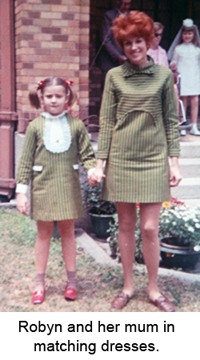 When I was a girl, my mother sewed many of my clothes. Sometimes she would make coordinating mother and daughter outfits and she would turn the cotton remnants into dolls’ clothing. This was before Velcro™. The tiny dresses would always fasten with snaps or hooks and eyes. I’ve carried on the tradition in making special clothes for my daughter, such as her princess dresses and Halloween costumes, as well as altering and resizing her purchased things as necessary. Plus, I enjoy making clothing for her dolls and as gifts for doll playing friends. When I was a girl, my mother sewed many of my clothes. Sometimes she would make coordinating mother and daughter outfits and she would turn the cotton remnants into dolls’ clothing. This was before Velcro™. The tiny dresses would always fasten with snaps or hooks and eyes. I’ve carried on the tradition in making special clothes for my daughter, such as her princess dresses and Halloween costumes, as well as altering and resizing her purchased things as necessary. Plus, I enjoy making clothing for her dolls and as gifts for doll playing friends.
One of the purposes of this column is to encourage people to participate in the great modern crafting resurgence and learn needlecrafts in a way that frees them from fear. By using their own outworn clothes as the raw materials, they don’t have to be concerned about making mistakes with expensive yardage. They can experiment freely and cheaply. What I hope my future readers will discover is that there are no mistakes. In fiber arts, the happy accident is happily anticipated. Nothing is wasted or unsalvageable. I’ll include several projects incorporating “inchies.”
However, we want to be eco-minded, so there are quandaries. One is the concept of “cutting” that has sparked debate in the textile and mixed media art world. Some people regard the practice of cutting up any old garments as reprehensible destruction of our cultural heritage, even for the purpose of using the pieces to make art works. Others buy old trunks full of antique clothing from estates and other places and chop the vintage laces and garments into fat quarter or jelly roll size fabric lots for sale.
I want to see vintage garments of significance preserved and appreciated. In fact, I want more museum exhibits devoted to all textiles. However, in cases of common, everyday clothing, especially if there are already plentiful examples of similar garments and piecework in museum archives, I have no problem with giving the material a new life of useful beauty.
My mother-in-law sent me a box of assorted lace and linen pieces, many of which appear to have belonged to her mother and grandmother; others are modern remnants. Her idea was that I would make them into art dolls. I have done so with some of the lengths of lace, and pieces of hand embroidery previously pulled away from a garment that was already crumbling. However nothing will persuade me to dismantle either of the antique christening robes included in the package, and I am saving the several intact lace jabots until I can consult an expert as to their historical value.
So, no, I'm not about ruining vintage garments or experimenting with remaking collectible couture items. It is about rediscovering and reusing the fabric from contemporary and recent everyday clothing that you have ceased wearing because it has become outmoded, faded, damaged, or too small.
But that’s not the end of the moral dilemma. In these days of economic downturn, is it right to be taking apart perfectly good clothing that could be donated to the poor? My answer is usually a well considered “yes.”
| Goodwill reports that eighty percent of their donated clothing is sold to used clothing dealers, probably for less money than donors would hope. |
The second hand rag trade is a convoluted business. Many garments happily donated to charity, with the expectation that they will be sold through local stores or given to the nearby poor, actually end up as part of a strange flow back and forth between the wealthy nations and developing countries.
Goodwill reports that eighty percent of their donated clothing is sold to used clothing dealers, probably for less money than donors would hope. Although spotters comb through the goods for designer items that can be refurbished for sale in high end resale or vintage inspired designer shops, much is then exported. In 2003 385,000 tons of used clothing was exported from the United States, a figure that continues to increase. The collection bins set up conveniently around the neighborhood are often run by for-profit entities rather than the charities the labels imply.
At the time of writing this column, I am watching the aftermath of the January earthquake in Haiti. “Pepe” is the Haitian name for secondhand goods, especially clothing and shoes. It’s a huge phenomenon with debatable effects. On one hand, there are new manufacturing industries taking advantage of the inexpensive raw materials by remaking trendy recycled garments and accessories that may return here for sale. Individuals make something of a living reselling in their communities. On the other hand, the new clothing makers and most especially local cobblers are finding that they cannot compete with the cheap imports. Some countries in Africa have banned the importation of used clothing as detrimental to local developing industry – a controversial stance.
I have a personal recollection that also informs my willingness to keep my old clothes for fiber art repurposing. Just over twenty years ago, when I was in college in Wollongong, Australia, there was some kind of natural disaster in Eastern Europe. It might have been the Spitak Earthquake in Armenia. What I remember about the event was the huge outpouring of concern and desire to help on the part of Australians. It was winter in Europe, and warm clothing was collected in a comprehensive coordinated effort, with the intention of sending it to displaced families.
Some months later, an artist friend and I were exploring a disused industrial area near the university. We rounded a corner and walked into a spacious warehouse. Either end was open to the elements. Seagulls and pigeons fluttered amongst the metal rafters and the sea breeze whistled into the open space.
Heaped in the center, a multicolored thirty-foot mountain that only dump trucks could have created and only bulldozers could easily move, were winter clothes. Knitted sweaters, overcoats, flannel shirts – damp, dusty, marred by bird droppings – here was the local contribution abandoned to rot...sad and wasted. I suspect that the response had been so heartfelt, so enormous, so immediate, that the aid organizations were overwhelmed. Rather than deter people from their genuine desire to give, they had simply hidden the stuff here.
The experience made me rethink my own charitable impulses. I have come to believe, and my sentiments echo those of Colin Powell discussing the Haitian earthquake, that the best thing to do in times of emergency is donate money directly to established aid groups like the Red Cross.
Meanwhile, I continue to turn sweaters into stuffed toys, pants into bags, sleeves into patchwork, and t-shirts into beanies, because I am a maker, a seamstress, a crafter, a fiber artist. And an environmentalist.
Part 2 of “Refashioning” will give you some how-to tips for doing the same.
After a long career designing for theater and independent films, Robyn Coburn finds her joy as an unschooling mother who also writes and crafts. She has been a confirmed greenie since working for Greenpeace during her college years in Australia. Robyn is currently working on two crafty books, a fairy tale screenplay and a TV series about doll making and collecting. A past speaker and funshop presenter at Live and Learn Unschooling conferences, she contributes regularly to unschooling e-lists. She lives in Los Angeles, California with her husband James and ever inspiring daughter Jayn. Contact her at dezignarob@gmail.com or visit www.Iggyjingles.etsy.com.
|