The Natural Family
The Smell of Ice
by Andrea Cameron
 My son may never see a polar bear in the wild. Among the great tragedies of the world, this is perhaps a minor issue, but it means two things. First, we’ll experience significant change in our planet’s ecosystems within this lifetime – it’s already happening. Second, we haven’t protected the earth for the next generation. In fact, we’ve done a fine job of screwing it up. My son may never see a polar bear in the wild. Among the great tragedies of the world, this is perhaps a minor issue, but it means two things. First, we’ll experience significant change in our planet’s ecosystems within this lifetime – it’s already happening. Second, we haven’t protected the earth for the next generation. In fact, we’ve done a fine job of screwing it up.
I have this dream of my family on the rocky shoreline of Ellesmere Island. My husband stands on one side of Kieran and I stand on the other. With the tiny community of Grise Fiord behind us, we look out over the bay and tell him our story, the story of how we met.
The High Arctic is the place where both my husband and I held our first teaching jobs. It is the place where we met and fell in love. It is also an ecosystem profoundly in danger thanks to consumer excess and industrial pollution.
In this Inuit hamlet of one hundred and fifty people, my students cheered for me when I jumped a crack in the sea ice on my Ski-Doo. As a new teacher, I didn’t think it unusual when I supervised school field trips where I was the only unarmed person. Students who were oppositional in the classroom offered me tea and bannock on the land, asking if I felt warm enough. They are at home out on the sea ice, an environment many would find intolerable.
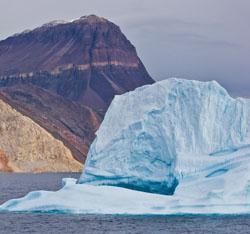
Will Kieran, like me, gaze up at the eternal sky, as he lays on a sled pulled by a dog team? Will he taste the fresh warmth of seal meat? Will he drink the pure water from a glacial lake? Will he stand at the foot of an iceberg and marvel at its sculpture? Will he smell the ice on his hair, on his skin, after he comes home from a day on the land?
Likely, by the time he reaches his eighteenth birthday, there will be no sea ice left. As the ice melts, the plankton disappears – and the chain shatters. The cod eat the plankton, the seal eat the cod, and the polar bears eat the seal. Without the ice, they all disappear. And the Inuit culture, a culture that has thrived for millennia in one of the earth’s most inhospitable places, will be irrevocably transformed.
Now, instead of standing on that Arctic beach, telling Kieran about our connection to the clean silence of that land, we’ll have to tell him we’re sorry. We’re sorry that we let it get to this point. We’re sorry that we let such beauty be destroyed in our pursuit of stuff.
Many of the current residents of Grise Fiord are descendants of a forced relocation by the Canadian government in 1953. Eight families were taken from Northern Quebec and dropped on the shores of Ellesmere Island to secure sovereignty over the High Arctic. Those families spent their first winter in canvas tents on the beach, watching their children freeze and starve. But they learned the migration routes of the animals in that new place and they survived. It is their relationship with the world around them – the land, the ocean, and the animals – that has allowed them to endure. They manage their environment with passionate resolve. Now, problems outside their control threaten to destroy it.
In the Arctic, just a thirty-minute Ski-Doo ride from Grise Fiord, I explored a thousand-year-old polar bear trap. Because things don’t break down in that desert climate, it’s also the place where I saw the dramatic effects of toxic chemicals on a fragile ecosystem. Core samples of the nearby glacier proved to be a historical timeline for our violent twentieth century, revealing the fallout from Hiroshima and then Chernobyl. One visiting scientist explained the high levels of common household chemicals that his team found in polar bear studies.
Now, instead of standing on that Arctic beach, telling Kieran about our connection to the clean silence of that land, we’ll have to tell him we’re sorry. We’re sorry that we let it get to this point. We’re sorry that we let such beauty be destroyed in our pursuit of stuff. And this is a pursuit in which we, his parents, have partaken. We’re trying, but we need to do more.
I hope I don’t have to make this apology. I hope Kieran’s experience of this amazing place is more tactile than a few faded photographs. I hope we don’t fail the Inuit, the wildlife, the children.
Perhaps one day my husband and I can tell our son another story, a story about how the world pulled together to save the planet. We’ve rallied incredible resources and masses of humanity to fight wars against each other. In our story, we rally incredible resources and masses of humanity to save ourselves, to save the land over which we once fought. It’s more than just the polar bears at stake.
Andrea Cameron is a mother and educator living in Eastern Ontario. She writes a weekly column for The Brockville Voice. Her poetry and fiction has appeared in Room Magazine and The Antigonish Review. You can read her blog at andreacameron.blogspot.com. This article was published in 2010.
|