Yurts: Housing in the Round
by Wendy Priesnitz
Originally created as portable homes by nomadic tribes of central Asia, yurts have become a symbol of a simpler, more sustainable way of life in the 21st Century.
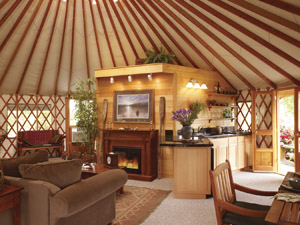
The 30-foot interior of a yurt. Courtesy Pacific Yurts. |
A yurt is a round, collapsible dwelling with a unique design. From Mongolia (where they’re known as “ger”) to Turkey and Afghanistan, yurts have been used by nomadic animal herders in central Asia for thousands of years. And in the past 30 years or so, they have been steadily increasing in popularity in the West – for both recreational use and permanent homes. They are environmentally friendly – with their wooden platforms easily moved without leaving a trace – and can withstand heavy snow loads, high winds and earthquakes. They are also economical to heat.
Cleverly engineered, a yurt’s structure makes use of the forces of tension, gravity and compression. The conical roof is made of a crown of poles or rafters radiating down from a central ring to meet the walls. In traditional yurts, the hole in the middle of the ring encloses a woodstove’s chimney; in more modern yurts, it is covered with a skylight. The ring holds the rafters in a state of compression. Around the perimeter, where the roof meets the walls, there is a natural outward pressure. A tension band of rope or, more commonly in Western yurts, galvanized steel cable, integrates the roof and the walls, maintains the tension on the rafters against the outward pressure, and gives the structure its strength. It also makes long roof spans possible without internal posts or beams. Snow loads on the roof simply increase the compression and the tension band pulls in and up on the rafters.
The walls of a yurt are made out of latticed pieces of wood (preferably recycled or sustainably harvested from non-virgin forests) that unfold like a baby gate. In a traditional yurt, this is then covered with fabric – Mongolian herders use felt made from their sheep’s wool; modern yurt manufacturers typically use canvas or vinyl. There are also frame wall yurts and walls constructed with straw bales. We’ve also heard of sod roofed yurts and other green variations.
This blending of traditional culture with modern needs, knowledge and culture has been spearheaded by Dr. William Coperthwaite, who, as a Harvard student in the 1960s, wrote his dissertation on yurts. He started some of the first yurt manufacturing companies in North America and went on to found the Yurt Foundation, which is a non-profit educational organization dedicated to gathering folk knowledge from the cultures of the world and placing it in a contemporary framework, thereby creating a reservoir of ideas for designing ways of living that are simpler, more beautiful and more sustainable.
It is estimated that tens of thousands of yurts are now in use in North America alone, in campgrounds, ski resorts and retreat centers, and as homes, offices, schools and sauna rooms. For year-round residences, the original design has been adapted with the addition of fireproof roofs, glass windows, plumbing, modern insulation and other items that might bring them into compliance with building codes. However, getting building code permission and financing might still be a hassle. If your yurt is intended to be a permanent or long-term structure, it will have to meet local requirements for snow load, wind speed, seismic ratings, fire safety, etc.
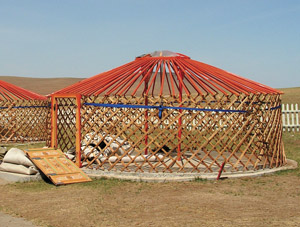
Yurt frame photo © E. Pals/Shutterstock |
That shouldn’t be a problem for a frame panel yurt, but you might find it difficult to get a portable fabric yurt approved as a permanent home. If it is being set up as temporary structure, the requirements are usually much more flexible. Before you buy a yurt, check with your local building department to see what the rules are in your area and how local officials are likely to react. You will find that some manufacturers avoid using the term “yurt” because it sets up unnecessary red flags. Most yurt manufacturers have experience stickhandling local building codes and can be a good source of advice.
Prices of ready-made yurts vary, but you’ll likely spend around $20,000 for one in the 30-foot diameter range, depending on your choice of fabric, doors and windows, extra insulation and other accessories. A much smaller basic fabric yurt shouldn’t set you back much more than $5,000. Once your platform is built, your yurt will be up within a couple of days.
Yurt dwellers value the spiritual and healing feeling of the space as well as the wonder of being close to Nature. In a cloth-covered yurt, you can stay cozy while enjoying the sounds of rain and wind; you can hear animals and see the stars at night and treetops during the day while being protected from the elements in a style of structure that has been sheltering people for millennia.
Learn More
Yurts: Living in the Round by Becky Kemery (Gibbs Smith, 2006)
Mongolian Cloud Houses: How to Make a Yurt and Live Comfortably by Dan Frank Kuehn (Shelter Publications, 2006)
The Complete Yurt Handbook by Paul King (Eco-Logic Books, 2002)
Circle Houses: Yurts, Tipis and Benders by David Pearson (Chelsea Green, 2001)
Wendy Priesnitz is Natural Life Magazine's editor and a journalist with over 40 years of experience. She is also the author of 13 books.
|