|
I Don’t Need to Know!
My Path to Secular Humanism
By Ute Mitchell
A young mother’s journey to understanding life is propelled by her need to understand what comes after death.
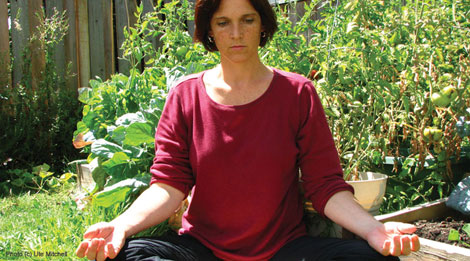
Imagine a garden. Flowers are blooming plentifully. Ripe, plump tomatoes are waiting to be harvested, next to rows of squash, cucumbers, onions, beans and lettuce. Birds are chirping their cheerful summer songs and bees are buzzing tirelessly from blossom to blossom. In the midst of this peaceful scene sits a woman, her body firmly rooted to the ground. She is sitting in a lotus position, her feet bare, her hands resting, ever so gently, on her legs. She meditates. She gives thanks to the universe for providing her with an abundance of vegetables and fruit – enough food to feed her family all summer and throughout the fall. It is a deeply spiritual moment, a moment of peace and relaxing solitude. This woman has reached the end of a long journey, a journey that had her question everything and everyone. It sent her soaring and dropped her into darkness. After endless nights of crying herself to sleep, this woman has made peace with a sometimes troubling fact: She is an atheist, a part of the most hated minority in America. And she is okay with it. This woman is me. I’m an atheist – a secular humanist – and this is my story.
Growing up in a small town in Southern Germany, I had religion all around me (although Germany is a decidedly secular country). I lived in a house right next to a cemetery and witnessed countless funerals. I would sit quietly in my secret hiding place and watch the coffin, decorated with mounds of flowers, carried to a deep hole where family members and friends gathered. All were dressed in black, holding handkerchiefs, carrying little bouquets of flowers. Then I would listen to the pastor’s monotonous speech and prayers before they lowered the coffin into the darkness. I still watched after all the people had left and only a couple of men were left endlessly shoveling dirt into the hole until it was filled completely, then decorated the heap of dirt with wreaths and bouquets of flowers.
I was in kindergarten when I “attended” my very first funeral from my hiding place in the bushes. I frequently ventured out to the cemetery to read the inscriptions on the tombstones and I was always sad for the very tiny graves where young children lay buried. Amazingly I did not wonder about what would happen to all these people after they died. To me, death was just that, the end of life.
| “I vividly remember my very first religious education class, during which our teacher, a Protestant minister, asked us what we believed in. My simple response was, 'Nothing.'” |
Then I entered first grade. In Germany, this meant religious education for all children, except the Turks, who were Muslims and got to play for an hour instead. And so I was introduced to the subject of religion. My atheist parents had felt no need to influence me in any way, knowing that soon I would come home with questions about God, Jesus, and the Bible. I vividly remember my very first religious education class, during which our teacher, a Protestant minister, asked us what we believed in. My simple response was of course, “Nothing.” The class bully sat right next to me. She turned her head in utter shock and yelled into my ear, “You are a heathen. You’re going to hell!” My teacher, a very kind man, instantly intervened, worried about my reaction to this outburst. But I wasn’t bothered. The concept of heaven and hell was new to me. I had never even heard the word heathen, so it meant nothing to me. I did understand that it was meant as an insult: The tone of her voice, high pitched, shrill and with just a little bit of disgust, said it all.
Religious education did have a huge impact on me. Suddenly, there was this idea that somewhere in the sky a supreme being was taking care of me, was watching over me at all times and was going to punish me if I didn’t pray or behave. My teacher, who painted the picture of God in glorious colors, also made a point of instilling in our minds a dark and gloomy picture of this place called hell, where all bad people would burn for eternity. And so I did the only thing I could. I started praying to God. I even attended church with my cousin, but was told that since I wasn’t a real Catholic, I really couldn’t be saved. I was utterly confused. My Protestant teacher had promised that I would go to heaven if I was good but my Catholic cousin’s priest destroyed all my hopes for salvation. I prayed with all the desperation of a young girl, hoping, wanting so badly to be heard by this God, who apparently had spoken to so many, but who simply chose to ignore me.
At age fourteen, I quit. Countless discussions with various religious education teachers from both the Catholic and the Protestant side had turned me into a skeptic. I attended Catholic religious education one year and the Protestant religious education the next year. At home, I was introduced by my mother to the idea of Buddhism and, my best friend Hatice, a Turkish girl, told me all about Islam and how hers was the true religion.
I finally sought the conversation with a minister at my school and asked him a question he could not answer: “You choose not to believe in Allah, Buddha or even the Catholic God. If you can’t even agree with other Christians, give me one good reason to believe in the Protestant God, or the Catholic or any other one for that matter.” He squirmed and I do think he tried to come up with an answer, but I honestly do not remember it. What I do remember is walking out the door, disillusioned by what this “Man of God” had said to me. It made absolutely no sense and I would no longer spend my time finding God.
Years passed and I was never approached about the subject of religion again. Nobody ever asked me about my beliefs. It simply wasn’t important. I was friends with atheists, Christians and Muslims, and religion was never discussed.
And then I met my future husband, an American, and I followed him to Arizona. Mike was also an atheist. Not that it mattered when we met, but it was good to know when he proposed to me on Valentine’s Day and we agreed that a church wedding was out of the question. We were married by a rabbi, who performed a beautiful secular ceremony on a warm Arizona spring day. Soon after the wedding, I found out I was pregnant with my daughter and made a conscious effort to find friends. I joined a MOMS Club chapter and soon was surrounded by a community of friends. We attended play dates, park days, picnics and zoo days during the week but, on the weekend, almost all of my friends were busy at church. They were all passionate about their churches, their Sunday Schools, their church functions, and almost all of them felt genuinely sorry for me.
“You, too, will find your way to Jesus,” I was told once. “Come and join us for church on Sunday.” It soon had become a hobby among my friends to belittle me or to try to convert me to their faiths, of which there were many. One friend told me she got “extra points” for converting Jews and atheists to Christianity. I felt, again, like the odd one out, the one who hadn’t yet found what she was looking for. And, strangely, I bought into it. I didn’t want to find God, but I did want to find a community like my friends had. I wanted to belong. And so I went searching for a community, for a church that wasn’t a church, without success.
In 2003, my grandfather passed away. Death, as you may recall from the beginning of my article, had never concerned me. Yet, suddenly, I was terrified. I had never lost anyone so close to me. The reality of it hit me like a brick in the face. I watched my mother cope by believing in reincarnation. I watched my grandmother cope by believing in heaven. I watched my brother push it away, so as not to be bothered by the thought of what might happen to him after he died.
| “I would like to educate my children about religion, and I hope they will have a chance to attend at least one church service, get to see at least one synagogue from inside and experience faith through believers around them. My hopes are that they will grow up with strong moral values and with an insight into the world’s religions, and that they will be open-minded freethinkers with the ability to choose their path and live it passionately.” |
We moved to Oregon in the summer of 2006, where everything changed for me yet again. I joined a resource center for homeschooling families in Portland. My children started taking art, dance and history classes, while I spent my time chatting with other parents in the nursery. I found some peace in the fact that both my best friends are “atheists,” although one of them considers herself an Atheist Jew, who finds comfort in practicing the Jewish traditions without the religious aspect of it, and the other one refuses to accept the label atheist or any other label for that matter. She likes to refer to herself as a “tree hugging dirt worshipper.” But neither of these lovely ladies, who provide friendship and comfort, was able to take away my fear of death and answer the question of “what happens then?” The answer to that question came from a completely different direction, unexpected and so amazingly simple.
None of their approaches worked for me. I had to find out what came after death. I read book after book about death, dying, the next world, reincarnation, ghosts. The more I read, the less comfortable I was. It was not dying that scared me. It was infinity. I was afraid of being dead for eternity, about the disappearance of all humankind, about everything simply being gone. Night after night, I cried myself to sleep, as images of the great big nothing whirled through my head. I was incredibly jealous of my friends, who took comfort in their beliefs, that there was a God waiting for them, cradling them, taking care of them. Their promise of heaven, as unbelievable as it was to me, held so much comfort that it nearly drove me crazy. I felt that I was somehow, more than others, entitled to the truth. Wasn’t there good reason for me to find out? For my own sanity… and then, of course, for the sanity of my children, who were by now four and two years old? During the day, I lived a very outspoken atheist lifestyle. I was going to homeschool my children for a number of reasons, but the freedom to educate them about religion was right there on top of my list of priorities. I wanted religion far away from my children, or at least I wanted to be the one to introduce it to them, rather than a teacher or their peers. And yet, I had, in my opinion, no good answer for them about the death question, because I had no answer for myself.
I sat, like so many times before, at the bookstore, reading a book, searching for the truth. A man sat down next to me, glanced at my book several times and finally commented on it. During a two-hour conversation, he shared his own story with me, of searching for truth and finally finding peace. He told me that he was standing in the shower one day, when “it” spoke through him.
“I don’t f***ing need to know,” he heard himself say out loud.
I told you it was amazingly simple, didn’t I? And yet, these few words held the truth. I am a puny human being and it really doesn’t matter if I know what, if anything, happens to me after I die. The man and I said our goodbyes and, though we did exchange email addresses, we never talked again. I don’t even remember his name. I do remember, though, driving home that day, singing in my car. I wanted to dance and hug the world. I screamed that sentence from the top of my lungs over and over again. At night I went to bed and instantly fell asleep. No tears, no fear, just deep, relaxing sleep like I hadn’t experienced in years.
Three years later, my daughter, who is now eight, is an outspoken atheist with a strong belief in faeries. My six-year-old son doesn’t really care either way. Both of them attend my Rational Sunday School, a program that I founded with my husband a few years ago. Through the Center For Inquiry (CFI), which fosters a secular society based on science, reason, freedom of inquiry and humanist values, we hold a bi-weekly Sunday School program using “The Six Pillars of Character” curriculum, teaching our children and others the concepts of trustworthiness, respect, responsibility, fairness, caring, and citizenship. By the end of next year I hope to have written my own curriculum on comparative religion for children of secular parents.
I would like to educate my children about religion, and I hope they will have a chance to attend at least one church service, get to see at least one synagogue from inside and experience faith through believers around them. My hopes are that they will grow up with strong moral values and with an insight into the world’s religions, and that they will be open-minded freethinkers with the ability to choose their path and live it passionately. My daughter recently asked me what happens to us after we die. I asked her what she thought and she said, “I don’t really know. I think we’ll just turn to dust.” I asked her if that was a problem for her and she said no. Nothing to it.
As for myself, I’ve come to the conclusion that my journey will never quite be over. I use affirmations and meditation for peace and comfort. I even research subjects like reincarnation. I speak often with my friends who give me an amazing insight into their lives and belief systems. Through CFI, I have recently started a parenting discussion group, based on Dale McGowan’s books Parenting Beyond Belief and Raising Freethinkers.
I will continue to speak openly about my secular humanism because I am, at this point in my life one hundred percent committed to the cause of humanity. I try to promote a positive picture about the word “atheist,” which carries so many negative connotations and implies that we are the personified evil, eager to take over the world, one poor soul at a time, when all it really means is “a person without belief in a supreme being.” No more, no less.
Ute Mitchell lives with her husband and two children in a Portland, Oregon suburb, where she learns, writes, gardens and is known in her homeschooling community as the friendly atheist.
Learn More
The Six Pillars of Character www.charactercounts.org
Center for Inquiry www.centerforinquiry.net
Parenting Beyond Belief by Dale McGowan (AMACOM, 2007)
Raising Freethinkers by Dale McGowan (AMACOM, 2009)
What Is Secular Humanism? by Paul Kurtz (Prometheus Books, 2007)
|