The Buzz About Backyard Bees
by Wendy Priesnitz
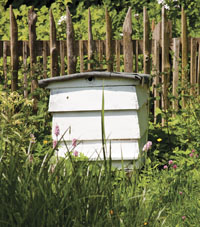 There’s a buzz in the air these days…and it’s being caused by the growing number of bees living in cities. Since the mysterious collapse of bee colonies a few years ago, an army of urban beekeepers are striving to rescue the population, one bee at a time, because they’re worried about the environmental impact of fewer pollinators. There’s a buzz in the air these days…and it’s being caused by the growing number of bees living in cities. Since the mysterious collapse of bee colonies a few years ago, an army of urban beekeepers are striving to rescue the population, one bee at a time, because they’re worried about the environmental impact of fewer pollinators.
Some people have blamed the colony collapse disorder phenomenon on the large, commercial beekeeping operations with their overworked colonies and use of pesticides. Others focus on mites and diseases that the chemicals are supposed to conquer, in the same way that factory hog or cattle farms are susceptible to diseases. Other urban beekeepers value the one hundred or so pounds of honey a hive can produce in a good year and cultivate bees in the same way they’d grow organic veggies and fruit.
Beekeeping is a relatively inexpensive hobby and is more common in the city than you might think. It takes up very little space, with stackable hives that are about one foot square. Urban beekeepers typically keep their hives in their backyards, but some are kept on city roof-tops, such as the roof of downtown Toronto’s Fairmont Royal York Hotel. Bees can travel several miles to collect nectar and pollen, so they do not need flowering plants close by. As long as you practice good hive hygiene, your involvement can be as limited as you wish, since bees are pretty self-sufficient creatures. Then, once a year, you’ll have to get involved with the honey harvesting process, which is time consuming and messy. That involves removing the bees from the hive, removing the honey-holding wax from the frames, extracting the honey from the wax and jarring the honey.
The Challenges
However, there are challenges. In the city, these include jittery neighbors, vandals and by-laws banning the activity. Outright bans seem to be rarer than those banning livestock such as chickens, but some places have put practical constraints on beekeeping, such as limiting the number of hives, regulating the distance from property line and requiring that the beekeeper provide water for the bees (which you should do anyway, since they’re thirsty critters). And then there are mites and parasites, which can be a problem no matter where your colony is located.
Neighbors’ fears can be the biggest obstacle for urban beekeepers to overcome. Many people think that bees are vicious and just hang around waiting to sting people, so they worry about the safety of their children. A little education can help in this regard, since honeybees are vegetarian – unlike wasps, which are meat eaters – and prefer nectar from flowers to human blood. Bees only sting when they sense that their hive or their young are in danger – and that’s often triggered by quick or threatening movements. That’s why beekeeping is a slow, methodical, almost meditative process – something urban beekeepers value about their avocation. Refraining from working with your bees while the neighbors are having a party or mowing their lawn, and when the temperature is cool, will help ensure the bees stay calm and minimize the chances of an angry colony member stinging someone.
Some urban beekeepers would rather their neighbors not even know about their hobby and resort to stealth techniques. They plant greenery in front of their hives and camouflage them with paint. Privacy fences and high hedges are also popular. And high fences can do more than hide the hives; bees normally travel in a straight path to their hive (hence, the term “beeline”) and constructing a fence (or locating the hives on a flat roof) forces their flight path upwards. That reduces the chance that people will see the bees or collide with them and get stung. Providing a source of water, such as a small pond, will keep your bees out of your neighbor’s dog’s drinking bowl or swimming pool.
Getting Started
The first thing to do if you want to keep bees is to learn everything you can about bees and beekeeping. Since you’ll likely start in the spring, winter is a good time to educate yourself. Your local library will probably have some books on the subject (see the sidebar for some suggestions) or a DVD. There are also some good internet sites for beginning beekeepers.
You can buy starter hive equipment from one of a number of manufacturers and mail order firms that have websites. A complete hive involves a metal covered top, an inner cover, a bottom board, two ten-frame hive bodies and a queen excluder. Although bees like to settle where a colony has been established previously, you should be cautious when buying used equipment. Check its condition carefully and be sure it’s been examined for the possibility of disease. A new starter kit can cost anywhere from US$150 to $300. You’ll also need a bee smoker, coveralls and a bee veil and gloves. You’ll also need to buy jars for the honey and to rent an extractor machine to remove the honey from the comb.
As for the bees, you can buy a three-pound starter box of package bees (15,000 bees and one queen) from a mail order bee supplier for around $100. You could also buy an established colony with all equipment from a local beekeeper or have the beekeeper install a swarm in your purchased hive.
It’s always a good idea to find someone with experience to help you get started and provide advice along the way. Writing in Bee Culture Magazine, Larry Connor has this advice for the novice urban beekeeper:
“There are many beekeeping organizations around the country that conduct beekeeping classes in the winter and spring. Most folks start their first hive in the springtime. If you decide to do this, find someone who will mentor you in your training as a beekeeper. It will probably take you several years to learn enough to feel comfortable keeping bees, but it is a great part-time activity, and people of all ages are in beekeeping classes, from school students to retirees.”
Learn More
Beekeeping For Dummies by Howland Blackiston (John Wiley & Sons, 2009)
The Backyard Beekeeper: An Absolute Beginner’s Guide to Keeping Bees in Your Yard and Garden by Kim Flottum (Quarry Books, 2005)
The Beekeeper’s Handbook, Third Edition by Alphonse Avitabile and Diana Sammataro (Cornell University Press, 2006)
The Original Langstroth On The Hive And The Honey-Bee: The World’s Foremost Bee Keeper’s Manual by L. L. Langstroth (CreateSpace, 2009)
The Backyard Beekeeper’s Honey Handbook: A Guide to Creating, Harvesting, and Cooking with Natural Honeys by Kim Flottum (Quarry Books, 2009)
|