What Are We Fishing For?
Exploring the health and environmental risks and benefits of eating fish
By Gene Sager
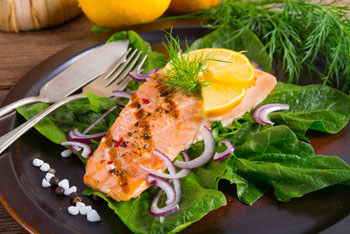
Photo © Dzinnik Darius/Shutterstock |
“Superhero Eats Superfood” was the title of a magazine article that caught my eye as the checkout line crept along at the supermarket. The article was about how U.S. President Barack Obama’s regular fare was salmon and broccoli. And the president is not alone. Nutritional blogs are crowded with information about the health benefits of omega-3 fatty acids from fish and fish oil.
But preference for fish is not just a media fad: The American Medical Association and Health Canada’s Food Guide recommend that we eat two servings of fish per week. As the industry flourishes, even the word “pescetarian” is making a comeback, referring to a vegetarian who eats fish. These individuals consume fish for health reasons and, some say, “Fish is not really meat anyway.” Whether we call it meat or not, we need to make some hard calls concerning the nutritional claims, as well as the related ecological and ethical aspects of the whole process – including spawning and habitat issues, trawling, DHA omega-3, mercury levels and the relation between wild fish and farmed fish.
Health Benefits
Seafood as a protein source is a long standing justification for the consumption of fish, but modern research has alerted us to a variety of viable alternatives. Even a strict vegan diet (no animal products and no seafood) can provide a full supply of protein.
Today, fish is recommended for the health of the eyes, the brain and the heart. However, many plant products also foster visual health: carotenoid from carrots, lutein from leafy greens and anti-oxidants from citrus fruits and olive and canola oils. Of special interest is the benefit fish consumption provides to the brain and nervous system; this includes memory, Alzheimer’s disease and even mood swing issues. But, again, there are excellent plant sources to support mental health and the growth and health of the brain: ground flax seed, wheat germ, canola oil and avocados. Fish can support a healthy heart, but so can whole grains, beans, lentils and oat bran.
Although fish is sometimes recommended to relieve inflammation and arthritis, leafy green vegetables, walnuts and ground flax seed can provide the same benefits. From cholesterol control to a selenium source, claims are offered in favor of fish but, in every case, we find that plant sources also meet these needs. Walnuts, olive oil, garlic, onions, citrus and okra are excellent cholesterol-controlling foods and regular exercise also helps balance and improve cholesterol levels.
Confusion about the health benefits of eating fish surrounds the omega-3 fatty acid called docosahexaenoic acid (DHA). Research shows that DHA supports the health of the eyes, the brain and the heart. In health food circles, there is a budding DHA craze. A hasty reading of current information sources today can lead us to accept two false assumptions:
1. DHA is found only in fish.
2. DHA is the only good nutritional source to support the health of the eyes, brain and heart. 
Ironically, the first assumption is obviously false because fish get DHA by consuming a plant: algae. The second assumption is clearly false because all the plants we specified above for the health of eyes, brain and heart have no DHA content but provide the same benefits as DHA.
The bottom line here is that the DHA craze is quite uncalled for. We can maintain excellent health without consuming DHA. Despite this fact, some still feel they may need to consume it. For such individuals, there are two assurances. First of all, our bodies produce their own DHA from other omega-3 fatty acids. Secondly, if a person wishes to take supplements, there are algal (algae) DHA supplements available online and in stores.
Health Risks
As a chemophobe, I launched a search for organic fish to reduce health risks. Since wild fish are completely free-range, they cannot be organic. There is no controlling the movements of water and wild fish, so we cannot know what toxins they may ingest. But I thought farmed fish might be organic because they are raised in carefully controlled conditions. My research showed, however, that most farmed fish contain more toxins than wild fish. Major studies have confirmed this time and again, including lab tests by Indiana University School of Public and Environmental Affairs Professor Ronald Hites on North American, South American and European fish, reported in Science Daily in 2004. A similar study showed the same results in 2008 (Science Daily, 3/12/08). Farmed fish are confined in pens and protected from disease with antibiotics and pesticides; they are fattened up with rich pellets made of oily fish, fish oils, grains and other materials.
The fish farming industry would like to gain organic certification. Their proposal to the National Organic Standards Board has been to carefully control the feed given to farmed fish by limiting the amount of wild fish flesh in the feed to twenty-five percent. But wild fish are not organic, so are they proposing to use non-organic material to produce an organic product? My organicophile friends advise me that imported “organic farmed fish” is now available in North America. It is imported from Scotland. When it comes to buying organic fish, I have two words to offer: “Caveat Emptor” – Let the Buyer Beware.
Failed in the attempt to find organic fish, perhaps we can at least sort out the relatively uncontaminated fish and toss out the more toxic ones. There are many groups and programs we can use for this purpose. Governments and independent organizations publish lists to help us. Very generally speaking, the published lists of bad (too toxic) fish usually include swordfish, shark, king mackerel, tilefish, bluefin tuna and several types of bass. Fish with lower levels of toxins include canned lite tuna, wild Pacific salmon and catfish. However, we must be very careful about the terminology used by those who make toxin level lists and package labels for grocery stores. Some toxin level lists simply say “tuna” without specifying the important details: There is fresh, frozen and canned; there is bluefin tuna, bigeye and albacore white tuna. In some cases, the country of origin may make a difference as well.
As for toxins, we are accustomed to concerns about mercury in fish, but there are several other toxins we should track, including PCBs (polychlorinated biphenyls), dioxin, pesticides and other suspected carcinogens. In the U.S., the FDA and EPA differ as to what amounts of mercury can safely be consumed. The FDA has allowed higher levels. Health Canada’s standards are more stringent and Britain’s Food Standards Agency has even different advice.
A very distressing irony is revealed by a careful study of the effects of fish consumption on the human brain. On the one hand, fish is recommended as a super health food for brain growth and development and to prevent Alzheimer’s disease. On the other hand, detailed medical advisories always warn us that even low levels of mercury are harmful to brain function, especially for fetuses and children.
On paper or in cyberspace, it may appear that fish are clearly identified and labeled for contamination levels. But we need an exacting and realistic approach to these matters in order to protect our health. We must realize that in dealing with such a large industry, those who test fish for contaminants cannot examine every fish. An example is the Safe Harbor certification program. Safe Harbor uses FDA standards and tests only for mercury in the particular fishes they sample. They then calculate an average, and the Safe Harbor stamp is based on the average level of mercury for a given species. So, for example, if the salmon on your plate had the Safe Harbor stamp, it would only mean that the average level of mercury in that type of salmon was below the FDA limit. Another factor to keep in mind is that some certifying organizations like Marine Stewardship Council (MSC) charge a fee for their stamp, so only the companies willing to pay the fee will receive it.
Each of us has to make our own judgments about the risks: Which type of fish, farmed or wild, from where, certified by whom, under what standards? There are experts who advise against all seafood and experts who would limit us to certain fish in certain amounts. The issues are complicated and controversial, so appealing to “experts” or “authorities” does not guarantee a valid judgment.
I can only offer my own opinion here, based on all of the above information and one more (to me) very telling consideration, which is the food chain. As on land, so in the sea, the ecosystem operates rather like a chain. The various algae, collectively called phytoplankton, are at the bottom of the chain. Moving up, the algae and single-celled diatoms are consumed by small crustaceans, which are the main food source for herring, mackerel and anchovies. These fish are, in turn, a main food source for fish like cod, tuna and salmon – the fish which often appear on our plates.
What does this come to? Fish like tuna are many links up on the chain. Toxins accumulate in the cells of marine life and are transferred up to the next link as they are consumed. When we eat fish, we eat the accumulated toxins and they, in turn, accumulate in us over a lifetime. Generally speaking, the higher on the chain, the more toxins. Most of the fish sold in the market represent a high level on the chain, so I prefer not to eat them. On land or in the sea, this chain-accumulation principle can help us decide what to eat.
Environmental Aspects
When we think of the risks of eating fish, we usually think of human health risks. But there are serious environmental risks as well. The ecosystem is an interrelated web. If fish contain toxins, these toxins get into puffins and gulls also, and into sea lions, mink and bears.
For some twenty years, overfishing has gradually developed into one of our most serious environmental problems. From 1950 to 1989, the overall marine catch kept pace with the world population but from 1989 to the present, the catch has declined in relation to population. The UN’s Food and Agriculture Organization (FAO) indicates that all fifteen oceanic fisheries are being fished at or beyond their capacities and thirteen of them are in a state of decline. What is worse, we target species (“tasty” or useful fish), thus weakening or destroying links in the food chain.
One of the most destructive means of fishing is bottom trawling (trawlering) for shrimp. The weighted nets scrape the bottom, destroying all habitat and collecting bycatch (unwanted fish and crustaceans that die and are discarded). We are bulldozing the ocean bottom and discarding most of what is collected! The shrimp farms are infamous for destruction of mangroves and the pollution of water; no feasible way to dispose of the shrimp wastes has been found.
Fishing sometimes causes environmental and justice problems in combination: Where indigenous people live on traditional land, a disruption of the supply and movements of wild fish is a disruption of sacred tradition – in their view, an infraction of justice. And in a world with population and hunger issues, we relatively comfortable citizens of the West, with our many dietary options, should not forget that some developing countries are totally dependent on a steady supply of fish to meet basic nutritional needs.
This becomes an eco-justice issue about the equitable use of natural resources. For many of us, raw fish sushi is a current fad and cooked salmon or tuna is an extra health food; but for people in some developing countries, fish may be the only viable option for the next meal.
Our litany of problems must include the burgeoning fish meal business. Today, one-third of the wild fish catch is ground up, mixed with grain and other materials, then fed to poultry, pigs and farmed fish. Evidently, the mad cow episode did not teach us about the dangers of reorganizing the food chain. Most of the fish used for fish meal are wild “forage fish” – sardines, anchovies and mackerel. As this fish meal business increases, it depletes the supply of forage fish, which are a food source of the bigger wild fish and marine animals. About half of the fish meal produced today is fed to farmed fish – a “separate breed” which does not fit into the earth’s ecosystem.
The strange fallouts from fish farming are becoming clear to us now. Author, journalist and salmon specialist David Dobbs warns us in these terms in an article in Eating Well magazine (March/April, 2008): “To eat farmed salmon tonight is to decide you may as well eat farmed salmon, and only farmed salmon, forever.” One of Dobbs’ reasons is that as the farmed salmon production increases, the food source (forage fish) of wild salmon is depleted. Additional dangers include sea lice spreading from farmed salmon to wild salmon and escaped farmed salmon disturbing the spawning behaviors of wild salmon.
Some fish farmers are now using a new production process with a closed pen, called CSA or closed system aquaculture. Advocates of CSA claim that by preventing all interaction with wild fish it will overcome the many problems that have plagued fish farming, but it remains to be seen whether CSA will be successful in terms of a healthful product, environmental friendliness and economic feasibility. Today CSA farms are a tiny minority in the fish farming business.
In sum, fish farming today is not unlike CAFO (concentrated animal feeding operations) or “factory farming” of cattle, chickens and other land animals. Fish farming is not called factory farming, but if feedlot beef production deserves the name “factory,” so does fish farming. In both cases, the confinement is severe and inhibits instinctual behaviors. The captives are fattened up on an unnatural diet. Piles of excrement accumulate and pollute the surrounding terrain/water. Because of the confinement, antibiotics and pesticides are used to control the spread of disease. The use of grains to feed fish or cattle which are, in turn, eaten by humans is very inefficient; we can eat the grains ourselves, at half the environmental cost.
When the fish farming industry appeared on the scene, many of us thought it was “the answer:” It could mitigate the problems of overfishing; it could produce a healthful organic product; it could be environmentally friendly; it could be more humane. Sadly, it appears now that if fish farming is the answer, it is the wrong answer.
Ethical Issues
Many of the issues we have already discussed can be seen as “ethical” in the broad sense of the term. We have an ethical obligation to safeguard our health, and those who monitor and label products have ethical and legal obligations. Pollution and world hunger issues clearly involve both environmental and ethical aspects. Today, academics are accustomed to segmenting these intertwined matters so that “ethical issues” refers to issues concerning the suffering, pain and slaughter of animals, birds and fish.
Although ethicists have alerted us to ethical problems concerning the treatment of cattle, chickens, pigs and puppies (in puppy mills), most of us have not confronted issues about causing pain to fish or taking the life of fish. Fish exhibit behaviors of distress and struggle when they are caught or injured. They react to stress as humans do – with increased heart rate, breathing rate and adrenal hormone release. They have a brain, a spinal cord and a nervous system. As a basic principle, on land or in water, a life form high on the food chain is capable of feeling pain; so tuna and salmon, for example, may feel pain when they are injured or killed. Most of the fish we catch and slaughter die slowly of suffocation after being removed from the water.
In addition, factory fish farming, including the new closed system aquaculture, raises ethical issues about confinement. Clearly, fish have instinctual drives and many of these drives or natural behaviors are stifled by enclosing them in pens or tanks. This issue is different from that of physical pain and, as we saw, it runs parallel to the problems about confinement of land animals. It seems cruel to frustrate the natural drives of these living beings.
Conclusion
In my view, we who live comfortably in the “developed” countries can well afford to take a stand on the side of compassion. We do not need to eat fish and I suspect the health risks of eating fish outweigh the health benefits. But our dietary decisions should not be based on our health alone. Eating is not a one dimensional action. Dietary, environmental and ethical dimensions are inextricably intertwined. For me, the environmental impacts from the fishing industry are the most striking. If we risk the balance and health of the environment, we are all in jeopardy.
Gene C. Sager is Professor of Environmental Ethics at Palomar College in San Marcos, California.
|