The Family Hammock
by Rosalie Schultz
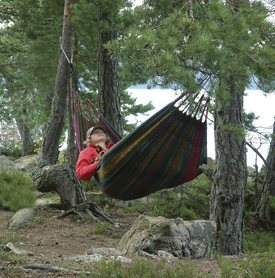
Photo © Shutterstock |
In one of my favorite country-folk tunes, the singer pledges, “Just a hand-woven love song – is all I have to bring to you.” (Portales by Ray Wylie Hubbard). When I was touring the Yucatán Peninsula, I saw some actual “hand-woven love songs” in the form of the hammocks that are made there.
The City of Mérida in the Yucatán is famous for the hand-made hammocks that many of its citizens devote themselves to producing. For the most part, they use the same techniques that were used by their Mayan ancestors over 1,500 years ago, and their work is a study in continuity and community.
A guide ushered our group through one of the hammock-weaving businesses where we saw the artisans using a variety of materials. Some of the hammocks were being made of silk or cotton, but sisal is still the most commonly used fiber. Sisal is an indigenous plant that is so strong and useful that countless people died through the centuries, warring over which faction had the right to control its trade. Countless Mayan people died in virtual enslavement, working to produce and harvest the sisal crop at the behest of the Spanish conquerors.
If we wanted to buy a hammock, ones of undyed sisal were suggested as the most natural choices. Still, the multicolored ones were eye-catching. I ended up buying a hammock of varied blues and purples, created with traditional dyes made from tree sap and cochineal bugs.
But as interesting as these details of production were, I was even more interested to learn how these hammocks are woven into the fabric of the persisting Mayan/Mexican culture as a whole. The hammocks are produced in three sizes: individual, couples and family. The large family size is the most popular among the area residents themselves. Here, the “family bed” in the form of a hammock is not an arrangement that anyone has to advocate. It is already taken for granted. It is assumed that families will share the one large hammock they own. Cosleeping is the norm.
This practice didn’t seem to be only a matter of necessity. I got the feeling that it would have continued to be the norm for parents, children and, sometimes, elders to sleep together, even if the families had the wherewithal to build extra rooms.
The hammock is, in most cases, a young married couple’s most important acquisition. Hammocks are sometimes handed down from parents or even grandparents to the newlyweds. The hammocks are made to last. When a couple does go shopping for a new one, though, they consider their choice carefully. This is a more momentous purchase than our typical North American family’s purchase of a new car. The hammock remains the center of family life in the Yucatán.
We could see this first-hand as we drove through the countryside, past hundreds of typical one-room residences strung along the roadsides. These are huts, again constructed largely according to ancient Mayan tradition. They are made of stucco, adobe and crushed or broken chunks of cement – the same kind of cement that was used to coat the famous earthen mound pyramids of the area. Poles arranged like the spokes of a wheel support the huts’ thatched roofs. Most huts aren’t any bigger than the walk-in closet you’d find in many North American homes.
But that single room and surrounding yard is sufficient in this culture of family togetherness. The prized family hammock is strung diagonally across the room, dominating, bisecting the interior space. It is often left up day and night. During the day, it is a family gathering spot. At night, everyone tumbles in together to sleep.
Hammocks have many advantages over beds in the hot, humid climate of the Yucatán. They are secured to the hut walls with grommets and rings in such a way that any slight movement in them sets up a gentle swaying motion, which, in turn, generates a breeze across the bottoms of the hammock occupants. Then the extra weave of the hammock can be drawn up and over the occupants, serving as a kind of mosquito netting or a general cocooning.
But the essential meaning of these large hammocks lies in the way they support the family bond. Children in this area and throughout much of Mexico participate in earning a living with the family from a very early age. They are not simply consumers. They are valued producers, integral to all the family’s occupations. We were told that a couple’s hammock would hold at least 1,000 pounds; the family hammocks will hold even more. But in reality, these hammocks carry the whole weight of the family’s struggle to earn a living and make it through the world – together.
Children and parents nestle into these hammocks, not at any specific time, but whenever they feel tired. So many of the problems that our North American families continuously face just naturally don’t exist under these circumstances. There is no tussle over enforcing bedtime schedules here. Parent isn’t pitted against child as the latter maneuvers to win a few precious extra minutes awake with the adults before being “put to bed.” There is no need for a child to scream, whine or invent pretexts to leave its isolation chamber and come cuddle with parents. All of these roots of war between the generations are eliminated.
A couple of retired teachers in our tour group were appalled at the way many of the children they saw were kept out of school so that they could help make and peddle goods on the streets. But, without romanticizing what must surely be a precarious poverty for most of the people in this region, and without completely dismissing the dangers of child labor, I couldn’t agree with the teachers’ blanket disapproval. I saw in the rhythm and dynamics of these families an example that we might do well to emulate in many ways. Instead of our insisting that these children always be sent to school to learn, we might consider how we ourselves could learn something from their family arrangements. We could learn how to grow together and be part of each other’s lives, instead of remaining estranged occupants of separate rooms and single beds.
Rosalie Schultz learned primarily at home, while helping in her family’s Chicago printing business. She still lives in that childhood home where business and residence were mixed together and where there was only one common bedroom. Contact her at rosalies101@gmail.com.
* * * * *
The Family Bed
Cosleeping with a baby is common in ninety-five percent of the world. It facilitates breastfeeding and provides the warmth, stimulation and monitoring that babies need. Research has also shown that children who routinely sleep with their parents become more independent socially and psychologically, are more able to be alone and have greater abilities to interrelate and be empathetic.
But cosleeping is controversial in North America, where some organizations warn that it can cause suffocation. The U.S. Consumer Product Safety Commission (CPSC) and the Juvenile Products Manufacturer’s Association tell parents that co-sleeping should never be practiced. They base that recommendation on a 1999 CPSC study, which found that 515 cases of accidental infant deaths occurred in an adult bed over an eight-year period. The causes included being smothering by an adult, getting trapped between the mattress and headboard or other furniture and suffocation on a soft waterbed mattress. However, during the same time period, about 34,000 total cases of SIDS occurred. Unfortunately, the researchers failed to examine how many cases of SIDS occur in an adult bed versus in a crib and how many babies sleep with their parents instead of in a crib, although the data is available. Independent researchers have examined those numbers and concluded that sleeping with your baby is actually safer than not.
Renowned pediatrician and author Dr. William Sears points out that this is a conflict of interest for an association of companies that make cribs. Sears, who coined the term “attachment parenting,” does support the USCPSC’s efforts to research sleep safety and to decrease the incidence of SIDS. But he feels they should go about it differently. “Instead of launching a national campaign to discourage parents from sleeping with their infants, the U.S. Consumer Product Safety Commission should educate parents on how to sleep safely with their infants if they choose to do so. The bottom line is that many parents share sleep with their babies. It can be done safely if the proper precautions are observed.”
James J. McKenna, Ph.D., director of the Mother-Baby Sleep Laboratory at the University of Notre Dame says, “Done correctly, whether this means cosleeping, bed sharing or room sharing, infants sleeping with their parents are more likely to survive. It is sad that a small group of ‘experts’ have the parents in western countries bamboozled into believing that the entire history of civilization was wrong! The vast majority of scientific studies on infant behavior and development conducted in diverse fields during the last 100 years suggests that the question placed before us should not be ‘Is it safe to sleep with my baby?’ but rather, ‘Is it safe not to do so?’ ” ~ Wendy Priesnitz, Editor of Natural Life Magazine
Learn More
Sleeping With Your Baby: A Parent’s Guide to Cosleeping by James McKenna (Platypus Media, 2007)
The Attachment Parenting Book by William Sears and Martha Sears (Little, Brown, 2001)
The Baby Sleep Book by William Sears and Martha Sears (Little, Brown, 2005)
The Family Bed: An Age Old Concept in Child Rearing by Tine Thevenin (Penguin Putnam, 1988)
|