Yoga For Children
By Indra Singh
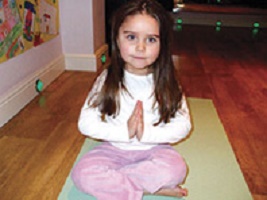 We often think of children as carefree, with very few worries, and forget that they go through stress just like any adult. In today’s society of peer pressure, consumerism and bullying, children need to be able to find a safe place to release their worries and concerns. We often think of children as carefree, with very few worries, and forget that they go through stress just like any adult. In today’s society of peer pressure, consumerism and bullying, children need to be able to find a safe place to release their worries and concerns.
As a yoga teacher and a single mom of two very strong-minded girls, I decided to begin teaching classes to children, since, as with most things, the younger you begin yoga practice the easier it becomes. I spend a great deal of my time around children between the ages of four and fourteen, and have noticed that they sometimes find it hard to enjoy the simpler aspects of life due to all the stimulation they experience in their lives. They need to learn to be happy with who they really are in peace and harmony, enjoy their own company and, most of all, love themselves. So I began my mission to help children naturally access the tools from within so they could understand their true selves and true personalities.
Teaching yoga to a group of ten- to thirteen-year-olds is a challenging but positive experience. They absorb all they learn with pleasure and enthusiasm, which is truly heart warming.
Our practice is kundalini yoga as taught by Yogi Bhajan. It is a very balanced and positive practice, which works on the process of uncoiling our energy so that we are able to know and understand our true potential. Our class structure consists of the following:
- We tune in with a particular kundalini yoga chant, “Ong namo guru dev namo.” It means, “I greet the wise teacher within me and outside of me.” We are all true teachers inside ourselves and being aware of this is of great importance.
- Then we warm up our bodies with gentle stretches.
- We then begin a set of positions that are known as a “kriya,” which means “action.” Kriyas come in a particular structured format not to be changed unless the timings are reduced for each position. Each kriya stimulates a certain area of the body to produce optimum health. A different one is chosen every week to work a particular area of the body.
- When we have completed our kriya, we relax and meditate.
- Children love the use of color, so I try to incorporate color into a visual meditation that encourages each child to use her imagination. One of the many examples of this is for them to sit cross-legged – this is known as “easy pose” – and focus their minds on the space between the eyes, becoming aware of a blank white screen in front of the eyes. In time, they begin to see a house appear on the white screen, see its chimneys and its doors and windows, notice the colors and the activity around the house. This practice is done without force and should flow naturally. The visualization takes around five minutes, which is enough time to keep the children’s attention.
- Once the meditation is complete, I encourage the children to draw what appears to them. We then form a display of their interpretations of a home, with encouraging results. This is a simple practice that can be performed by any parent and their child, and is a wonderful practice before sleep.
- To end our practice, we tune out with “the sunshine song,” a positive prayer to the world and we chant “sat nam”three times. “Sat nam” means “true identity,” which encourages us to be who we really are and proud of it.
The Benefits of Yoga
How does yoga really benefit children? Yoga has many aspects, one of these being the physical. This includes the practice of kriyas in kundalini yoga or what can also be known as “Asana,” meaning a position or a movement held in yoga practice. The benefits include helping children to gain mental and physical flexibility through movement, focus and concentration on the body.
But the physical side of yoga is only part of a bigger picture. Yoga gives children the ability to be able to handle stress from within. One of the main practices that we teach a beginner of any age is how to breathe correctly. This is the practice of breath awareness or “pranayama” as it is known in ancient Sanskrit text. Unfortunately, the majority of us are unable to breathe correctly and, instead of using the full capacity of the lungs, we only use a small percentage and breathe from the upper chest instead of the abdomen. Yoga focuses on learning to deepen the breath and encourages the use of different breathing techniques, which help us handle stress.
For instance, the “breath of fire” is a strong abdominal breath which brings energy and vitality to the body. Alternate nostril breathing has the opposite effect and is a calming and balancing breath.
Meditation and relaxation calm the body and mind. They help put confused thoughts in order and give children the knowledge of how to gain a positive mental perspective on all aspects of their lives. Meditation combined with chanting creates focus, positivity and a centered child.
Relax With Yoga at Home
To help encourage your own positive, peaceful children who can learn to be totally in tune with who they really are, I have included two simple practice sessions for you to do together with your children at home.
- Basic breathing technique (full yoga breath): Lie comfortably on your back and become aware of the movement of your breath flowing through the nostrils. Place your hands on top of your abdomen with the middle fingers touching at the navel. As you breathe in, push the abdomen out like a large balloon. This will naturally create a space between the middle fingers and use the full capacity of your lungs. After five minutes of this breathing, you will feel totally calm and relaxed.
- Candle gazing (tratakam): Choose a beeswax or soy candle that is special to you for this practice. Sit com- fortably on the floor, ideally with the legs crossed and the hands resting on the knees. If it is possible, place the candle at eye level. Begin to stare at the centre of the flame. When you feel the need to blink, bring the palms of your hands together and rub them as fast as you can until they are warm, then rest them over the eyes, relaxing the eyes behind the warm palms. When you are ready, place the hands back on the knees and repeat the whole process. Resist the temptation to blink and, instead, let the eyes water and cleanse. This beautiful practice has many benefits. It strengthens the eye muscles, brings focus and clarity to the mind and helps with symptoms of insomnia. When practicing this technique, always be aware of the breath as it moves in and out of the body.
Indra Singh has been studying yoga for twenty years and trained to be a yoga teacher in the U.K., U.S.A. and Brazil. Her main practice is kundalini yoga as taught by Yogi Bhajan. She specializes in teaching children’s yoga and yoga for children with special needs, and the benefits of yoga for the pregnant mother and her unborn baby. She currently lives with her two young daughters in the UK.
|