|
Hemp Fabric:
The New, Old Fiber Makes a Comeback
for Clothes and Home
by Ed Mass
Hemp fiber is a very old fiber that is making a comeback. It is increasingly popular in a wide range of products, including textiles and clothing, carpeting, home furnishings, construction materials, auto parts and paper. Hemp seed, an oilseed, likewise has many uses, including industrial oils, cosmetics, pharmaceuticals and food.
Hemp is among the oldest industries on the planet, dating back more than 10,000 years. The Columbia History of the World states that the oldest relic of human industry is a bit of hemp fabric dating back to approximately 8,000 BC. Currently, more than thirty nations – predominantly including Canada – grow industrial hemp as an agricultural commodity. About fourteen of those sell part of their production on the world market. The U.S. is the only industrialized nation in the world that does not recognize the value of industrial hemp and permit its production.
Hemp was widely grown in the United States from the colonial period into the mid-1800s. Presidents Washington and Jefferson both grew hemp. Ben Franklin owned a mill that made hemp paper. Jefferson drafted the Declaration of Independence on hemp paper. In fact, due to its importance for sails (the word “canvas” is rooted in “cannabis”) and rope for ships, Americans were legally bound to grow hemp during the Colonial Era and Early Republic. Both fine and coarse fabrics, twine and paper from hemp were in common use. However, by the 1890s, labor-saving machinery for harvesting cotton made the latter more competitive as a source of fabric for clothing and the demand for coarse natural fibers was met increasingly by imports.
By 1933, in an effort to stem the use of cannabis flowers and leaves for their psychotropic effects, thirty-three states had passed laws restricting legal production to medicinal and industrial purposes only. Then, in 1937, Congress passed the first federal law to discourage cannabis production for marijuana while still permitting industrial uses of the crop. In fact, the government actively encouraged and subsidized farmers to grow hemp for fiber and oil during World War II. After the war, competition from synthetic fibers, taxation and increasing public anti-drug sentiment resulted in fewer and fewer acres of hemp being planted, and none at all after 1958.
|
Hemp is Not Marijuana
(or don't smoke your hat)
Commonly, although not necessarily used consistently by all sources, “hemp” refers to industrial hemp, “marijuana” (or “marihuana” as it is spelled in older statutes) refers to the psychotropic drug (whether used for medicinal or recreational purposes), and “cannabis” refers to the plant species that has industrial, medicinal and recreational varieties.
Hemp is characterized by low levels of the primary psychoactive chemical (tetrahydrocannabinol or THC) in their leaves and flowers. The European Union (EU) and the Organization for Economic Cooperation and Development (OECD,) which includes Canada, use 0.3 percent THC as the dividing line between industrial and potentially drug-producing varieties.
In these countries, cultivars having less than 0.3 percent THC legally can be cultivated under license; cultivars having more than that amount are considered to have too high a drug potential. A THC concentration of 1 percent is considered sufficient to have a psychotropic effect.
|
In 1970, Congress passed the Controlled Substances Act, which makes growing hemp illegal without a DEA permit. Those have been near impossible to obtain. As a result, all hemp products sold in the U.S. are imported or manufactured from imported hemp materials. However, that may be about to change, as more than 25 states have passed laws calling for economic or production studies and there is a proposed federal bill being studied by two House Committees that would permit industrial hemp production based on state law, without preemption by the federal government under the Controlled Substances Act.
Hemp Farming
Hemp growers cannot hide hemp plants in their fields like they can marijuana. Marijuana is grown widely spaced to maximize leaves. Hemp is grown in tightly-spaced rows to maximize stalk and is usually harvested before it goes to seed.
Hemp has incredible environmental benefits. It doesn’t pollute the air, water or soil. On the contrary, it builds soil composition. It is commonly grown organically, without pesticides or synthetic fertilizers. And it is a natural weed suppressor due to fast growth of the canopy.
Unlike other crops, such as cotton, hemp doesn’t exhaust the soil. Hemp plants shed their leaves all through the growing season, adding rich organic matter to the topsoil and helping it retain moisture. Farmers have reported excellent hemp growth on land that had been cultivated steadily for nearly 100 years.
Where the ground permits, hemp’s strong roots descend for three feet or more. The roots anchor and protect the soil from runoff while building and preserving topsoil and subsoil structures similar to those of forests.
Because it is an extremely fast growing crop, hemp produces more fiber yield per acre than most other sources. Therefore, the amount of land needed for obtaining equal yields of fiber place hemp at an advantage over other fibers. Hemp can produce 250 percent more fiber than cotton and 600 percent more fiber than flax using the same amount of land.
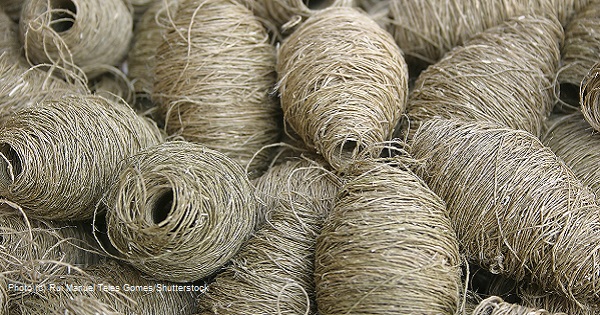
The bark of the hemp stalk contains “bast” fibers, which are among the Earth’s longest natural fibers. The fiber is also stronger, more absorbent and more insulative than cotton fiber.
Harvesting and Processing
To turn the plant into a textile, hemp must go through several stages including harvesting, retting and fiber separation. These are environmentally friendly processes. The main drawback is the use of a great deal of water in one of the retting processes described below, a process that I hope will be improved upon over time. However, compared to the environmental damage caused by other textiles, hemp is still a far more ecological choice.
Although there are variations on the practices, a generic description includes the following steps. First, a tractor-drawn harvester-spreader cuts the hemp stems and lays them in windrows for field retting. The bast fibers of the plant must be separated from the rest of the stalk. “Retting” is a microbial process that breaks the chemical bonds that hold the stem together and allows separation of the bast fibers from the woody core. The two traditional types of retting are field and water retting.
With field or dew retting, plant stems are cut or pulled up and left in the field to rot. Farmers monitor the process closely to ensure that the bast fibers separate from the inner core without much deterioration in quality. Moisture is needed for the microbial breakdown to occur, but then the weather must be dry enough for the stalks to dry for bailing. Although varying weather conditions affect the quality of fiber, field retting has been used extensively for hemp because it is inexpensive, mechanized and does not use water.
Water retting produces more uniform and high-quality fiber, but the process is very labor- and capital-intensive. Stems are immersed in water (rivers, ponds or tanks) and monitored frequently. Not only is this labor intensive, farmers and/or workers must be knowledgeable about fiber quality. Also, the process uses large volumes of clean water that must be treated before being discharged. Water retting has been largely abandoned in countries where labor is expensive or environmental regulations exist.
Once the stalks are retted, dried and baled, they are brought to a central location for processing. With mechanical separation, in a process called “breaking,” stalks are passed between fluted rollers to crush and break the woody core into short pieces (called “hurds”), separating some of it from the bast.
The remaining hurds and fiber are separated in a process called “scutching.” Fiber bundles are gripped between rubber belts or chains and carried past revolving drums with projecting bars that beat the fiber bundles, separating the hurds and broken or short fibers (called “tow”) from the remaining long fiber (called “line fiber”).
After retting, a second machine is used to gather and tie the stems into bundles for pickup and delivery to the mill. These systems are designed to maintain the parallel alignment of hemp stems throughout harvest and processing in order to maximize the recovery of long textile fibers.
Great Fabric
Hemp is an excellent ecological alternative to environmentally destructive non-organic cotton cultivation and synthetics. It is a great fiber for everything from home furnishings to eco-friendly clothing. Hemp has excellent insulative and conductive qualities. When compared to cotton, for example, hemp is warmer, yet breathes better. Plant fibers breathe much better than leather and synthetics, and hemp breathes better than other plant fibers.
Hemp’s fiber molecule has a shaft-like structure that allows it to:
- wick moisture off the body and dry quickly;
- allow the wearer to feel warmer when wet, even in cold conditions;
- keep the wearer cool, comfortable and fresh, even in very hot and/or humid conditions.
Hemp is also anti-bacterial, so clothing made from it is resistant to developing odor even after a shirt is worn for days or a week at a time. This makes it especially great for travel. Hemp clothing is good for individuals with allergies and multiple chemical sensitivities due its hypoallergenic and non-irritating qualities.
Hemp fabric is extremely durable and resistant to degradation from mold, bacteria, salt water, sunlight, abrasion and chemicals. However, unlike synthetic fibers, it is fully biodegradable.
Other Uses
There are many other fiber-related uses for this great plant. Its hurds are manufactured into construction panels, insulation, animal bedding and a composite material used in car interiors.
According to the U.S. Department of Energy, hemp as a biomass fuel producer requires the least specialized growing and processing procedures of all hemp products. The hydrocarbons in hemp can be processed into a wide range of biomass energy sources, from fuel pellets to liquid fuels and gas, and can significantly reduce consumption of fossil fuels and nuclear power.
Hemp produces more pulp per acre than timber on a sustainable basis, and can be used for every quality of paper. Hemp paper manufacturing can reduce wastewater contamination. Hemp’s low lignin content reduces the need for acids used in pulping and its creamy color lends itself to environmentally friendly bleaching instead of harsh chlorine compounds. Less bleaching results in less dioxin and fewer chemical byproducts. Hemp fiber paper resists decomposition and does not yellow with age when an acid-free process is used. The long fibers in hemp allow hemp paper to be recycled more times than wood-based paper.
Great Britain lifted its ban on hemp in 1993 and Germany followed suit in 1996. The European Union subsidizes hemp fiber production under its Common Agricultural Policy. In 1998, Canada authorized production for commercial purposes. And slowly, some U.S. states are beginning to think about allowing it to be grown. It’s about time production of this environmentally friendly crop was authorized across the U.S. because it would help both the environment and the economy.
Ed Mass is President and Founder of Yes It’s Organic, an online store for organic, fair labor and eco friendly goods. After being an environmentalist for over 40 years he decided to participate more directly in growing the organic, fair labor, and eco friendly industries by educating consumers and influencing their buying habits. This article was published in 2009.
|