Turn Your Toddler Green
By Alison Bayne
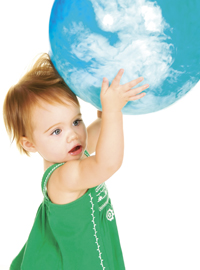 Green Baby? Been there, done that, worn the (stained) T-shirt and washed the nappies. But what happens when your little one begins to wise-up to hand-me-downs and reject yard sale toys? What do you say when they are desperate to have what other children have and hang the ecological consequences? How do you keep your children green? Green Baby? Been there, done that, worn the (stained) T-shirt and washed the nappies. But what happens when your little one begins to wise-up to hand-me-downs and reject yard sale toys? What do you say when they are desperate to have what other children have and hang the ecological consequences? How do you keep your children green?
Firstly, start as you plan to continue, so that your children are used to receiving toys without packaging (i.e. second-hand) or clothes without price-tags (passed on from friends). Emma, a mother of two from Harrogate, North Yorkshire in the U.K., says “I have a few friends at the school who have kids of different ages, so we tend to swap clothes and even shoes when they are outgrown. Sometimes we have a coffee morning and bring a bag of old clothes/toys and put them in the middle for pickings; the rest go to charity.”
Charity shops are perfect hunting grounds for home-ware, clothes and toys, especially those in the more well-off districts. “When my two were toddlers,” says Emma, “I would buy them a toy from the goodwill shop as a treat. We got some great bargains! My kids have never pestered me for toys as, luckily, they cherish all their toys, but that makes it hard to get rid of old ones. I have two toy boxes and we keep several toys out to play with and then every few months I empty out the toy boxes. The kids have fun seeing playthings they had forgotten about and we put the more recently played with items to the bottom of the box.” Alternatively, store toys in your attic or basement and swap toy boxes every now and then. This keeps children interested in the playthings they already own and makes it less likely they will want more.
Decorate their bedrooms with posters made from colorful wrapping paper, a collage of birthday cards, a collection of photos and, of course, their own artwork. This way they’ll have an individual space that reflects who they are, rather than a themed room depicting what a marketing executive has deemed they should be. Painted walls in a neutral color are a good idea, with a bright border (try end-of-line bins in decorating shops, or make your own “border” of postcards, photos and drawings). I made my daughter a sea creatures mobile and stuck silver-foil stars onto the ceiling. Perhaps a friend or relative could paint a picture for the wall. We have a framed nursery rhyme watercolor by my son’s late great-grandfather. Who says anyone needs matching curtains, duvet, rug and dimmer switch?
Involve your children in green-related tasks around the home. Emma’s children help with recycling yogurt pots, paper, etc. “They enjoy putting it into the appropriate bag and sorting it out at the end of the week. Sometimes, they take some of the cardboard boxes or margarine tubs to school for crafting. If we have a few big boxes, we flatten them out and they love drawing a landscape on them; my eldest likes to draw a military camp, my daughter likes to draw castles and fields, and my youngest son draws roads. Then they get their action figures/cars/dolls and play with them in the new land they made.”
Philip is a computer programmer and active cyclist. Although he is a car owner, cycling is his main means of transport. While your children are little and still open to suggestion, minimize car use as much as you can. He says, “Save on fuel costs, do your bit for global warming/pollution and get everybody fit. It’s a bit more effort with a toddler but it’s worth it. Get a light- weight foldable stroller” – he recommends you opt for a recognized brand so that it is easier to buy wheel replacements when they wear out – “and leave your car at home when making short journeys. Try to use local facilities as much as possible so that your journeys can be short but purposeful.”
Emma also leaves the car at home as much as possible. “If we are bored at the weekend, we have been known to spend the whole day walking around the nearest town and having a picnic. It is a nice way to appreciate where we live. The tourist information center provides treasure maps for a small fee. Sometimes, we take a video camera and make a film about it when we get home.”
Many of us will remember the “adventure” of riding on buses and trains as a child, and how the view always seemed better from the back seat of a car. “Children also love bikes,” adds Philip. “A child seat on the back of your bike is great if the journey just too far to walk. As soon as they are big enough to ride little bikes of their own beside you on the cycle track, you’ll find you can travel much further on foot than they can walk.” This increases your chances of getting out into the countryside, or to bigger town parks, museums, libraries or galleries.
Phillip’s children traveled on the back of his bike from six months to about four years old. “We had a bike trailer for a while too. It wasn’t as popular as the seat on my bike but made it possible for me to tow two kids at once. They had two-wheeled bikes with stabilizers once they were about three and got rid of their stabilizers by school-age. Now, at eight and 11, they enjoy bike rides of up to about 20 miles on quiet roads. We’ve found all the best children’s play areas in the villages around the district for stops on the way.”
As Phillip points out, “Sustainable transport will be an ingrained habit that they will hopefully continue into adulthood.”
Nurture children’s interest in living things. Remember the endless renditions of “Old MacDonald”? And the (perhaps now rather embarrassing) memory of showing off your child’s grasp of animal sounds to anyone who would listen? Build on the “What does a cow say?” “Moo!” and encourage an interest in garden creatures, farms and wild animals (both native to your country and beyond). As well as observing creatures in your own back garden, and learning about them, your children may be inspired by visits to working farms. Emma has a friend who buys potatoes and eggs from a local farm; “We take it in turns to drive up there and take the kids to see the animals, and then we share out the produce as a whole sack of potatoes is too much. It costs us half as much and only takes one car to make the journey.”
Further afield, why not get your family involved in protecting a threatened species, such as whales and dol- phins? Many charities maintain online shops, which are ideal for birthday presents for your children or for their friends, and have suggestions for actions you can take to help the endangered species.
Encouragement is key to developing a green attitude and green thumbs in young children. It can sometimes be difficult to motivate children to get outdoors into the fresh air or stop playing on their Wii. Much depends on the child’s age: A toddler will quite happily follow mommy or daddy out into the garden and enjoy messing about in the dirt or helping to plant, but older children sometimes need a bit more encouragement or persuasion.
The earlier you start involving your children in garden-based eco-tasks and activities, the more they will accept it as part of everyday life. Try to involve them in the decision-making about what fruits, vegetables or flowers they would like to grow. Emma made her own vegetable patch last year and her children enjoy planting different vegetables, maintaining the patch and then picking it all to eat. “They have their own plots to plant sweet corn (fast growing for impatient kids!) and sunflower seeds. We invested in a couple of garden implements for them and they enjoy digging the borders and sweeping cuttings.” Even more importantly, children should be shown what fun they can have outdoors in the fresh air, playing, using their imagination, learning about nature, insects and birds, and sharing their outdoor experiences with their parents.
A powerful step is to avoid commercial television so that children see fewer advertisements. That way, they don’t long for toys, games etc that they were previously quite happy not knowing about. In addition, it helps to reduce their exposure to completely unrealistic and unobtainable portrayals of human beings and lifestyles, in the name of marketing.
Clearly, there is a time and a place for television. I know some parents have jettisoned their television sets, but it can be a valuable stand-by to enable you to cook a meal, for example. Given the choice between a microwave ready-meal while the kids play round my feet in the kitchen and a pasta dish cooked from scratch while they watch Thomas the Tank Engine, I know which I would opt for. Having said that, I would not allow either child to have a television or computer in their bedroom. By recording children’s television programs, you can control your children’s exposure.
Secondhand shops and freecycle are excellent source of videos and DVDs suitable for children, not forgetting your local library. Offer your children a choice between two programs that are appropriate to the moment.
Many parents feel targeted by advertisers and, indeed, the desire to make one’s child happy is a powerful marketing tool. But the pressure to buy conflicts with the values we want to instil in our children – values like individuality, critical thinking and sustainable living. Finding the balance between what our kids want, what they need and what’s available is difficult.
The home environment is where we have choice and it is up to us to decide what is appropriate for our children. One thing many parents have begun to do is to avoid buying both plastic and branded goods, and to request that friends and family buying presents do the same. When children are very young, it is good to get into the habit of saying that birthday gifts are not necessary, but if people do wish to buy a present, then ask please could they avoid plastic and instead buy something previously-owned and wearable or readable. That way, the child grows up and doesn’t expect to have the (battery-operated) “moon on a stick” every Christmas and birthday. “Sometimes friends do pass on toys that we would never buy,” says Elsa, “but Daisy loves them and it would be churlish to refuse. It’s not that I want to keep her from the outside world, but I think there are better things to do and play with than the standard Babybjorn/Barbie/Bratz combo.” However, often the “best” choices are also the most expensive.
Nevertheless, eco-parents try to encourage individuality over fads. Whilst brands boost the profits of multinationals, they do restrict choice and creative thinking. Children need to learn creative skills, ways to amuse themselves in times of boredom without having to pester their parents to buy something. We also need to help them understand that, although television can be fun to watch, it is designed for a reason and often that reason is actually to sell products or ideas.
Resisting the urge to spend for the sake of convenience or pleasure is difficult for parents as well (especially when accompanied by a toddler). One way to cut pester power and associated purchases is to shop online or to frequent smaller independent stores.
Linda, a breastfeeding counselor, agrees that “if you start off on a good footing with lots of cuddles and attention instead of lots of television and junk food, they are less likely to hanker after the bad stuff.” She urges all parents to lead by example. “If you are growing your own, avoiding plastic bags, walking everywhere, etc., then your children are learning from watching you.” Children will pick up on the brands you favor and whether you buy things to cheer yourself up, and will copy you. My three-year-old is so used to rummaging in goodwill shops with me that she expects to find everything there (“Do you think they will have a snowsuit for me this time, Mummy?”), is quite used to leaving the shop empty-handed and assumes all clothes I wear are second-hand (“Who did those jamas used to belong to?”). Blacking out logos on items or customizing things to give them an original look makes an anti-consumerist statement.
The best we green parents can hope to do is to try and live the values we want our children to learn, for their sake and for the sake of the environment. It isn’t always easy to run only one car, to eliminate processed foods or to try to buy locally. But if we don’t live according to our eco-principles, how can we expect the future generation to do the same?
A stay-at-home mom by day and a writer by night, Alison Bayne is married and lives in Harrogate, in the North of England, where she enjoys rising to the dual challenge of mindful parenting and living an eco life on a budget. Previously employed in industries as diverse as law, healthcare and education, she has found motherhood to be the only job she’s ever been much good at. Amidst rising utility bills and food prices, Alison is now thankful for her dad’s insistence throughout her childhood that lights be turned off, doors shut and extra sweaters worn. Last year, she grew vegetables in her back yard for the first time and dreams of meeting the challenges of the buy nothing lifestyle.
|