A Straw-Clay House That’s Inspired by Nature
by Wendy Priesnitz
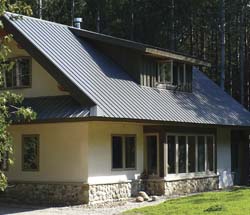 Locally-sourced natural materials and hand labor combine with inspired design to create an attractive, sustainable and healthy timber-framed straw-clay "EcoNest." Locally-sourced natural materials and hand labor combine with inspired design to create an attractive, sustainable and healthy timber-framed straw-clay "EcoNest."
A bird builds its nest using the materials at hand to create a shelter that’s highly relevant to its bioregion. And that’s the model used by Robert Laporte and Paula Baker-Laporte, a pioneering natural house designer and builder who helped to create one of their EcoNests an hour-and-a-half northwest of Toronto.
The New Mexico-based Robert Laporte is a timber framer, natural house builder and teacher who used to live in Sudbury, Ontario. Paula is a University of Toronto-trained architect, baubiologist, and author specializing in healthy and ecological design.
Their elegant, hand-crafted EcoNests – one of which was featured on the September/October 2008 cover of Natural Life Magazine – embody the principles of sustainable building, health and beauty. They utilize natural building techniques that include timber framing, straw-clay walls, earth plastering and natural, non-toxic finishes. Paula and her team at EcoNest Design work with clients to design their dream eco-homes. Robert and his team at EcoNest Building build the shells and special home features. Together, they teach four-day workshops, which create the straw-clay walls for clients’ homes.
The EcoNest they helped create in Ontario this past summer is located at the Riverstone Retreat Centre. Local timber-framer Joshua Thornton was the instigator of the project. He is the author of a recently completed research report on straw-clay building for Canada Mortgage and Housing Corp. and suggested the concept to owners Ernie and Edith Martin, who wanted a highly ecological structure. Other collaborators were local architect David Macaulay and local builder Randy Martin, in addition to the owners. But Thornton says that “none of this would have been possible without the enlightened, progressive professionalism of our local building inspector Ray Holliday, and sewage inspector Les Mackinnon on behalf of the municipality of West Grey.”
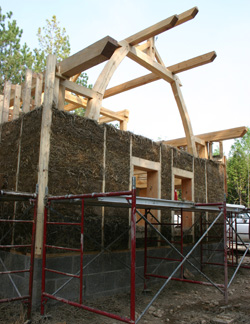
EcoNests are made by combining loose clay, loose (not baled) straw, wood chips and water into a slurry that is lightly packed between wooden slip- forms. When the loose straw is combined with the slurry, the clay coats the straw in a protective mineralizing coating, which adds longevity to the fiber. After the walls cure for two or three months, they are plastered using an earth plaster mix, both inside and out.
One of the principles behind ecological building is the use of locally-sourced materials. Both the straw and clay, as well as the giant beams that form the frame and the stone for the facing that matches the other Riverstone buildings came from the property on which the EcoNest is situated. In total, the building used 85 percent low-processed local (within 40 kilometers) materials. 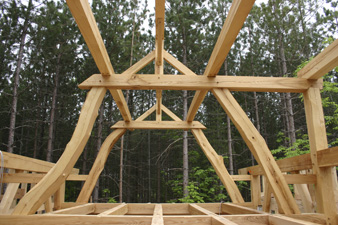
Foundation
The foundation walls are made from Durisol, a locally made product composed of specially graded recycled wood shavings and chips, which are neutralized and mineralized, then bonded together with Portland cement. It can be molded to suit any desired shape, texture and thickness and, in this case, was used as an insulated concrete form (ICF). Manufactured with a mineral wool insert, these ICFs achieve R 20 and significantly reduce the use of concrete. Durisol is a vapor permeable wall system which requires no vapor barrier and, therefore, is congruent with the “flow through” properties of the straw-clay walls.
Timber Frame
The timber frame was designed by Thornton, who was also the lead timber framer on the project. It is made predominantly from local white ash milled by local Mennonite Dan Shetler. The planed timbers were oiled with Ontario-grown hemp oil.
All of the natural curves were sourced from the fencerows of the Riverstone Property. Otherwise overlooked for their structural value, these pieces would normally only be considered valuable as firewood.
Thornton says the timber frame is influenced by two traditions – the Welsh “Cruck” frame typology, and the German “Liegenderstuhl” – to produce a frame which is both beautiful and functional.
Straw-Clay Walls
Once the timber frame was in place, the straw-clay walls were constructed by 20 students who paid to learn the procedure at an on-site workshop led by Laporte and Thornton.
Thornton’s CMHC report notes that straw-clay has an average R-value of 1.6 per inch (about R-20) for a 12-inch wall with plaster skins. These walls are designed to be a “flow through” wall assembly. Flow through wall assemblies are very vapor permeable but air tight. This is sometimes referred to by the layperson as “breathable.” Straw-clay walls contribute to excellent indoor air quality helping to balance the indoor relative humidity during heating periods. Dry indoor climates lead to dry mucous membranes, the body’s first line of defense against virus and bacteria. Further, the effective movement of moisture helps to control molds and mildews and the clay entrained in the wall filters out pollutants.
Heat and Insulation
The roof is insulated with a water-blown spray foam called Icynene that creates a continuous air barrier, minimizing both air leakage and the intrusion of outdoor allergens and pollutants. Icynene has been used in LEED Platinum certified buildings, emits no VOCs, contains no ozone-depleting substances and does not off-gas over time.
Heat in this EcoNest comes from a masonry heater custom designed by local master stove builder Alex Chernov. In a masonry heater, energy from a short, hot fire is stored in the thermal mass and then slowly radiates into the house for the next 18 to 24 hours. It is by far the cleanest way to burn cordwood.
Interior Finishing
The straw/clay walls are plastered with an earthen plaster sourced 50 feet from the building. The walls are painted with a silicate dispersion paint, also known as inorganic mineral paint. It was developed in Germany in the late 1800s, is anti-microbial without fungicides and very vapor permeable. All interior partitions are made of wattle and daub construction, an ancient method utilizing woven twigs covered with earthen plaster. Their high thermal mass acts as a secondary heat sink for the masonry heater.
The second-story floor is made from reclaimed maple hardwood, as is the maple trim. All soffit tongue and groove is red pine from the site. The interior doors are white ash.
The kitchen counters and patio floor are made from marble and limestone produced from high density local dolomite that features distinctive colors and patterns.
Laporte says there are straw-clay homes that are still standing after 800 years in Germany and he believes an EcoNest will last for centuries.
Cost
Thornton says the EcoNest cost a very competitive $200 per square foot to build, including a calculation of the owners’ sweat-equity at $20 per hour.
Learn More
EcoNest, Creating Sustainable Sanctuaries of Clay, Straw and Timber by Paula Baker-Laporte and Robert Laporte (Gibbs Smith, 2005)
Wendy Priesnitz is Natural Life's editor, and a journalist with over 40 years experience. She is also the author of 13 books.
This article was published in Natural Life Magazine in 2008.
|