A Dome for a Home
by Rolf Priesnitz
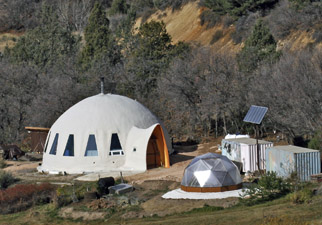
Photo © Judy Crawford/Shutterstock |
Domes are common public structures, being used in government legislature buildings, sports complexes and religious buildings…even as covers for road salt. As homes, they are less common, although the igloo is a notable exception. And that’s too bad, because domes are incredibly strong structures that enclose a volume of space more economically than conventional architecture that is based on squares and rectangles.
In a dome, the roof and exterior walls are integrated into a continuous curved surface, which removes the need for the space- and material-wasting interior support walls and attic. Dome dwellers also enjoy more efficient and less expensive use of heating and cooling resources, since a dome’s decreased surface area allows less heat to escape in the winter and infiltrate in the summer, and air circulates naturally in a round structure.
Geodesic Domes
All domes are rounded, but in the U.S. in 1954, Buckminster Fuller patented a design, called “geodesic,” which applied triangles to dome construction. The Buckminster Fuller geodesic design has inspired many famous dome structures including Epcot Center in Florida, the American pavilion at the 1967 Montreal Expo, as well as the Windstar Foundations Bio-dome in Snowmass, Colorado, a 50-foot diameter structure that grows approximately 4,000 pounds of fruits and vegetables year-round.
Bucky’s method of building a dome uses much less material and allows the spanning of greater distances than ever before. The large amount of lumber used in conventional construction creates a lot of weight, which requires more concrete in the foundation, not to mention wasting trees. Since triangles are the most rigid shape known, the geodesic dome is extremely strong, although light weight. Geodesic domes have been wind-tunnel tested to withstand 200 mph winds and can withstand heavy snow loads.
There are two methods of building a geodesic dome. They are hub-and-strut and panelized. (The geodesic dome pictured right is by Timberline Geodesic Dome.)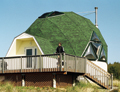
Hub-and-strut domes use aluminum or steel for the hubs and wood, conduit or even bamboo for the struts. They are delivered in kit form for relatively easy assembly. The skeleton is assembled, followed by the interior covering of the triangles and the application of insul- ation, then the exterior decking. Construction involves scaffolding and much crawling around on the exterior surface.
A panelized system is less do-it-yourself, with much of the dome being prefabricated off-site before installation. It is also possible to add insulation to the panels before assembly. Measurements tend to be more exact using this method, resulting in fewer of the leaks common to geodesic domes.
Concrete Domes
Concrete or monolithic (mono = one, lithic = stone) domes are made of one material (often shotcrete, ferro-cement or other concrete) applied over a dome-shaped form. Concrete lends itself to free-form structures, resulting in some highly imaginative and artistic shapes.
There are a number of types of monolithic domes commercially available, and some hardy do-it-yourselfers have been doing it themselves since the back-to-the-land era.
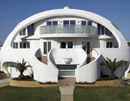 The company Monolithic Constructors, Inc. uses a patented air bubble form, which is a tarp made of single-ply roofing material attached to a pre-poured footing and inflated. Three inches of polyurethane foam is sprayed onto the inside of the “Airform,” then a grid of steel rebar is placed into the foam and embedded in shotcrete. Shotcrete is a process where concrete is projected or “shot” under pressure using a feeder or “gun” onto a surface to form structural shapes. (The Monolithic dome pictured left is courtesy Valerie Sigler.) The company Monolithic Constructors, Inc. uses a patented air bubble form, which is a tarp made of single-ply roofing material attached to a pre-poured footing and inflated. Three inches of polyurethane foam is sprayed onto the inside of the “Airform,” then a grid of steel rebar is placed into the foam and embedded in shotcrete. Shotcrete is a process where concrete is projected or “shot” under pressure using a feeder or “gun” onto a surface to form structural shapes. (The Monolithic dome pictured left is courtesy Valerie Sigler.)
Other companies create a sort of amalgam panelized geodesic concrete dome using prefab lightweight cement triangular panels to make a sort of geodesic igloo. A wood dome frame may also be used as a support structure for creating a rebar framework to which stucco or spray-on concrete roofing may be applied. Also possible are ferro-cement domes. Ferro-cement is a labor-intensive technique most commonly used to build boats. It employs a free-form frame of rebar, chicken wire-type mesh and lathing tightly wired together and covered with a cement mixture.
Although concrete domes can be highly energy efficient and durable, concrete is a somewhat problematic material. Cement is the principal ingredient in concrete and its manufacturing is a source of greenhouse gas emissions, accounting for approximately seven percent of carbon dioxide globally and 1.8 percent in Canada. The cement industry has made significant progress in reducing CO2 emissions through improvements in process and efficiency. And there is now concrete available that replaces cement with other materials such as fly ash, which is a by-product of coal-fired power plants.
Further improvements are limited because CO2 production is inherent to the process of calcinating limestone, a chemical reaction that happens in a cement kiln and is basic to the production process. Also, heating the kiln to 2,700 degrees F, usually by burning coal, requires an enormous amount of energy and releases not only CO2 but nitrous oxides, sulfur oxides and particulates.
For their part, proponents claim that concrete is a sustainable construction material because its impact is positive in terms of resource depletion. Also, domes built with concrete are energy-efficient, aren’t attacked by rot or termites and will withstand harsh weather.
Unfortunately for the eco-rating of cement domes, there are also concerns related to the use of polyurethane foam insulation. Several varieties of spray insulation require flame retardants in order to meet fire safety standards. The brominated flame retardants like penta-BDE that are commonly used in polyurethane foam products are controversial due to their dramatically rising levels in human breast milk. In research on animals, penta-BDEs have been shown to damage the liver, harm developing brains and lower thyroid hormone production. Although banned in Europe, they are still used in North America and no labeling is required. So if you’re going to use foam insulation – which tends to be more energy efficient – be sure it’s also healthy! Recycled spray-on cellulose is a good choice.
Gardening Domes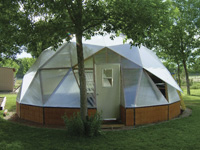
Geodesic domes make excellent greenhouses because of their energy-efficient shape, 360-degree sun exposure, abundant growing space and relative low cost. Dome greenhouses tend to be portable and, due to their light weight, don’t require a poured foundation – or a building permit in most areas. That makes them an excellent introduction to domes if you contemplate one to live in.
Properly insulated and situated, with the addition of heat sink like a water tank, a 16-foot dome greenhouse, like the Growing Domes model (right), can produce enough food to feed two to three adults, even in sub-zero temperatures. Or, there are kits on the market for free-standing domes that, like an old-fashioned plant cloche, can be moved around the garden to improve the growing environment for different plants in different seasons.
Making it Happen
Building a dome home can be more complicated than building a conventional structure. The building industry, your local municipality and mortgage lender may or may not be familiar with alternative structures, so be sure to plan lots of extra time to deal with these issues. Some experts suggest doubling the time you think will be required to acquire blueprints, financing, building permits, contractors and subcontractors.
Conventional mortgage lenders tend to be ultra-conservative when considering a dome. If you are applying for one, do your homework, including budgets, building code approvals, insurance commitments and, if possible, engineering or architect signatures. Many of the dome companies have engineer-approved plans that will help you get financing and building department approvals.
Construction loans are notoriously difficult for individuals to acquire. An appraiser will determine a value for the finished house, based on your plans, in addition to appraising your land; if there are no domes in the area, determining a value will be difficult. Mortgage brokers or indirect sources for financing may be more flexible. Refinancing other property or acquiring loans from other sources may be easier, while avoiding the requirements of conventional construction loans. Another popular option is the pay-as-you-go method.
A dome is generally a safe, low-risk structure, but you’ll have to convince your insurance company of that fact. So, once again, gather all the engineering data you can prior to contacting your agent. However, dome owners say it’s worth all this preparation to have a dome for a home.
Learn More
Illustrated Dome Building: Step-by-step Complete Plans by Gene Hopster (Hexadome America, 2005)
Home Work: Handbuilt Shelter by Lloyd Kahn (Shelter Publications, 2004)
Dome Living: A Creative Guide For Planning Your Monolithic Dream Home by David B. South (Monolithic Dome Institute, 2000)
The Dome Builder’s Handbook by John Prenis (Running Press, 1988)
Passive Solar Dome Greenhouse Book by John Fontanetta (Storey Books, 1979)
Domebook One edited by Lloyd Khan (Pacific Domes, 1970)
Rolf Priesnitz is Natural Life Magazine's founder and publisher. He also has over 50 years experience in the construction industry.
|