Babywearing: A Natural Fashion Statement
by Andrea McMann
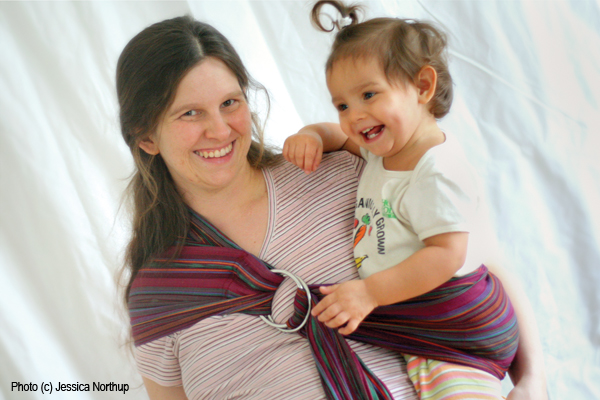
Babywearing is a growing trend these days, but it is as old as humankind. Although the actual term was coined by the author, pediatrician and attachment parenting proponent Dr. William Sears, baby carriers likely evolved very early in human history. "Perhaps…the need to support an altricial (completely helpless) newborn may even have contributed to the evolution of bipedalism (walking on two legs),” says Katherine Dettwyler, PhD., a professor of anthropology at the University of Delaware. “And some people have suggested that the first ‘tool’ made by early humans was some sort of sling or net carrying device.” She goes on to explain that the earliest baby carriers were probably made of animal skin or plant fiber nets – “both things that do not preserve in the archeological record.”
If babywearing has been around so long, why isn’t it more common now? Dr. Dettwyler theorizes that, long ago, women of higher classes ceased wearing their babies as a status symbol. “Only the wealthy could afford prams (or) carriages and where would they be going except to take the baby out for sunshine and fresh air – and the wealthy would likely have the servants do it.”
Thankfully, babywearing is beginning to make a comeback and Susie Spence, president and co-founder of Babywearing International, believes that the Internet has played a vital role in its re-emergence. “Before high-speed Internet access was prevalent, access to baby carriers was, for most people, limited to what was available in their local big box stores,” Spence says. “E-commerce has radically changed the market for baby carriers and the overall effect has been very positive.”
However, Spence says that she thinks it is liberating to think of babywearing as a parenting skill rather than as a function of a purchased baby carrier. “People all over the world carry their babies in pieces of fabric fashioned into slings simply by tying a knot.”
Babywearing Safety
While babywearing can be tremendously liberating, certain safety guidelines should be observed.
“This may sound obvious, but babies need to breathe,” says David Kaufman, M.D., a pediatrician with Children’s Physicians of Omaha, Nebraska. “Make sure your infant is able to breathe through their nose when babywearing.” That means her chin shouldn't be resting on her chest and she shouldn't have her face buried in fabric.
Position your infant so that his head is higher than the rest of his body and his head is supported.
Only use a sling that fits your body size and adjust it so that you can see your baby at all times and, as some experts put it, so that she is riding high enough that you can kiss her.
Never cook or handle hot liquids or sharp objects while wearing your baby.
Adjust your carrier correctly, making sure your posture isn’t compromised.
Do not bend at the waist. Instead, squat using your legs. This will save your back and keep your baby from falling out of the carrier. |
Why Babywearing?
In 1986, researchers Hunziker and Barr found that babies who are worn cry forty-three percent less than babies who are not worn. In a 1991 study conducted at Columbia University, mothers with infants were given either plastic carriers or soft carriers. After a year, eighty-three percent of the babies who were carried in the soft carriers were determined to be securely attached to their mothers (in the psychological sense), whereas only thirty-eight percent of the plastic carrier babies were securely attached.
David Kaufman, M.D., a pediatrician in Omaha, Nebraska, says that babywearing makes the transition to life outside the womb easier for newborns. “The majority of infants have just spent the past nine months in an environment that is in constant motion with a constant level of varying noises – from the beat of mom’s heart to the churning of her stomach, it is a noisy place to be! It is, therefore, very logical that infants will be calmer when in immediate contact with their care provider and in relatively constant motion.”
The skin contact provided by babywearing is also crucial to a baby’s health and development. “Researchers have found that infants who are touched and carried more produce more immunoglobin, which protects against respiratory infections. Touch improves intellectual and motor development immediately from birth,” says Barbara Nicholson, co-founder of Attachment Parenting International. “It also helps regulate a baby’s temperature, heart rate and sleep/wake patterns, especially when baby is held skin-to-skin. These babies not only gain weight faster, but they nurse better, are calmer, and are able to be more quickly soothed when they cry.”
For Toddlers Too
Carriers don’t lose their usefulness when babies learn to walk. Toddlers are heavy and can sometimes be clingy. Babywearing saves parents from aching backs and sore arms. Plus, as Nicholson discovered, carriers can keep curious toddlers out of trouble. “I loved having a carrier with me if we were in a store that had many temptations like delicate breakable things.”
Baby carriers can also help siblings bond. Terri Korthase often wore her second child when she played with her son, who was two at the time. “When she was in the carrier, she was right between us when we were playing,” says the Riverdale, Michigan mom.
Lysa Parker, also a co-founder of Attachment Parenting International, says that although toddlers are more independent than younger babies, babywearing is still a welcome source of comfort. “It is healthy and a good sign to see toddlers play independently, then frequently go to their mother or father to touch them, show them a toy or seek comfort, then happily run off to play again. If they have been carried since birth, they will immediately associate carrying with feelings of warmth, safety, and love.”
Free Yourself
One of the best things about babywearing is how much the parent can do with his or her hands free. “In today’s busy world, babywearing helps parents to take care of their baby while managing the tasks of life: making a phone call, doing a load of laundry, getting some exercise,” says Ann Seacrest, a lactation consultant in Lincoln, Nebraska.
It’s amazing what a parent can accomplish while the baby snuggles comfortably in a carrier! California mom Nicole Bovey used her carrier when traveling by plane. “I found it wonderful to put the baby in the sling and to have my hands free for handing over tickets, paying, and dragging carry-ons,” she says.
Alan Davis, a database programmer from Crete, Nebraska, is a babywearing father of six. He says, “I feel a father has to be as much a participant in child raising as the mother. Heck, even more so, because in the ‘traditional’ family model, Daddy is gone ten hours a day. He needs to make up some of that lost time, and lugging the baby along in a chestpack or backpack is definitely a step in the right direction.”
Babywearing fathers enjoy a close bond with their children and often have little sympathy for men who are afraid that they’ll look foolish wearing their babies. As Damon Smith, a produce operator in Saskatoon, Saskatchewan, succinctly states, “Suck it up, princess. It’s your child too.”
The most important thing to remember when choosing a baby carrier is that everyone is different. Each person has unique likes and dislikes. “Don’t give up until you find something that works for you!” says Andrea Gilliland, owner of No Mother Left Behind. “All babies love to be worn, but it can take some time to find a carrier that is right for you.”
Like breastfeeding, babywearing really is best for babies. It is a vital tradition that has been passed down from our earliest ancestors, an ancient art that still holds tremendous value.
Andrea McMann is a freelance writer from Nebraska. She discovered the joys of babywearing when her second child was born and has never looked back. In addition to babywearing, she is an advocate of co-sleeping, extended breastfeeding, and gentle discipline.
|