A Sense of Place
Sustainability is More Than Solar Panels -
It's Also About How People Interact
by Wendy Priesnitz
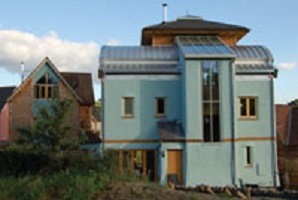 Living Villages, the developer of The Wintles and a number of other similar projects in the U.K., works on the principle that sustainability is achieved through the way in which homes are clustered and interact – it is the external and internal spaces of individual homes that influence community, people, and relationships and, therefore, the way in which resources are used. The company believes that by engaging in their community, people are more likely to live in a way that benefits society, both socially and environmentally, and that this is key to reducing carbon emissions. Living Villages, the developer of The Wintles and a number of other similar projects in the U.K., works on the principle that sustainability is achieved through the way in which homes are clustered and interact – it is the external and internal spaces of individual homes that influence community, people, and relationships and, therefore, the way in which resources are used. The company believes that by engaging in their community, people are more likely to live in a way that benefits society, both socially and environmentally, and that this is key to reducing carbon emissions.
Living Villages began life as The Living Village Trust, set up in 1994 with the aim of researching and building houses and neighborhoods that are both eco-friendly and convivial to live in. The Trust actively researches how to design inspiring places by looking at successful examples around the world, new and old, which have the qualities that matter to it. Living Villages Holdings (LVH) was established in 2006 to create Living Villages schemes nationally in response to huge public and industry interest.
Sustainable Construction
Each of the homes at The Wintles is built facing towards the sun and, to draw in and trap as much light and solar energy as possible, large, high performance, double- or triple-glazed argon-filled windows. There are interior “sun spaces” and inside balconies so that with the sunlight flooding into the homes and their warm, dry interiors, residents feel like they’re living in a Mediterranean climate. This contributes to the sense of well-being, creativity and comfort that residents claim to experience.
To keep heat within the highly draft-proof building envelope, a 300mm thick layer of “Warmcel” insulation, produced from recycled newspapers, is vacuum-packed into a membrane in the wall cavities.
When the houses are occupied and functioning as busy family homes, they require very little energy for heating and are designed to maximize its effectiveness when it is used. Should it be necessary, heat is released into the home by means of gas-fueled underfloor heating in the areas where it is most needed, such as living rooms and bathrooms. It then permeates upwards through the less frequently used areas, like the bedrooms, which are unheated by any direct means. This general principle has been called “the thermal onion,” meaning that heat is released into the centre of the onion and gradually moves outwards, thus heating the outer layers to a lesser extent – and the outer layers serving to insulate the inner. For those who like a real fire in the winter, flues are installed for wood-burning stoves.
Heat recovery systems extract the warm, moist air from bathrooms and kitchens and collect the heat. The stale air is vented outside while the collected heat is transferred, via a heat exchanger, to the fresh air coming into the building. This is distributed through vents to the bedrooms and living rooms at a constant, comfortable temperature.
| The clusters of cutting-edge eco houses are one good reason to move to England’s bucolic Shropshire countryside. But The Wintles housing development combines modern high-tech energy efficiency with old-fashioned values like conviviality and neighborliness. |
Hot water is provided through the use of solar panels, although the gas condensing boilers, which supply the underfloor heating, can also provide a boost to water temperature should it be necessary. Residents can usually obtain at least sixty percent of their domestic hot water needs over the year and up to 100 percent in the summer from solar energy.
Photovoltaic systems are employed to generate some of the electricity required by residents. The electricity is supplied by Good Energy, which provides 100 percent renewable electricity sourced from the natural energy of wind, sun or running water.
For the health of the planet and those living with the homes, Living Villages endeavors to use paints and other materials that are free from toxins or harmful products of the petro-chemical industry.
The houses are manufactured off-site using double skinned timber frame panel systems and, once on site, the individual components can be erected quickly. Such systems reduce waste and help raise standards of construction quality.
Wherever possible, timber used in construction is from sustainable sources and carries FSC (Forestry Stewardship Council) certification. Living Villages has also planted thousands of trees – including fruit trees – around the perimeter of the site to give protection and envelop the development in a natural cocoon.
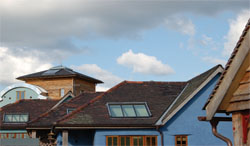 Sand, gravel and lime are locally sourced to save energy being used in transport. Sometimes cement has to be used for practical reasons but, wherever possible, Living Villages uses lime instead. Lime has been used as a building material for thousands of years and, although energy and carbon dioxide are used in its production, it turns back to limestone over time, absorbing carbon dioxide in the process. Reclaimed materials, particularly bricks, slates and roof tiles, are used wherever possible. Sand, gravel and lime are locally sourced to save energy being used in transport. Sometimes cement has to be used for practical reasons but, wherever possible, Living Villages uses lime instead. Lime has been used as a building material for thousands of years and, although energy and carbon dioxide are used in its production, it turns back to limestone over time, absorbing carbon dioxide in the process. Reclaimed materials, particularly bricks, slates and roof tiles, are used wherever possible.
The houses at The Wintles are designed to be flexible, taking into account the changing needs of families over the years. Internal stud walls can be moved to alter the size of rooms as families grow and shrink in size. Mindful of the development’s rural location and the polluting aspects of commuting to work, the designers have provided flexible room layouts and broadband wiring to encourage working from home.
A Sense of Place
Living Villages’ determination to create a village-like and neighborly environment – a sense of place – has been spawned from years of research by The Living Village Trust. The Wintles includes land that is shared by the residents and used for recreation, gardening, sport, woodland, orchards and allotments. Each household has an automatic share in the ownership and control of these areas via a residents’ management company.
This company operates in the same way as a conventional management company for people who live in apartments with a shared lobby or facilities such as a gym. When the development is completed, the residents take over the ownership and control of the shared areas of the site.
Through the management company, residents are empowered to do things like set up car sharing; bulk-purchase telephone time or power supplies from green sources; organize local food supply chains, childcare or care of the elderly; and build new facilities like health clubs. Each of the households has the opportunity to participate in the running of the residents’ company and to vote on suggestions made. 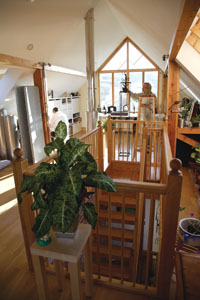
The Living Villages model is to build communities of between 35 and 85 houses in clusters of 12. Each cluster is centered on a village green so that neighbors may come together, get to know one another and have a central focal point in which communal activities can take place. It also enables children to play in a safe and supervised area. Vehicle parking is positioned away from the village green, encouraging people to walk and making the development an even safer place to be, especially for children playing.
Porches are a feature at the front of each home. Open porches allow residents to sit outside on wooden decking and overlook their neighborhood, chatting with neighbors, watching children play or dogs being taken for a walk.
The Wintles is only a few minutes’ stroll from the centre of the old market town of Bishop’s Castle with its population of 2,500, a well-earned reputation for hospitality, public events and festivals, as well as sports facilities, restaurants, pubs and shopping. A twice weekly market, dating back some 200 years, still takes place.
This combination of technology and community is what an eco-community is about, whether it’s rural or urban.
Living Villages Eco-Community Principles
- An eco-community should have no more than 10 to 12 households; the wider neighborhood should have only 40 to 70 households.
- Homes must be designed to accommodate a full range of households and types of people.
- Front doors should face each other on a circular communal area.
- Cars should be banned from the front-door area and not be allowed to drive directly through the eco-community.
- Developments should have land set aside for woodland, orchards and food gardens.
- The houses should be ultra-energy efficient, include passive solar design and wood-burners for heating.
- Designs should reflect the local vernacular and be made as much as possible from local materials.
- The design should encourage residents to stay for their lifetime and work for the next generation of their family, too.
|