Living and Working Off-Grid
Natural Life Editor Wendy Priesnitz talks to Cam and Michelle Mather
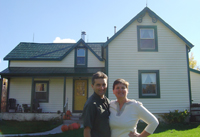
 Cam and Michelle are partners in Aztext Press, which publishes books and multimedia materials about renewable energy and sustainable living. They operate their business from an off-grid home on the family’s Sunflower Farm in rural eastern Ontario, Canada. Cam and Michelle are partners in Aztext Press, which publishes books and multimedia materials about renewable energy and sustainable living. They operate their business from an off-grid home on the family’s Sunflower Farm in rural eastern Ontario, Canada.
NL: First of all, tell me about the off-grid home you’ve lived in for the past decade or so.
Cam: The home was built in 1888, and renovated by the previous owners. It’s located on 150 acres surrounded by lakes and bush north of Kingston, Ontario. We also have a guest house the previous owners built, which houses our office, a garage and several extra bedrooms. Ninety percent of our electricity comes from our solar panels, five percent from the wind and five percent from our gasoline generator that we run in months with little sun or wind, like November and December.
Michelle: Despite this being a century-old farmhouse and off the grid, we have all of the conveniences of a modern home, including satellite Internet and a satellite dish for our TV. In that sense, our home is a wonderful blend of old, traditional styling with modern sensibilities.
NL: Why, how and when did you become interested in renewable energy?
Cam: The house is about $150,000 from the nearest utility pole, so the decision to go with renewable energy was an economic one! As our family became more environmentally aware, it was a logical progression to look at where our energy came from. We had already reduced our garbage to one can every eight weeks for our family of four, walked and cycled as much as possible, ate a vegetarian diet from as many local sources as we could, and started looking at the impact of electricity generation. Ontario’s power is still 25 percent coal that has horrible implications for greenhouse gases, and the 50 percent of the electricity produced by nuclear power is leaving a legacy of waste for future generations that we fundamentally disagree with.
NL: Was moving to the country a big step for you and your family? 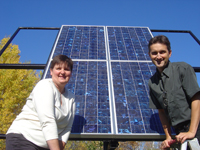
Michelle: Yes, it was an enormous step! Moving away from friends and family and the support system that they provided was scary. We were home- schooling our two daughters at that point and we left behind a wonderful network of other homeschooling families. Also, we were accustomed to being able to walk to a grocery store, the library and other necessities. Now our nearest neighbor is four kilometers away (and a long-distance phone call!). When we first moved here, our closest grocery store was a half-hour drive away. (Luckily one has opened up in our village, 13 kilometers away.)
Cam: It was terrifying. We were moving three hours from the customers who supported our electronic publishing business, to a place that was powered by the sun and wind. Although we did have six months to get the house prepared with a phone and Internet system, it was still the craziest thing we’ve ever done.
Michelle and I are a writing our first book, called Off-the-Grid Without a Paddle. It was a huge leap of faith and, like so many things, the risk exemplifies the reward.
NL: What were the adjustments to attitudes and behavior that your family had to make to accommodate the renewable energy systems?
Cam: Living off the grid is fantastic but challenging. Not knowing anything about electricity when we moved here was a huge opportunity to test our belief in “lifelong learning,” which we had developed as we homeschooled our kids.
The steep learning curve was an excellent opportunity to put that theory into practice! In terms of lifestyle changes, with the system we inherited from the previous owners we came to the realization that like everything on the planet, our electricity supply was finite. Some days there wasn’t enough electricity in the batteries to waste on powering the TV. So we made sure that what electricity we did use, we used efficiently.
Michelle: Luckily, we had been energy conscious even in our old, on-grid home. We chose to be energy efficient back then. And when you live off-the-grid, you must be energy efficient!
NL: Besides utilizing solar and wind power, are there other sustainable aspects to your lifestyle on Sunflower Farm?
Cam: We have found that our activities more closely mirror Nature and the weather. On sunny days we do laundry, both because it means we’ll have lots of power for the washing machine and to pump water, but also to dry everything on the clothesline. While a lot of off-grid people use propane dryers, we felt that using a non-renewable resource for an activity that can be done with the sun and wind is wasteful, inefficient and wears out your clothing more quickly too.
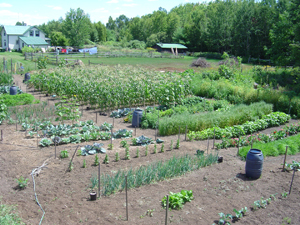
We have a huge vegetable garden in which we grow much of our own food, and we heat with wood harvested on our property. It’s important to remember that heating with wood is one of the few carbon neutral ways to heat your home. The wood absorbed carbon dioxide as it grew and it will release the same amount of CO2 and heat, whether it rots on the forest floor or is burned in our woodstove.
 The key is to have an EPA Certified, highly efficient woodstove with either a catalytic combustor or second oxygen burn cycle. If you burn the wood correctly, your emissions should be close to a natural gas furnace. The difference is: I can’t keep up with the supply of dead trees on our property, but the country is running out of natural gas. The key is to have an EPA Certified, highly efficient woodstove with either a catalytic combustor or second oxygen burn cycle. If you burn the wood correctly, your emissions should be close to a natural gas furnace. The difference is: I can’t keep up with the supply of dead trees on our property, but the country is running out of natural gas.
Michelle: We drive a small, fuel-efficient Honda Civic and have never had a larger vehicle, even while raising two children. If we needed extra storage space for camping or long trips, we used a box on the roof. And we eat a vegetarian diet, which is more sustainable than a meat-based one.
NL: Your lifestyle and your business seem nicely aligned. How did that come about?
Cam: Michelle was a teacher and I was a landscaper/ radio broadcaster/electronic publishing salesman. We started our own electronic publishing business 20 years ago, and have been really fortunate that the book publishing, which was a sideline, has now become our full time gig.
We always dreamed about making a living sharing our passion for renewable energy. We stayed focused on it and worked very hard, and it happened!
Michelle: When we moved to this off-grid home, we looked for a book that could tell us everything we needed to know about this lifestyle. No such book existed and we were forced to do our own research. When we met Bill Kemp, and found a person who not only lived off-the-grid but also understood it all, we knew we had found the right person to write the book that we hadn’t been able to find!
NL: And so now your company publishes Bill Kemp’s books on sustainable living, renewable energy and carbon- neutral transportation….
Cam: Yes, meeting Bill was incredibly serendipitous. I went to Bill’s house with a friend to move some batteries that Bill was getting rid of when he upgraded his system. After noticing a vegetarian cookbook on their counter, I invited Bill and his wife Lorraine back to our place for dinner and we became good friends. Bill has an incredible grasp of the technical issues related to renewable energy and energy efficiency, and he is able to communicate it in a way that people get.
NL: Do you experience any problems running a business off-grid, especially with the computers and other equipment required by a publishing business?
Cam: Absolutely none. We have always used laptops, which consume much less energy than desktops, but the power our inverter produces is of much higher quality than you get from your local utility.
Last summer, we upgraded our system to 24V for our new wind turbine and added a new charge controller, which our batteries just love. It doesn’t seem to matter how much we use the electric kettle to make tea or the electric toaster to make toast, we cannot use as much power as we produce right now. It’s amazing!
NL: Do you think we have reached a tipping point in terms of a realization of the reality of climate change … that we all need to make changes in our personal lives, such as you two have done, to mitigate it?
Cam: Yes, there’s no question we’re at the tipping point. There are a variety of studies released in various science magazines reporting that sea ice is at the lowest levels ever, glaciers are melting, sea levels are rising. All of the researchers are saying the same thing, that we are correctly predicting the effect of increased CO2 levels, but understating the magnitude.
NL: There seems to be a lot of talk and not enough action right now. What do you think it will take to move us to the next stage, where awareness turns into large-scale action?
Cam: I started doing workshops on solar energy years ago at homeschooling conferences. Then I started doing them on weekends at community colleges. Five years ago, I was lucky to get 10 people to attend. Last winter, I had 130 people attend a workshop!
Things are happening. People are waking up. I think people are starting to realize that we are in this together and, from a global perspective, we generate 10 times the CO2 of developing countries, so we’ve got to get cracking.
Michelle: I think what is needed is a great deal of political will. From what I’ve seen, most people aren’t willing to make major steps on their own, especially when they’ve been told for years that all it takes is small steps. Small steps are important but major changes must be made.
It seems to me that people want to buy their way out of this: “What can I buy to help the planet?” This is the wrong approach.
NL: Where do you think we are headed in terms of the development of renewable energy in North America? Do you think the future is in big solar and wind or small-scale, individual systems? Will we have wind farms all over the countryside or will each of us have a wind generator and solar panels on our roof?
Cam: The Europeans are looking at their power grid as an Internet-like system of distributed generation, with lots of smaller producers pumping into the grid, rather than massive, inefficient, centralized power stations sending electricity long distances and wasting lots of it along the way.
Here in Ontario, Canada, as hard as people have lobbied to have efficiency and renewables taken more seriously, the current government has decided to invest billions of our dollars in nuclear energy, which basically bankrupted the system in the first place. They did this while scrambling to keep up with the applications from people who want to provide renewable energy to the grid through the Standard Offer Contract. I think if you gave the $40 billion that will be spent on nuclear power to homeowners to purchase more efficient appliances and to install their own green power systems, you would get a better result. And we wouldn’t have 10,000 years worth of nuclear waste to deal with. None of the $30 billion that the atomic waste agency says it will cost us to dispose of the waste currently stored on-site at nuclear plants is accounted for in your electricity bill.
NL: Someone recently wrote me a tirade about “enviro-Luddites,” suggesting that it was ridiculous to think that the global warming problem could be solved by “people moving to the country and sticking up a windmill.” He quoted Amory Lovins’ old statement that the only good technology is no technology and said that environmentalists are taking us back to the Stone Age. How would you respond to that person? Is renewable energy low-tech? And can it “solve” the global warming problem on its own with other measures?
Cam: I’ll admit that I moved to the country for that elusive “hippy gardening dream.” But the reason I can live and work off the electricity grid is because of the technology in my solar panels and my inverter, which converts the energy so my household appliances can use it. I have a satellite dish for television, a satellite dish for high-speed Internet, which is essential to my business, and a “tellular” phone system, which uses cell service to act like a real phone. I have thousands of dollars in computers and hard drives, and now thousands of dollars invested in cameras and software for creating professional quality DVDs. I’m a Luddite at heart, but my house looks like Mission Control in Houston. I would suggest the letter writer watch our upcoming DVD on the steps involved with evaluating your site and installing a wind turbine. The mind boggles at the number of factors one has
to take into consideration.
At a certain point, though, it’s not about spending money to solve problems. We all just have to use less. Our family of four uses five kilowatt hours (KwH) of electricity a day, while the average family here uses 35 KwH, and I don’t think many people who stay here ever notice a difference in the quality of their lifestyle. No, we don’t have air conditioning. When it gets hot, I sleep on the back porch. That’s a low tech solution.
NL: What do you think about biofuels? I am concerned that it’s not sustainable, in that corn, etc. grown for energy will replace food crops.
Cam: I would agree that biofuels and using food for fuel is a zero-sum game. Our biodiesel book discusses using waste vegetable matter as the feed stock, which again can be considered carbon neutral.
Bill Kemp has developed a combined heat and power system that would be considered a “bio-mass” system as well. It takes the manure from a farming operation and heats it up in an anaerobic digester, which kills the pathogens, making it safe to spread on fields. The manure produces methane, which is 20 times more harmful as a greenhouse gas than CO2. This methane is used by a generator, which produces electricity to power the farm, and the excess is pumped back into the electricity grid, where the farmer is paid 11 cents/kilowatt hour under the Province’s Standard Offer Contract. They also receive an additional 3.5 cents because it is “dispatchable,” meaning it can be generated when the power grid needs it most.
The water that cools the engine is used on the farm for domestic hot water. Many farmers will now make more money selling their electricity than selling food.
This is the brilliance of Bill Kemp. He’s taken an environmental problem – manure – and he’s solved that problem, solved the environmental problem of methane, and is making money for some of the most important members our society – farmers. That’s win/win/win! Bill is able to look at problems and engineer solutions.
Now, if we start to look at switchgrass and other crops that will grow on marginal lands and can be used for heating, we may be able to help farmers more.
NL: In your experience, do most people care about the environmental aspect of renewable energy, conservation, and such, or are they mostly concerned about the cost and future availability of energy … as seems to be the motivation for alternatively fueled vehicles?
Cam: It doesn’t matter anymore. We’ve run out of the easy energy and, now, rapidly increasing energy prices are going to force everyone to look at using it more efficiently and to try to make some of their own. According to the Canadian Gas Producers we have about eight years of natural gas left, at current discovery and use rates. Eight years!
How do you heat your house? And we won’t be able to build the infrastructure to bring in LNG or liquefied natural gas as quickly as we’ll need it. Under NAFTA, we have to ship 50 percent of our gas to the U.S., even if Canadians are freezing. So put on a sweater and log onto the NRCAN website to get your EcoEnergy Audit done. It’s time you made “energy efficiency” your mantra.
And in terms of driving, the price of a barrel of oil has broken $100. It was $20 in 2001. The days of driving Hummers are rapidly drawing to a close. For many people transit will become a necessity … or a bike or Smart Car if they want to drive themselves.
NL: What would be your first bit of advice to a suburban reader wanting to explore the use of renewable energy for his or her home?
Cam: I would suggest they read Bill Kemp’s book called Smart Power: an urban guide to renewable energy and efficiency. Yes, I publish it, and I want to make money to buy more solar panels. I will not deny that. But in that book, Bill has developed a graph that has become the industry standard in explaining how to approach this topic. It shows that to get the fastest payback you have to start with the simple, inexpensive steps like replacing light
bulbs and turning off phantom loads. Then, as you progress up the chart it shows how to replace your appliances properly, then finally how the fastest payback on a renewable energy system is a solar thermal system on your roof, to preheat your domestic hot water. Cost on that would be between $3,000 and $4,000 with a payback of about six years. I think with the way energy prices are set to go, it will probably be faster than that.
And finally, Bill writes about when you’re ready to invest in some solar panels and a wind turbine, what the payback is. Yes, there is a payback! Plus, you’ll inflation-proof your family from energy price increases, while you’re reducing your footprint on the planet. So many people are obsessed with saving for their child’s post secondary education. What better legacy to leave to your kids, than some solar panels on your roof, with a 25-year warranty and no effective end to their productivity, that will produce clean, green energy for decades. The days of thinking and dreaming about this are over. It’s time to “Go Solar!”
Learn More
The Renewable Energy Handbook by William H. Kemp (Aztext, 2005)
$mart Power: An urban guide to renewable energy and efficiency by William H. Kemp (Aztext, 2005)
Biodiesel: Basics and Beyond by William H. Kemp (Aztext, 2006)
The Zero-Carbon Car: Building the car the auto makers can’t get right by William H. Kemp (Aztext, 2007)
Grow Your Own Vegetables: Seven easy steps to your own backyard produce department hosted by Cam Mather (Aztext, DVD)
Aztext Publishing www.aztext.com
This article was published in 2008 in Natural Life Magazine.
|