Building Green in the Great White North:
A Cold Climate Net-Zero Condo Duplex
By Wendy Priesnitz
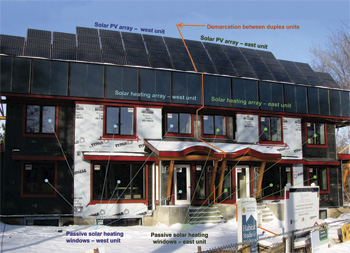 A side-by-side condominium duplex in the downtown Riverdale neighborhood of Edmonton, Alberta boasts one of the first residential building-integrated solar heating systems in Canada. The Riverdale Net-Zero Project was designed as part of the CMHC EQuilibrium demonstration home program. Its highly efficient solar system integrates the collectors directly into the building membrane, just like a window or a skylight, offering more flexibility in home design than more conventional solar panels. A side-by-side condominium duplex in the downtown Riverdale neighborhood of Edmonton, Alberta boasts one of the first residential building-integrated solar heating systems in Canada. The Riverdale Net-Zero Project was designed as part of the CMHC EQuilibrium demonstration home program. Its highly efficient solar system integrates the collectors directly into the building membrane, just like a window or a skylight, offering more flexibility in home design than more conventional solar panels.
“Building integrated solar heating is the newest and most advanced solar heating technology available in Canada,” says Joe Thwaites, president of Taylor Munro Energy Systems of Vancouver, which is responsible for the building’s mechanical and solar thermal systems.
The solar technologies (including direct-gain south-facing windows), combined with an ultra-low energy consumption building envelope (including high thermal mass 16-inch-thick walls), play a major role in the home’s capacity for meeting Net-Zero requirements, meaning the home will, on an annual basis, produce as much energy as it consumes. That is not an easy technical and economic challenge in Edmonton’s cold northern climate, but the developers claim that the building can be heated by four four-slice toasters when the outside temperature is -32 degrees C (-26 F).
Developer Peter Amerongen of Edmonton’s Habitat Studio & Workshop Ltd. says that their approach to designing the home has been very conservative. “In spite of a temptation to consider spending almost whatever it took to achieve Net-Zero, we have been very frugal and practical with resources. A good example is our wall system, which has a very low incremental cost, very little embodied energy and low environmental impact. It uses only regionally produced lumber and recycled newspaper and has cut the wall component of heat loss by approximately 70 percent compared to a standard 2x6 wall.”
The insulation value of the walls is R56 (typical new energy-efficient house is R30); the ceiling is R100 (typical new house is R20 to R40) and the basement floor is R30 (typical house has none).
Other features include quadruple-glazed windows, window quilts, an ultra-high efficiency heat recovery ventilation system and ultra-low energy appliances. For instance, the appliances and lighting fixtures require 3900 kWh of electricity consumption per year for average occupancy, as opposed to 6600 kWh for the average home in Edmonton.
One solar system heats both space and domestic water. The vertically-mounted solar thermal collector array measures 22 m2 and the 30 m2 photovoltaic system generates 5600 kWh of electricity per year, with any excess beyond the householders’ needs backfed into the grid for credit. Sustainable materials were used throughout the building, with the criteria being durability, locally produced, low embodied energy and low off-gassing.
What: three-bedroom 1,870 square-foot side-by-side duplex
Where: Edmonton, Alberta
Who: Builder/Developer: Habitat Studio & Workshop Ltd., Edmonton, Alberta
Learn More: www.riverdalenetzero.ca
This article was published in Natural Life Magazine in 2008.
|