The Wonderful World of Trees and Treehugging
by Wendy Priesnitz
“Trees are wonderful things. They provide shade, hold soil, water, carbon and nutrients, and provide habitat for innumerable species. Our ancient ancestors lived in and among trees, and both benefitted. Is there still a primal connection between humans and trees, and do we still benefit from being among them? The answer is yes. Studies have shown that we are psychologically healthier when we spend time around trees and in woods.” ~Harv “Ponderosa” Teitelbaum
Heart, Lungs and Soul of the City
 Urban trees have a terrible life. Tall trucks bash them, utility companies dig up their roots and trim back their branches, high-density developments squeeze them out, insurers hate them. However, trees have real benefits for cities and their occupants. They provide cleaner air, help reduce noise, provide flash flood protection, and can actually reduce air temperature. They can also enhance our emotional and physical well-being. According to behavioral scientist Roger Ulrich, physical signs of stress such as pulse rates and muscle tension lower within four minutes of a stressed person moving into leafy surroundings. Urban trees have a terrible life. Tall trucks bash them, utility companies dig up their roots and trim back their branches, high-density developments squeeze them out, insurers hate them. However, trees have real benefits for cities and their occupants. They provide cleaner air, help reduce noise, provide flash flood protection, and can actually reduce air temperature. They can also enhance our emotional and physical well-being. According to behavioral scientist Roger Ulrich, physical signs of stress such as pulse rates and muscle tension lower within four minutes of a stressed person moving into leafy surroundings.
New York City’s parks department has found that, including their ability to combat pollution and add real estate value, the city’s street trees provide an annual benefit of about $122 million, with the city receiving $5.60 in benefits for every dollar spent on trees. In Salem, Oregon, there is a Greenways Ordinance, which is designed to help preserve salmon habitat. In recognizing trees’ role in reducing the amount of impervious surface area in the city, planning officials have also realized that shading parking lots reduces the temperature of stormwater runoff so it doesn’t harm aquatic life.
I think that I shall never see
A billboard lovely as a tree.
Perhaps, unless the billboards fall,
I’ll never see a tree at all.
~Ogden Nash, Song of the Open Road
 Mitigating Climate Change Mitigating Climate Change
Trees also have benefits to the broader environment. Over the last 300 years or so, the activities of humans (such as the burning of fossil fuels and vegetation clearing) have increased the concentration of greenhouse gases such as carbon dioxide in the atmosphere, helping to create our current climate change emergency.
Planting trees can help offset that by removing carbon dioxide from the atmosphere and storing it as carbon in the plant material and the surrounding soil. Unfortunately, when forests are clearcut, and if the wood from those trees is burnt or allowed to decay, much of that carbon is released back into the atmosphere. But when it is used for other purposes, such as building houses or furniture, the carbon remains locked up in the timber for the life of the product.
Trees Communicate With Each Other
 Aside from destroying animal and bird habitat and releasing carbon, clearcutting is also hard on the trees and forests themselves. University of British Columbia ecologist Suzanne Simard tells us that trees “converse” with each other, communicating their needs and sending each other nutrients via a network of latticed fungi buried in the soil and connecting one root system with another. She has found that these symbiotic fungal networks help trees send warning signals about environmental change and transfer their nutrients to neighboring plants before they die. Aside from destroying animal and bird habitat and releasing carbon, clearcutting is also hard on the trees and forests themselves. University of British Columbia ecologist Suzanne Simard tells us that trees “converse” with each other, communicating their needs and sending each other nutrients via a network of latticed fungi buried in the soil and connecting one root system with another. She has found that these symbiotic fungal networks help trees send warning signals about environmental change and transfer their nutrients to neighboring plants before they die.
Simard and her students have also discovered that forests have what they call “mother trees,” which are the biggest, oldest trees. They are the most connected to other trees in their forests and can even nurture their own kin. The importance of these hub trees is a good argument in favor of sustainable forestry, rather than clearcutting of old growth. Nevertheless, while Simard warns that these communication networks are being disrupted by environmental threats such as climate change, pests like pine beetle infestations, and logging, she is optimistic that the conversations among trees will continue.
What we are doing to the forests of the world is but a mirror reflection of what we are doing to ourselves and to one another. ~Mahatma Gandhi
Enlightenment and Health From the Trees
Many people feel a strong personal kinship toward trees and some ancient cultures believed humans actually came from trees. 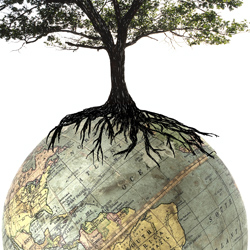
There is no doubt that spiritual insight and personal transformation can be achieved through close contact with trees. Many an inspiration is born while meditating, praying, singing, or writing beneath a tree. Perhaps the most famous enlightenment ever came while the Buddha was sitting under the bodhi tree.
Both the ancient Celts and Native Americans believed that trees reaching for the sky united the earth with the spirit world. They believed trees communicated with the moon and the stars and were forewarned of any oncoming dangers by the wind. Trees, in turn, would send those warnings and other heavenly messages down to the earth through their roots. The “wish trees” of northern Europe are successors to ancient pagan tree shrines where people once appealed to the spirit beings or devas for help in solving problems.
In North America, trees are also an integral part of the rich relationship with Nature that the indigenous peoples of the Northwest Coast First Nations have evolved over thousands of years. They carve totem poles from the native, densely-grained ancient western red cedars. Unfortunately, during the past century, industrial logging has dramatically reduced the number of these trees that are suitable for totem pole carving.
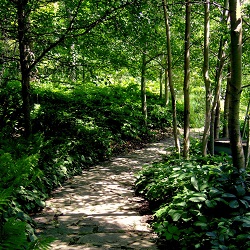 In the 1980s, the head of Japan’s Ministry of Agriculture, Forestry, and Fisheries coined the term “shinrin-yoku” to refer to the way people are impacted by being in forests. That concept has been popularized in the West as “forest bathing.” Research has shown that walking in a forest can significantly lower blood pressure, promote relaxation, increase energy levels, and create feelings of happiness, while improving attention and concentration. At least one study demonstrated that spending three days in a forest can improve the immune system for up to seven days. In the 1980s, the head of Japan’s Ministry of Agriculture, Forestry, and Fisheries coined the term “shinrin-yoku” to refer to the way people are impacted by being in forests. That concept has been popularized in the West as “forest bathing.” Research has shown that walking in a forest can significantly lower blood pressure, promote relaxation, increase energy levels, and create feelings of happiness, while improving attention and concentration. At least one study demonstrated that spending three days in a forest can improve the immune system for up to seven days.
Resources for Healing
Since ancient times, trees have offered resources for healing. They have not only yielded medicines from their leaves, roots, bark, wood, and fruit, but have also supplied a source of energy on which many indigenous healing traditions rely. For thousands of years, trees of various sorts have been used to make infusions, decoctions, poultices, ointments, and tonics to heal both humans and domestic animals. Even modern-day pharmaceutical companies include parts of trees in some of their drugs and treatments. For instance, medical researchers have found the dried bark and needles of the Pacific yew to contain taxol, an anti-cancer compound that has been judged effective in treating ovarian cancers.
The Ultimate Treehouse
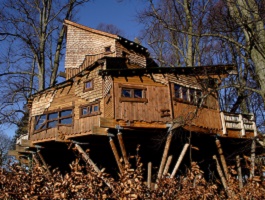 People of all ages are fascinated by treehouses. Suspended in a treetop, far above the ground and other people, a treehouse can be a fun hideout for kids and a welcome hideaway for adults. There are even treehouses available to rent as vacation cottages. People of all ages are fascinated by treehouses. Suspended in a treetop, far above the ground and other people, a treehouse can be a fun hideout for kids and a welcome hideaway for adults. There are even treehouses available to rent as vacation cottages.
Perhaps the most lavish treehouse is owned by the Duchess of Northumberland in northeastern England. Sitting high in the branches of 16 trees, the five-room, 6,000 square-foot structure is part of a transformation of Alnwick Castle’s grounds into a fantasy garden. The castle is already famous as the setting for Hogwarts School in the Harry Potter films.
“Regardless of their ability, children should be encouraged to get outdoors and appreciate nature,” says Lady Jane Percy, the energetic young duchess whose husband’s family have resided at Alnwick since the early 14th century. The duchess was apparently an avid tree climber as a child and was inspired to construct her house in the trees by a survey which found that one-third of children aren’t allowed to climb trees.
The tree I had in the garden as a child, my beech tree, I used to climb up there and spend hours. I took my homework up there, my books, I went up there if I was sad, and it just felt very good to be up there among the green leaves and the birds and the sky. ~Jane Goodall
Embracing Protection
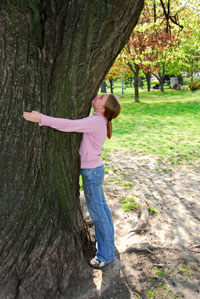 Given all the benefits we receive from trees, it’s our duty to protect them, whether that’s by physically preventing them from being cut down or by carefully stewarding the use of the products made from them, like wood and paper. Given all the benefits we receive from trees, it’s our duty to protect them, whether that’s by physically preventing them from being cut down or by carefully stewarding the use of the products made from them, like wood and paper.
The term “treehugger” – originally derogatory – came from the Chipko movement, a group of villagers in India who prevented commercial logging by hugging trees. Some of the largest protests have been to protect the old growth temperate rainforests in coastal British Columbia from clearcutting. And one of the main protestors is a grandmother named Betty Krawczyk (born 1928) who was first arrested with almost 90 others during the notorious 1993 Clayoquot Sound demonstration against MacMillan Bloedel on Vancouver Island.
Tree sitting is another tree protection tactic. For 738 days in the 1990s, Julia Butterfly Hill lived in the canopy of an ancient redwood tree called Luna to help raise awareness of the plight of ancient forests. That led to protection of the 1,000 year-old tree and the creation of a three-acre buffer zone around its home in Stafford, California.
Planting trees and combating deforestation is the focus of a Kenyan woman named Wangari Maathai who founded the Green Belt Movement to organize poor women to plant trees. Since 1977, the movement has planted over 30 million trees and over 30,000 women have been trained in forestry, food processing, bee-keeping, and other trades. Maathai received the 2004 Nobel Peace Prize for her work with the movement.
So, whether they are providing shade, energy, medicine, enlightment, or fun; holding soil, water, carbon and nutrients; or providing habitat for humans and other species, trees are invaluable to life on earth. And we should be doing everything we can to protect them for future generations.
Wendy Priesnitz is the founding editor of Natural Life Magazine, an author and journalist with over 45 years of experience. This article was first published in 2007 as part of a photo essay in Natural Life Magazine, and updated in 2018. Photos (c) Shutterstock and photographers
|