The Natural Life Interview
Georgie Donais:
cob builder, community activist, homeschooling mom
by Wendy Priesnitz
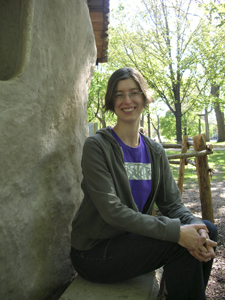 Georgie Donais was a homeschooling parent living in Toronto, Ontario, when this interview was conducted. She is involved in dance, music, graphic design, cob building, and her local community. She was a recipient of a 2005 Clean and Beautiful City award and, as a finalist in the 2007 Green Toronto Awards, she received an Award of Excellence. The work she and others have done to create a community gathering space in their neighborhood park has become a model for many other cities. Here, she chats with Natural Life Magazine editor Wendy Priesnitz. Georgie Donais was a homeschooling parent living in Toronto, Ontario, when this interview was conducted. She is involved in dance, music, graphic design, cob building, and her local community. She was a recipient of a 2005 Clean and Beautiful City award and, as a finalist in the 2007 Green Toronto Awards, she received an Award of Excellence. The work she and others have done to create a community gathering space in their neighborhood park has become a model for many other cities. Here, she chats with Natural Life Magazine editor Wendy Priesnitz.
NL: The City of Toronto has recognized your community-based activities regarding a cob building project in a downtown park. How did you become interested in cob?
Georgie: I spent much of my youth holding the trouble light or extra nails for my carpenter father. Unfortunately, I had a fear of power tools and a difficulty with measuring that put me off building things myself. I chose instead to sew, finding that cloth was more amenable than wood to being stretched and shaped.
Many years later, I came across a book on strawbale building and was intrigued. Through strawbale, I found other techniques, each more elemental than the last, until I came across cob. This technique sang to me, holding within it the possibility of shelter building that seemed unattainable to me before. It espoused the values of “small” and was quiet, gentle, inclusive and ecologically sensitive. I realized then that the desire to build was always there, but I had only just found the right medium.
For my first project, I convinced my mom in Saskatchewan to let me create a cob fireplace and low courtyard wall in her backyard. When I got back to Toronto, I spent four months hauling materials into my tiny backyard to build an earthen oven, using Kiko Denzer’s book Build Your Own Earth Oven as my guide. I got my clay from a local disposal yard, where they got a bit of a chuckle out of me, wanting to use this stuff that everyone else was throwing out.
NL: What do you like about cob as a building material?
Georgie: For me, cob is the penultimate do-it-yourself building system. It is simply the mixing and application of sand, straw, clay and water. Tools required include hands and feet, though a tarp, a shovel and some buckets are also helpful. The work is gentle, low impact exercise that conditions and tones legs, arms and back. Connection between participants happens naturally because conversation is not overwhelmed by the sound of power tools. The extreme amount of labor required to build a cob house invites the creator to think small and design a building that will fit like a glove, with no wasted space. That, combined with the use of local, free and often un-valued material, means it can be extremely ecologically sensitive, which really matters to me.
NL: So how did you come to be building cob structures in a park in downtown Toronto?
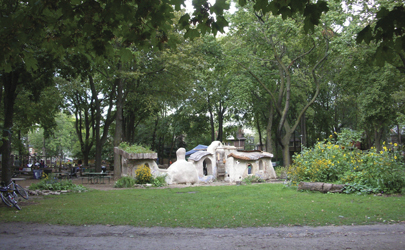
"I had heard that the Public Health department was requiring the installation of hand-washing sinks by the wading pool and playground, where park staff runs a summer café. I proposed a sort of enclosure without a roof that would house the sinks, as well as a cooking fireplace and baby-changing station. It would be built of earth, using cast-off material and volunteer labor." |
Georgie: In 2005, I spearheaded the creation of a cob courtyard wall in Dufferin Grove Park (which I’ll refer to as “DGP.”) I had heard that the Public Health department was requiring the installation of hand-washing sinks by the wading pool and playground, where park staff runs a summer café. Fresh from my two small experiences, I proposed a sort of enclosure without a roof that would house the sinks, as well as a cooking fireplace and baby-changing station. It would be built of earth, using cast-off material and volunteer labor.
The park’s advocate, Jutta Mason, was skeptical at first, but I seemed to know enough about the idea that she was willing to support my proposal. The city’s Parks, Forestry and Recreation (PFR) officials were themselves bemused but supportive. And that summer we turned a hot, dusty corner of the park into a bustling hive of activity, as approximately 500 people dropped into our free, ongoing earthen building workshops.
Throughout that process, many people said to me, “The sinks are fine, but what we really need is a toilet.” Since I knew from my own children that the other park washrooms were too far away from the playground for little kids to access them quickly and safely, I began to look into possibilities. PFR said that a flush toilet was out because of plumbing issues and, since I was familiar with the idea of composting toilets, I began to consider that as another option.
While we were working on the wall in 2005, someone who was impressed with our work at the park came by and offered to foot the bill for the toilet assembly, to the tune of $8,500. I put together a plan for the building, made arrangements with PFR and applied for funding. We began work on an earthen building with composting toilet in the spring of 2006. The purpose of the venture was threefold:
- to provide nearby toilet facilities;
- to offer people of all ages a chance to learn how to build low impact shelter;
- to function as a demonstration project showcasing earthen building, as well as alternatives to our current sewage model.
NL: Now, I know that the Friends of Dufferin Grove have had to stickhandle around building codes, bylaws and so on a few times in the past. Has this project experienced any problems of that nature?
Georgie: To say that we have spent the majority of our time over the last year trying to surmount regulatory hurdles would be an understatement! Although we had staunch support from a majority of friends and neighbors, the project did have its detractors. They mobilized, and numerous complaints to the city building department and city councillor’s office meant that work was stopped several times while officials tried to determine whether regulations required them to step in. As we built the rammed earth foundation (a mixing process similar to cob) we were told that labor code regulations would now be applied, meaning that as a “work site” all participants were to have regulation footwear, and hand and eye protection. Oh yes, and no children were allowed. Since part of the point of this exercise was to have children involved, this ruling caused major upset.
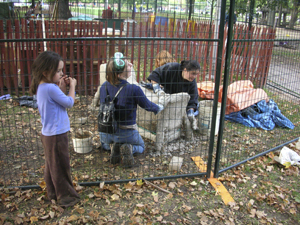 I devised a workaround whereby people mixing materials on tarps would be outside the six-foot-high construction fence that PFR ordered installed, and only booted adults would be allowed inside the “site.” This had a net effect of segregating people by function, so that a dad who came by to help would get stuck shoveling clay all afternoon, as he happened to have his steel toed boots on. Boring for him and a loss for the project. Children were relegated to the function of “mixing” and could have no involvement in the more exciting aspects like shoveling, hauling material or filling bags. For the project leaders, who went from boots to bare feet and back again depending on whom they were helping, much time was wasted washing and drying feet, putting on boots and taking them off again. This also discouraged people from taking on leadership roles, since they did not want the boots on/boots off hassle. I devised a workaround whereby people mixing materials on tarps would be outside the six-foot-high construction fence that PFR ordered installed, and only booted adults would be allowed inside the “site.” This had a net effect of segregating people by function, so that a dad who came by to help would get stuck shoveling clay all afternoon, as he happened to have his steel toed boots on. Boring for him and a loss for the project. Children were relegated to the function of “mixing” and could have no involvement in the more exciting aspects like shoveling, hauling material or filling bags. For the project leaders, who went from boots to bare feet and back again depending on whom they were helping, much time was wasted washing and drying feet, putting on boots and taking them off again. This also discouraged people from taking on leadership roles, since they did not want the boots on/boots off hassle.
In terms of project authorization, it was determined that, although the project was small enough that it did not probably need a permit, it still was required to meet all the conditions of one. More delays and expense followed, as PFR hired an architect and finally an engineer who would try to guide the project past regulatory hurdles.
We are still, in fact, in negotiations with the architect and engineer to come up with drawings that they are comfortable signing off on, and that I am comfortable building. The problem is that, since the building code does not address earthen construction and since professionals’ insurance does not cover them for earthen construction, we must substitute the wall’s structural function with conventional means of holding up the roof.
So far, changes to the design in order to satisfy the building code but that subvert the stated purposes of the project include:
- steel posts for roof support;
- concrete floor;
- concrete bond beam at the top of the walls;
- lintels in addition to arches;
- no stroller ramp because it would not meet wheelchair accessibility requirements;
- construction severely hampered by application of labor code.
NL: Why do you think this happens? Is it part of the “expert” mentality – only people trained and credentialed are allowed to (or know how to) do certain things? Or is it a lack of knowledge about sustainable building?
Georgie: New ideas are proven by trying them out, and in the coming environmental upheaval, our survival may depend on new ideas. The time to try them out is now. However, I believe that people are threatened by the specter of liability. City employees have been told that if something goes wrong on their watch, they can be personally liable and fined tens of thousands of dollars – hence the labor code rules. With the structure, the building department requires professionals to sign off on documents so that the liability of any errors shifts from the city’s insurance and on to the professionals’. In turn, the professionals’ insurance won’t cover problems unless the building stays within defined parameters. With so much potential punishment, it becomes unlikely that anyone will step up and say, “Let’s try this; it seems crazy but it just might work.” There is no incentive to innovate, and quite a serious disincentive.
There is also the “Tyranny of the Ruler,” which is a phenomenon that occurs when making construction drawings. It is the tendency to want to round sizes of things up or down to the nearest even measurement for ease of drawing. Ease of drawing is not ease of living, however. A building’s function is to relate to people’s bodies, not notches on a ruler or standard sizes of plywood and 2x4s. Curved buildings are difficult to measure and to draw, but they are a joy to build and to live in. It is the joy that we want to strive for, and not the efficiency of standardized measurements. Let’s make sure that rulers are a tool for description and are not themselves a reason for a building’s shape or size.
NL: Are there other – perhaps cultural – reasons for the roadblocks, such as bureaucracy versus an unstructured community….?
Georgie: We are obviously sorting out what it means to be involved in a partnership. Maybe this is a weird hybrid model, where citizens take an unusually active role in public space and city officials then are asked to facilitate their vision. For those of us in the park where citizen initiative is commonplace, it’s easy to forget that this is not the parks department’s usual role. Instead of being managed and administrated, what we’ve been striving for is consultation and inclusion, and recognition of our leadership role in this project and in this park.
I can see it would be hard to support some woman who wants to – with barely any money and very few power tools, but with many bare feet and children involved – create a building out of mud that houses a toilet. It takes a leap of faith to see the vision of real and actual community engagement and of environmental innovation, and to value an apparent layperson’s pivotal roles in its creation.
As we’ve seen, all the rules and conventions are set up against these very things. Indeed, this project asks us to go beyond and outside the standard client/professional relationship, beyond the administrator/administrated relationship, and beyond the citizen as passive consumer paradigm.
NL: What are the objections of the naysayers in the local community?
Georgie: Their objections range from an apparent lack of consultation, imagined wading pool contamination and loss of green space, the use of “child labor,” and supposed lack of hand-washing facilities. What it really seems to come down to be. They would perhaps like the park to be a quiet, contemplative place with wide open vistas of lawn. I would like the park to better serve the people who come to it. I think that we might all agree that it does get too busy sometimes, probably because people come here from far and wide to experience the atmosphere and the offerings that they cannot get at their local park.
For as long as she’s been active there, Jutta Mason has been encouraging PFR to treat the park as a “laboratory” where new things are tried out and if they work, then why not export them all over the city? This request has been studiously denied for over a decade.
NL: Nevertheless, Dufferin Grove Park seems to have become rather well-known for its community development initiatives. Is there something special about this particular neighborhood that makes the park work?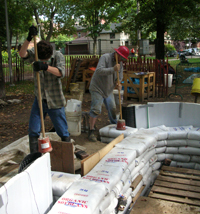
Georgie: The neighborhood around the park is, in many ways, typical Toronto – a mix of incomes and ethnicities, longtime residents and newcomers. The thing that is different is that 15 years ago a woman in the neighborhood decided to start talking to her neighbors. Since then, Jutta has been working full-time, inviting park goers and park staff to talk to each other, to see each other as allies and to imagine ways to enhance their quality of life. This has led, over the years, to many benefits for the community: a big sand pit for older children, a basketball court, retention of wooden playground equipment in an era of its wholesale removal in other parks, campfires, an organic farmers’ market, community gardens, theater festivals, craft fairs, park suppers, an extended skating rink season, to name a few. But most importantly, Jutta has done what she can to remove barriers that would prevent people from giving their gifts to the park.
It is my impression that, although the park is acknowledged to be one of the jewels in the crown of Toronto’s parks, there has never been a concerted attempt on the part of the city to understand what goes on here, to figure out why it works or to replicate it elsewhere. It seems that activities here are only barely tolerated, and programs here are constantly under siege. Campfires – a 13-year, injury-free tradition in the park – were suddenly cancelled last winter by city officials, citing safety concerns. Months of concerted effort and lobbying ensued, finally getting fires reinstated, but with onerous caveats.
What we need, and what has been sorely lacking, is a willingness and an interest in collaboration on the part of the city. This includes an acceptance of people’s inherent competence, and permission for officials and staff to go ahead and take some risks.
NL: Do you wonder about the irony that you’ve been recognized by the City a couple of times for your work on the cob structures, when they have given the project such a hard time?
Georgie: There is a disconnect between the grand pronouncements and the on-the-ground policy. Until the two start to converge, this kind of situation will continue.
NL: Are you optimistic that it will turn out well? After all, Toronto has a green mayor and everybody’s interested in green living these days, so one would think a project like this would have the doors flung wide open.
Georgie: It depends on what you mean by “well.” If you mean do I think it will be built, yes I do, if only out of my own bloody-mindedness. But in the sense that it will have cost tens of thousands of dollars more than planned, will have run two years behind schedule, will have taken up whole seasons worth of my and others’ lives, and will have incorporated a whole host of materials and processes that are anathema to earthen building, it certainly could have turned out better.
In terms of a demonstration project that shows the beauty, utility and ease of earthen building, and in terms of showing a way to profit from human waste instead of throwing it away, I do believe it will turn out very well. That vision is what, ultimately, keeps me going.
NL: Do you have any advice to others wanting to build cob or other sustainable structures – in either public or private places?
Georgie: Do your research, try to take some workshops, but don’t let inexperience stop you. Learn on something small. Many like to avoid permits and construct their shelter in hidden spots, away from prying eyes. The trouble is, building with cob and other materials is such a joyful experience that it’s hard to keep that to yourself. The large amount of work required also means lots of people coming and going, which is bound to attract attention. On the other hand, going by the book means expense, delay, compromise and more expense. It’s important to decide on your priorities before starting out.
Gather people around you for support. Be open to others’ input, but stay connected to why you are undertaking the venture. And be prepared for a fight that is way beyond the scale of the actual project.
NL: Do you see yourself ever building a larger cob structure, like a house for your family?
Georgie: Absolutely. Sometimes the urge to live in a south-facing house that traps the sun’s heat in its heavy walls and floors gets so bad that I get physically agitated. This usually happens in mid-winter, and when I go home to Saskatchewan, land of sun and sky, and see nary a house turned towards the sun. Living in Toronto, vacant land is hard to come by, but my eyes are always open to potential opportunities.
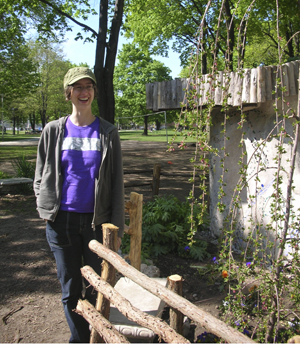 NL: So the prairies are home? NL: So the prairies are home?
Georgie: I grew up in small-town Saskatchewan, one of three children born to a couple of multi-tasking entrepreneurs. As a child, I was always producing some show, arranging this or scheduling that. I guess I’ve always been rather forward (some would say bossy,) wanting to have an impact on the way things happen.
Later, I spent some time on the Gaspé coast before coming to Toronto “for a couple of years.” I did a dance degree at York University and spent some years singing in a band, dancing,, bookkeeping and paying off show-induced debt. These days, my husband and I homeschool our children and I also design a magazine, make music occasionally and build things.
When I found DGP, I was so grateful to find a place where my children could play and I could meet friends and colleagues. Then I discovered that I was welcome to give my time and effort to the park, so that when I heard of the need for a washing station in the park, I was comfortable saying, “What about this idea?”
NL: I understand that you got an Arts Council grant for the cob project in the park. Some people would wonder what’s artistic about a toilet….
Georgie: When people see structures made out of cob, they immediately appreciate the sculptural qualities of this type of shelter. The curves, the arches, the bas relief sculptures, the tinted plasters, the design of the entire building, the process…these are all things that fall under the rubric of “artistic.”
I also think that art tends to address and question social issues as a matter of course. Even more than that, having experience in these artistic mediums has really developed the Do-It-Yourself-er in me. No one to produce your show? DIY. No one to do your band bookings? DIY. No one making the connection between how we house ourselves and environmental degradation? DIY.
Through dance, I learned about the honor of sustained hard work. I learned how to produce shows from top to bottom, and have found that building something with volunteer labor and scarce financial resources is very much like producing a modern dance show. I learned that questioning authority will be about as popular in the real world as it was in the dance world: not very.
NL: Can art be a tool for social change?
Georgie: In my experience, allowing the participants to be real agents of change in a project creates something that is much more than the original vision. This has happened for me when choreographing dances, when writing songs and when building walls. The people who are involved get a taste of autonomy in the context of collaboration, and my feeling is that they tend not to settle for less in their next experience. They hunger for that kind of input and crave that kind of effectiveness.
NL: You’re also the mother of two young children who are learning at home. What is your family’s motivation for that? 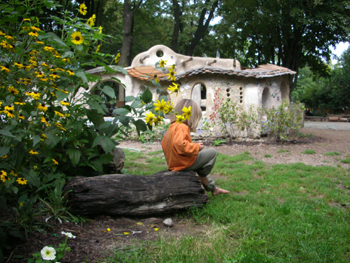
Georgie: My husband and I wanted to foster an environment where children’s autonomy was allowed, where lots of time for free, unstructured play was provided and where we could cultivate an unhurried pace in our lives. These values seemed most compatible with homeschooling, particularly forms known as “unschooling” or “life learning.” For us, life learning means playdates, reading to each other, trips to the Science Centre, zoo and museum, sleeping in, staying up late, grocery shopping, cooking, traveling, watching movies, the list goes on. We both work from home, me part-time and my husband full-time, so we both have the opportunity to be involved in the children’s lives.
NL: Is the idea of children being part of the cob building experience at the park part of your life learning philosophy?
Georgie: It is very important to me that children be allowed and invited to participate, trusting in their competency and ability to contribute. Part of our homeschooling philosophy is to respect children’s choices, and that includes listening to them when they say they do not want to be involved in cobbing. The project itself has a childminding component, so that children who have tired of cobbing are free to play in the park, pool and sandpit while their caregivers work.
NL: You are busy in a number of roles: dancer, graphic designer, cob builder, mother, musician. As someone who also combines a number of roles/personas, I’m interested in knowing how you combine these multiple identities into a whole…and how you juggle them all.
Georgie: Instead of being discreet elements, they all inform my life in some way. For example, it was dancing and choreographing dance that developed my visual acumen in a way that I was able to design a dance magazine. Building with cob combines the physicality of dance with the organizational skills of producing a performance. I do find it difficult to make time for music in the hustle and bustle of daily life. And it’s true that some days, it seems as though I am living in a dust storm of competing priorities.
Mothering is my greatest joy and challenge. Homeschooling my kids allows our family to maintain lives that are integrated with our interests and with each other.
NL: Your website refers to a communication strategy called Nonviolent Communication. What does that involve?
Georgie: NVC is a communication strategy that connects people to their own feelings and needs, and to the feelings and needs of others. I wanted to respect my two-year-old’s growing autonomy, but I didn’t exactly know how. All the books seemed to be variations on the theme of how to get them to do what you want. What I was really looking for was a way to avoid the judgments that came so quickly to my tongue, and instead see how we could work together to get our needs met. Some of the most powerful aspects of this process include taking personal responsibility for choices, so that the words “should” and “have to” are excised from one’s vocabulary. The process continues to be challenging, but I am terribly grateful to have found NVC.
It’s also been helpful in other aspects of my life. I think that if it were not for NVC, I would have abandoned the toilet project a long time ago. It helps me to get past the anger, frustration and exasperation, and find some peace in what has been a very difficult process.
NL: How does your family incorporate green living principles into your daily lives?
Georgie: I’ve always had a thing about composters, and have built many square ones and even a raised drum composter. I currently have two Envirocycles, which is one too many for our tiny yard. We have a programmable thermostat and on-demand hot water heater. We purchase organic, unprocessed foods as much as we can. We cook most of our own meals, run our dishwasher at night, hang our clothes on the line, turn off power bars to reduce phantom loads, have dimmers on all our incandescent lights, bike and walk almost exclusively and find ingenious ways to squeeze four people into less than 1,000-square-feet.
NL: Are there important things that you think families should focus on in terms of their conversion to greener living?
Georgie: Reduce and reuse are the most effective, but most neglected part of the 3-Rs philosophy. Reduce the amount of stuff that comes into your house by subjecting every potential acquisition to the question: “Is this really going to benefit me relative to the time it took me to earn that money, and how am I going to dispose of this after I’m done with it?”
Reuse your stuff or find someone who might want it, by posting on one of the many reuse sites on the Internet. Recycling can then be the “R of last resort” and garbage generation can be reduced significantly.
NL: Do have a wish list for ways that governments – either local or otherwise – can help people live greener lives?
Georgie: Oh yes! Make it cheap and easy for every homeowner who wants one to install a green roof. Not with paltry rebates after the fact but with timely, up-front help with engineers and substantial subsidies.
Encourage neighborhood initiatives, such as shared solar power, wind power and geothermal heating.
Make it mandatory for all new construction to be off-grid, including such features as cisterns, composting toilets, personal solar and wind power, geothermal heat and thermal mass. It was proven over a decade ago by the Canada Mortgage and Housing Corporation (CMHC) Healthy House in Riverdale [see article in Natural Life’s July/August 1997 issue) that even within the confines of narrow downtown lots, off-the-grid living is possible. Let’s get on with it.
Since this interview was published in Natural Life Magazine in 2007, Georgie Donais and her family have moved out of the city but she continues her interest in cob building, home-based learning, and community engagement.
Wendy Priesnitz is the Editor of Natural Life Magazine and a journalist with over 40 years of experience. She has also authored 13 books.
|