|
Catching a Green Wave:
Greening Human-Powered Action Sports
by Wendy Priesnitz
People who participate in human-powered action sports like skateboarding, skiing, surfing, snowboarding, and BMX cycling can be among the first to notice polluted water and landscapes. However, these sports can cause problems for the environment, often using eco-unfriendly practices and materials.
Surfing is a good example of the problems surrounding extreme sports. Surfers, who cultivate an image that speaks of living simply on pristine beaches, are often made ill from navigating raw sewage discharged into oceans near their favorite beaches. On the other hand, the toxic nature of surfboard manufacturing, which has included urethane, fiberglass and polyester resin, has become a well-known downside to the sport. In 2005, the primary supplier of polyurethane foam “blanks” for surfboards went out of business, rumored to be under investigation for poor environmental practices and having been sued by the widow of a former worker, who claimed her husband died from exposure to toluene diisocyanate at the factory.
The company’s demise created a temporary inconvenience and price hike for surfers; it also spurred innovation into the use of alternative materials for surfboard construction. Some manufacturers have been using epoxy resins in place of polyester resins, resulting in about 75 percent fewer volatile organic compounds (VOCs.) Epoxy resin has made the use of polystyrene possible, which can be, theoretically at least, recycled. Other companies have developed boards that use a woven bamboo mat in place of fiberglass cloth.
Hemp is being pursued as another alternative component of eco-friendly surfboards. Some users claim hemp-based surfboards are as good, if not better, than fibreglas ones. In 2006, a company based in Nicaragua and the UK, called Ocean Green, won an award for green surfboard manufacturing with its EcoFoil boards, which are made in a Fair Trade environment entirely from natural materials like FSC-certified sustainably forested balsa wood and organically grown hemp cloth.
No matter what the impact of the board, a surfer needs clean beaches at which to surf. And that’s the aim of the Surfrider Foundation, an organization founded in 1984 in California by four surfers determined to protect their favorite surfing area from a proposed seawall It now has over 50,000 volunteers in the USA who are devoted to protecting the planet’s coastal zones. In addition, International Surfrider Foundation chapters and affiliates have been established in many other countries including Europe, Brazil, Australia and Japan. Chapters are currently being organized on Canada’s west coast as well. Projects include taking its Respect the Beach program to schools, doing water quality monitoring and citizen-based coastal mapping. It has also created the Snowrider Project to give snowboarders and skiers a vehicle for environmental activism.
Skiers and snowboarders are well positioned to notice environmental problems. Some ski events in recent years have been cancelled because of too much snow while others were cancelled on account of too little snow. In fact, some of the highest ski slopes on the planet are predicted to soon be unskiable for lack of snow.
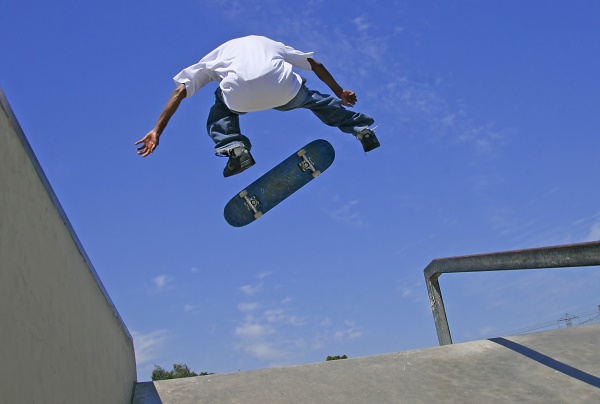
Those who can no longer find places to engage in their high intensity skiing or snowboarding habit may find themselves using the warmer climate for skateboarding. However, that’s another action sport that needs to green up its act. Skateboarding’s main problem is that it uses a lot of wood. An estimated 200,000 thousand new wood decks for skateboarding events are built every month. Skateboarders often compete on a 50-foot-high wooden ramp that lets them take flight. In an attempt to salvage some of that wood, an organization called the Action Sports Environmental Coalition (ASEC) unites athletes, celebrities and corporate sponsors in recycling the ramps. Over the last two years, ASEC has sponsored the “Give Back Good Wood for the Hood” program, which dismantles the wooden skateboarding ramps used at such events as the X-Games and re-creates skateboarding parks in disadvantaged neighborhoods.
ASEC was, in fact, co-founded by a skateboarder, none other than world champion Bob Burnquist, who is also an organic farmer and grass roots environmentalist. As well as skateboarders, ASEC involves other members of the sports action community such as surfers, snowboarders and BMX bikers in promoting ecological responsibility in their various sports.
Another summer action sport is paddling – in kayaks, outrigger canoes, paddleboards, or other assorted vessels. Paddling leaps into the extreme sports realm at the Molokai Race in Hawaii, a 32-kilometer journey on what has been called one of the most treacherous spans of ocean in the world. Japanese athlete Takuji Araki participates every year and is the only athlete to take part in four different competitions, including surf skiing. Every year, Takuji flies the Eco Flag, a symbol of the commitment of sports enthusiasts worldwide to the environment. The Ecoflag is a global initiative, run by the Global Sports Alliance, based in Japan and supported by the United Nations Environment Program. Over 6,000 of the flags now fly at sporting events around the world as a symbol of the athletes’ commitment to the environment.
Extreme sports began as a southern California alternative phenomenon favored by young, idealistic rebels, well suited to caring about the environment. But now it’s become big business, with the corporate world perceiving it as a vehicle for marketing to the important 18- to 25-year-old male demographic. And now, the pinnacle of participation in the action sports world is the X Games. Launched in 1995 by sports broadcaster ESPN (which is owned by ABC/Disney) and held in Los Angeles in August (there are also winter Games,) the X Games have jumped on the environmental bandwagon and have been declaring themselves in recent years to be “the world’s greenest action sports event.”
And they are trying, with the help of Greenpeace and the ASEC. The X Games Environmentality™ program focuses on preventing pollution, purchasing sustainable materials and reducing waste. Among the eco-friendly changes has been a switch to the use of FSC-certified wood for the competition ramps used by skateboarders, BMX bike riders and in-line skaters. In addition, athlete trading cards are printed on 100 percent recycled paper that’s processed without chlorine, the sound system is powered by a solar bus and recyclables are sorted out of the garbage bins. Wind power credits provide a source of renewable energy and last summer’s Games were carbon neutral through the use of emissions offsets. To honor participating athletes, 700 trees were planted in support of preventing pollution. In the staff catering area, utensils, plates, and cups made from biodegradable materials, such as corn, sugarcane, and paper were provided.
“The ESPN X Games attracts a young demographic, and that puts us in a terrific position to lead by example in increasing environmental education and awareness for future generations,” said Chris Stiepock, X Games General Manager. “Our sports depend on a healthy environment, and we’re proud of our efforts to preserve natural resources in any way we can.”
So whatever sport you choose to play this summer, for fun or competition, you can find a way to do it that won't harm the environment.
Wendy Priesnitz is the Editor of Natural Life Magazine and a journalist with over 40 years of experience. She has also authored 13 books.
|