Small is Beautiful
Living in less space can be good for the Planet
as well as for your bank account
by Wendy Priesnitz

Tumbleweed Tiny House Company designer (and tiny house dweller) Jay Shafer estimates this building can be built for $20,000 (not including price of lot and using some reclaimed materials.) |
I grew up in the 1950s and ’60s living in a small, two-bedroom bungalow where multiple uses of space were common and privacy was minimal. As a newly married couple, my husband and I lived in a VW van, and later an RV with our two small children. Much later, some of the happiest years of my life so far were when he and I lived and worked in a 500-square-foot apartment with a wall of south-facing windows overlooking Toronto's harbor. Maybe that’s why I’ve never been attracted to those multi-bedroom, multi-bathroom, increasingly large mansions that so many North Americans aspire to – even as the average North American family size is decreasing.
In most of the world, micro-homes are the norm because land is expensive and scarce and extended families are used to sharing their lives, living spaces and other resources. Even new homes in places like Tokyo are built on lots the size of many Western front yards. And now, there is a rising interest in compact dwellings here in the land of wide open spaces, where building big has been possible, so we have done it...and become used to it, even addicted to it. Like so many other lifestyle addictions, this one has caused us to hit a wall and many people are looking for antidotes in the smaller living spaces with tiny footprints that are popping up amongst the “McMansions.”
Big houses cost big money and many people of my generation are choosing to downshift, taking early retirement, switching careers in mid-life and generally acting on a desire for simpler, more effective living. As a result, many of us are “right-sizing” our living spaces, redirecting our financial resources away from big mortgages and toward our dreams. At the same time, many young people are having a harder time than their parents did getting established in careers, and are therefore finding that small houses and minuscule condos fit their economic conditions just fine.
Big houses are also resource-hungry. With the current blossoming of concern about the environment, reducing the energy consumption of our houses is, for many people, a personal step towards reduction of the greenhouse gases that contribute to global warming. And, according to many experts, one of the best ways to reduce a house’s energy consumption is by decreasing its size.
Writing in the Journal of Industrial Ecology (Winter/Spring 2005), Environmental Building News editors Jessica Boehland and Alex Wilson note that a small house built to only moderate energy performance standards uses substantially less energy for heating and cooling than a large house built to very high energy performance standards. They also point out that as house size increases, more land is occupied, increased impermeable surfaces result in more storm-water runoff and construction resource use increases.
Aside from saving resources, there are other ecological advantages to living in a small space. An obvious one is the need to own fewer possessions and therefore to consume less. Another advantage is that if you are building, renovating or even decorating a small living space, the reduced size might mean you can afford to use high quality, healthy, natural materials.
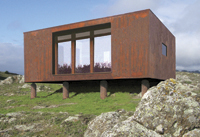
This 300 square-foot home from California-based Tumbleweed Tiny House Company represents the confluence of luxury and simplicity. The kitchen, bathroom, bedroom and storage are relegated to the ends of the structure, leaving the central area wide open. Stainless steel countertops, fireplace and other details contrast with the pine-ply interior. The exterior is clad in hot-rolled steel. |
Other advantages? Since small spaces require good design and efficient use of space (think boat galley or travel trailer,) many people find that they have just as much livable space in a small house as they did in one that comprised many more square feet and lots of wasted space. And I would be remiss if I didn’t mention that a small living space takes much less time and effort to clean! The time it takes to clean a big house would be time taken away from the work I’m passionate about, and from being with friends and family.
Sarah Susanka, an architect based in Minneapolis and author of The Not So Big House: A Blueprint for the Way We Really Live, advocates small houses in order to create a sanctuary that simplifies our lives rather than taxing our energies in maintaining it. And to accomplish that, she suggests making rooms do double duty, in the same way those in my childhood house did. She points out that many people live in houses with formal living rooms and dining rooms, yet these rooms are rarely used. In addition, many homeowners have added “specialty rooms” such as exercise rooms or media rooms, which are only occasionally used. So, instead, she suggests that we organize our living space relative to whether it is used for public or private purposes. Her Not So Big strategies include lowering ceiling height in part of a larger room to create a cozy reading spot or using controlled lighting to set the ambiance for different occasions (for example, making an eat-in kitchen into a dramatic dining area one night or a brightly lit place to do homework the next.)
Unfortunately, the idea of small living spaces may only be as viable as the municipal zoning bylaws and mortgage lenders that govern people’s access to the sort of housing they want. In many municipalities, homes under a certain size – often 600 or 700 square feet – are prohibited. And lenders thinking about resale value are often wary about financing what they consider to be too-small spaces.
Fortunately, times are changing. Issues like the need for affordable housing and the scourge of ugly “McMansions” have led some cities to try and ban larger houses and encourage smaller homes. For instance, the cities of Portland, Oregon and Vancouver, British Columbia have established zoning and design guidelines to encourage well-designed smaller living spaces in the 1,000 square-foot range (admittedly not tiny, but a big change in the right direction in terms of sustainability.)
| For some tips about adapting to small space living, check out this article. |
Portland has even held a design competition to create a “skinny house” that was acceptable to neighbors where the small structures would be built as infill. (The idea that “small” means “poor” dies hard, hence the NIMBY factor at play.) The plans for the two houses that were chosen are available free once a developer has a building permit for a “skinny lot.”
An alternative to building a new small house or living in a highrise is to find an older house that was built in the era of smaller homes – say, between 1945 and 1975. There are whole neighborhoods of these houses in towns and cities across the continent. They are usually less expensive that their larger suburban cousins, often accessible to stores by transit or walking, and just waiting to be fixed up and loved by someone who understands that small can be beautiful.
Wendy Priesnitz is the co-founder and editor of Natural Life Magazine and a writer with over 40 years of experience. She has also authored 13 books. Visit her website.
This article was published in Natural Life Magazine in 2007.
|