A Fruitful Harvest
Growing community and creating a local, public food supply by gleaning
by Wendy Priesnitz
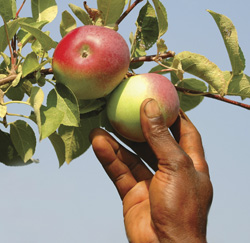 Imagine a city or town where apples, pears, nuts, oranges, cherries and berries line the streets, create welcome shade in parking lots and parks and provide free food for anyone who cares to pick it. Instead, most urban areas are planted with sad shrubs, neglected “ornamental” non-native trees that require too much water and bedraggled annual flowers planted in regimented rows. Imagine a city or town where apples, pears, nuts, oranges, cherries and berries line the streets, create welcome shade in parking lots and parks and provide free food for anyone who cares to pick it. Instead, most urban areas are planted with sad shrubs, neglected “ornamental” non-native trees that require too much water and bedraggled annual flowers planted in regimented rows.
Visionary groups and individuals around the world have found ways to combine the local food movement with beautifying neighborhoods, while building community and feeding themselves at the same time.
The idea of “public fruit” is what propels a project in Los Angeles that was begun as an activist art project called Fallen Fruit. Artists David Burns, Matias Viegener and Austin Young mapped the public fruit – which they define as fruit in or overhanging public spaces such as sidewalks, streets or parking lots – in their neighborhood. According to California law, if a fruit tree grows on or over public property, the fruit is no longer the sole property of the owner of the tree, which makes free food available year round in LA without trespassing on private property...providing one knows where to find it. While public fruit might not be a four-season phenomenon in other areas, Fallen Fruit has a vision of expanding the maps around the world, and provides tools on its website for learning how to map public fruit.
The group believes that fruit is a resource that should be commonly shared, like mushrooms from the forest. So it has moved from mapping to planning fruit parks in under-utilized areas and encouraging municipalities and urban planning groups to replace ornamentals with edible species to be shared by all citizens, similar to the communal gardens in many cities that provide food for poor families. The goal is to get people thinking about the life and vitality of our neighborhoods and to consider how we can change the dynamic of our cities and common values.
They also offer a Public Fruit Jam, where residents bring their own fruit and jars and learn the art of making jam. Fallen Fruit has only a few rules: “Take only what you need, say ‘hi’ to strangers, share, take a friend and go by foot.”
Common Vision is another southern California organization that believes in creating safe local food supplies through urban fruit plantings. Earlier this Spring, traveling in what they called the “world’s largest veggie-oil powered caravan,” 27 volunteers planted 1,000 fruit trees on their fourth annual 20-city, 70-day tour to urban schools from San Diego to Sacramento.
In a one-of-a-kind day-long interactive outdoor program that includes West African agricultural drumming and eco-conscious hip-hop, Common Vision’s Fruit Tree Tour teaches inner city students how to turn barren school yards into abundant orchards, using Permaculture principles to create living classrooms with the potential to produce enough fresh fruit for the a school’s cafeteria and for members of the school’s community.
Each year the tour visits first-time schools to plant new fruit trees while returning to old school orchards to start new initiatives like Roots to Fruits: School Nurseries to Feed Communities, a grafting program, and Harvest Hip Hop, a roots-rhythm rap contest.
| Visionary groups and individuals around the world have found ways to combine the local food movement with beautifying neighborhoods, while building community and feeding themselves at the same time. |
Founded in 1999, Common Vision is a solution-focused nonprofit organization, a project of the International Humanities Center. Its mission is to cultivate ecological awareness and respect for the Earth while generating social and environmental changes towards sustainable lifestyles.
Common Vision participates in another LA initiative called Fruit Trees to Combat Hunger, run by TreePeople, which has been planting trees in Los Angeles for over 25 years.
Urban orchards planted for community development purposes are growing in many other areas. In Boston, Massachusetts and neighboring areas, an organization called EarthWorks has been working towards a healthier and more sustainable local environment since 1990. Its Urban Orchards project is a greening and food production program that operates with local groups to plant, maintain and harvest fruit- and nut-bearing trees, shrubs and vines on public land. There are now close to 1,000 trees in almost 50 urban orchards and the organization publishes the Urban Fruit Guide, which lists publicly accessible fruit, nuts and berries – not only in its orchards but at all publicly accessible sites in Greater Boston – and provides growing and harvesting tips.
Not everyone lives in a place where there are public orchards or where it’s legal to pick fruit growing on or overhanging public property. So some so-called “guerilla gardeners” have taken to cleaning up and planting gardens on neglected public or private (often commercially- owned) property. Guerilla gardeners run the gamut from anarchists fighting corporate domination of space and food supplies to local gardening groups seeking to beautify their neighborhoods. And many of them will use whatever seeds or plants they can find or get donated, oblivious to their food value or compatibility with the environment in which they will be growing. Toronto (“we vandalize the city with nature”) and London, England have thriving but ever-morphing guerilla gardening groups that do encourage native plants and sometimes cultivate herbs and the odd tomato seedling. However, the movement has its roots firmly planted in urban food production.
Many in the movement trace the guerilla gardening term to New York City in 1973 when Liz Christy reclaimed a patch of land to grow a community garden that is still going strong. And yes, it contains fruit trees. The organization that resulted, called Green Guerillas, now uses a unique mix of education, organizing and advocacy to help people cultivate community gardens, sustain grassroots groups and coalitions, engage youth, paint colorful murals and address issues critical to the future of their gardens.
Working with fruit grown on private rather than public property is the focus of a community-based, registered charity in Vancouver, British Columbia. The eight-year-old Vancouver Fruit Tree Project connects people who have fruit trees, people who can help harvest fruit and community groups that use fruit in their programs. Last year, they distributed over 4,000 pounds of fruit to nine community partners, which, in turn, ensured that the fruit fed children, families and youth across Vancouver who would otherwise not have access to fresh fruit.
Their idea is simple: building communities and strengthen food security using local backyard fruit. The Vancouver Fruit Tree Project also partners with Community Kitchens to offer canning workshops to develop skills which are being lost in our urban environment.
Indeed, this productive urban fruit tree movement has many benefits. Fruit- and nut-bearing trees afford the same benefits as other urban trees: Aside from providing an abundant supply of locally-grown, chemical-free food, they provide beauty, shade in the summer, a nearby relief to carbon-based pollution and proximity to nature. That’s not bad for what was often under-used, abused or even forgotten space.
Wendy Priesnitz is the Editor of Natural Life Magazine and a journalist with over 40 years of experience. She has also authored 13 books. Visit her website.
This article was published in Natural Life Magazine in 2007.
|