Target: Zero Energy Homes
A new generation of houses that produce as much energy as they use
by Wendy Priesnitz
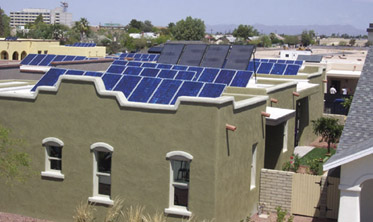
This all-electric Zero Energy Home was designed by architects Devereaux and Associates and built by John Wesley Miller Companies in the Armory Park del Sol development in downtown Tucson, Arizona. It features a 4-kW BP Solar photovoltaic array. Photo courtesy NAHB Research Center
|
“Zero Energy Homes” (ZEH) or “Net-Zero Energy Homes” (NZEH) describe buildings that are connected to the utility grid, but combine highly energy-efficient design and technology with solar electric and thermal systems to produce as much energy as they use on an annual basis, resulting in net zero energy consumption.
Zero Energy Homes have a number of advantages, including improved comfort, as an energy-efficient building envelope reduces temperature fluctuations, reliability because the systems continue functioning during blackouts, protection from fluctuations in energy prices and environmental sustainability. They optimize a variety of features, including climate-specific design; passive solar heating and cooling; energy-efficient construction, appliances and lighting; and solar thermal and solar electric systems.
In Canada, The Net-Zero Energy Home Coalition, a group of homebuilders and renewable energy developers, has concluded that Canada has the potential to become a world leader in the design and development of NZEHs.
“With existing Canadian innovation and technologies, the Net-Zero Energy Home builds upon Canada’s pioneering work in energy efficient home construction, embodied in the R2000 standards, and empowers Canadians to make an even greater contribution to the environment”, says Tom Krizsan, President of Thomasfield Homes, a member of the Coalition.
R2000, developed by Natural Resources Canada, is one of the highest technical standards in the world for new housing construction, ensuring that homes are more comfortable and energy efficient with better indoor air quality and quality of construction.
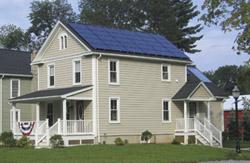
A dilapidated 4,000 square-foot historic farm house in Califon, New Jersey was remodeled by Bill Asdal (Asdal Builders) in conjunction with the NAHB Research Center and with support from the Department of Energy Building America Program. It is now a net-zero energy B&B. Photo courtesy NAHB Research Center
|
In 2007, with the Coalition’s consultation, the Canadian Minister of Labour and Housing announced a contribution of $1 million for the launch of the first phase of a NZEH initiative. This funding will serve to showcase the concept of net-zero energy homes in communities all across Canada. The initial phase is part of a five-year, community-scale demonstration aimed at completing 1,500 NZEH homes across all provinces and territories.
In 2006, Canada Mortgage and Housing Corporation (CMHC) began accepting Expressions of Interest from builder and developer teams to participate in what they are now calling the “Net Zero Energy Healthy Housing” initiative (NZEHH). Up to 20 teams were selected from the responses to proceed with the detailed design development of their projects. Winning designs were selected to advance to the construction and demonstration phase for NZEHH projects across Canada.
Successful demonstration teams were recognized nationally as a competition winner and received a financial contribution of between $50,000 and $100,000, depending on the costs associated with the project. Teams also received technical, marketing, research and communications support.
In a presentation to the Toronto Green Building Festival in October, 2005, the Net-Zero Energy Home Coalition predicted that by 2030 all new homes built in Canada would meet a net-zero energy standard.
At the same time, the U.S. Department of Energy’s Zero Energy Homes research initiative is bringing the concept to homebuilders across the United States. A newly published study, The Potential Impact of ZEH, developed through a collaborative effort by the NAHB Research Center, the U.S. Department of Energy and the National Renewable Energy Laboratory, presents a far-reaching outlook into the possibilities for Zero Energy Home technologies in the new home market and their potential impact on U.S. energy consumption through 2050.
While ZEHs are technically feasible and exist today in the U.S., they have yet to widely penetrate the new home construction marketplace. However, market penetration of highly efficient homes with solar energy systems has already begun, and will continue in certain geographic areas. EPA Energy Star home sales have experienced enormous growth, going from zero in 1995 to 130,000 in 2004, with up to 40 percent penetration in select markets.
The Potential Impact of ZEH study concludes that with continued federal research and development programs to lower the cost of advanced energy-efficiency building technologies, the ZEH concept will begin to diffuse into the mainstream housing market as early as 2012. Currently, in a new development by Morrison Homes in Lakeside, California, ten percent of the homes are ZEH, selling for an $18,000 premium. In the Premier Gardens development in Sacramento, all 94 homes are ZEH and 350 people are on a waiting list for future ZEH homes.
Author Wendy Priesnitz is the Editor of Natural Life Magazine and a journalist with over 40 years of experience. She has also authored 13 books. This article was published in Natural Life Magazine in 2006.
|