Renovate Your Home, Naturally
by Rolf Priesnitz
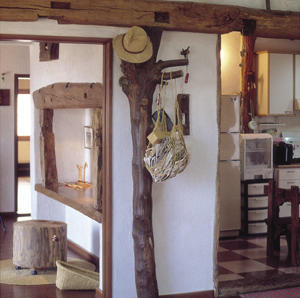
Photo © Shutterstock |
Millions of us are renovating our homes every year, spending more money annually on renovation than on new home construction. Since buildings are responsible for 40 percent of worldwide energy flow and material use, how you remodel can make a big difference to the environment. Kirk Smith, founder of the Greenhouse Crisis Foundation in Washington, D.C., has said that American homes and apartments account for the largest share of carbon dioxide released into the atmosphere by all sources worldwide. Upgrading insulation, furnaces, cabinets and fixtures like water heaters and toilets means less fossil fuel pollution and reduced resource depletion. It can also save you money in the long-run. However, renovations can be fraught with unintended consequences like indoor air pollution. There are many aspects of home renovation, but here are some tips for undertaking flooring and painting projects in a healthy, environmentally friendly way.
Green Reno Basics
A green renovation involves two interrelated concepts. One is to be as earth-friendly as possible by using sustainable and/or recycled materials, and to reduce energy and water use by employing measures like solar and geothermal heating, high-efficiency lighting and green roofs. The other is to create a healthy living space by using nontoxic alternatives to conventional building products.
The key to making a building green is to view the entire structure as a system. While it may seem like every little environmentally-friendly upgrading would be a good thing, it is also true that every aspect of the home can positively or negatively affect the other areas of the home. For example, sealing cracks and adding insulation affects how your heating system functions and can negatively impact indoor air quality or create mold growth. That is why it is important to think through your needs and budget, and draft a long-term plan for your renovations.
The current interest in environmentally friendly building and renovating has created a bit of a gold rush around the term “green”, with some products being labeled that way that aren’t…or that are, at best, a very pale shade of green. Fortunately, there are some certification and labeling programs that can help the confused consumer sort out the green claims. Lumber that has earned certification as sustainably harvested can be found at most lumberyards; appliances such as water heaters and refrigerators carry the US Department of Energy’s Energy Star rating labels; the Green Seal program recommends products like carpet, floor care products, wood finishes and stains, lighting and environmentally friendly room air conditioning; and Canada’s Environmental Choice program certifies everything from bamboo and other wood-substitute flooring products, carpeting, composting toilets and water-saving showerheads to exhaust fans, wallboard, hot water tanks and shingles.
Beyond labeling, use a common sense approach to purchase natural, non-petroleum-based, recyclable materials that will last longer and save landfills from being filled with poorly made junk. When choosing renovation materials or fixtures, look for aggressive rates of recycled content, absence or reductions of undesirable chemicals like formaldehyde and products that conserve resources.
Lastly, check with your municipal, provincial/state and federal government sources to see if there are tax credits, rebates or grants available for energy-efficient retrofitting of your home.
Wood
Wood floors, trim and furnishings can add value to a home and give it a warmth and natural aura. They are also generally easier to keep clean and therefore healthier than carpeting. However, clearcutting forests for their lumber can create loss of wildlife habitat, runoff into streams from erosion, and decline in carbon storage capacity and an increase in biomass carbon loss, severely impacting on climate change.
Fortunately, there are options for the environmentally conscious renovator. You might want to consider using fast-growing bamboo harvested from Southeast Asia or tiles of cork, made from the bark of trees in the Mediterranean.
Another green option is wood that has been cut from forests managed sustainably. This is wood that has been certified by the Forest Stewardship Council (FSC), an international nonprofit organization whose certification program is backed by industry and environmental organizations.
Wood carrying this certification must be produced in a way that minimizes such environmental impacts as road building and erosion, keeps pesticide use to a minimum, protects species and promotes diversity within the forest. There is a paper trail, called a chain of custody, back to the forest where the wood originated, so you know just how the wood has been grown, harvested, milled, stored, etc. Certified wood comes from more than 50 countries, including from Central and South American tropical rainforests.
Another alternative, which avoids felling new trees altogether, is to use recycled wood. Old reclaimed wood is often salvaged from large warehouses and buildings, from landfills or urban tree salvage, and from old barns and even riverbeds. Especially prized are the wide planks and massive hand hewn wood beams, in sizes that are unmatched in today’s lumber yards. Old recycled lumber is strong and dense; it is also dry wood and as such is unlikely to twist, warp or shrink. It features deep, beautiful colors, character features and a rich patina that can only be bestowed by time. And it also has a history that lends it story to your home. Heart pine, old growth oak, Douglas fir, cypress and black cherry, are all being rediscovered after centuries of growth and almost that many more years of aging. These “rediscovered” woods can be remilled into boards used for flooring, moldings, stairs, cabinets and furniture. Getting this old rustic used wood cleaned and ready to market is a labor-intensive job, so the price of reclaimed lumber is comparable to or sometimes higher than that of new wood.
Some recovered wood is certified. Under the FSC banner “SmartWood” a recovered wood certification program authenticates the wood, providing a chain-of-custody document that describes the origin and handling of the wood. Such certification does more than trace the timber; it guarantees its owner that the wood, the built environment from which it came and the ecosystem were all handled with respect.
Some companies and trade organizations, such as the Reclaimed Wood Council, offer their own documentation and wood histories. For instance, wood obtained from a demolition contractor can be linked to an address and photos. Lost timbers recovered from riverbeds can be identified by the number of growth rings. Whatever the method, verify that the dealer is reputable before investing in recycled wood.
Another category of options is sometimes referred to as “green wood” products. These products include formaldehyde-free composite wood panels, particle board made from waste wheat chaff, arsenic-free pressure-treated lumber, engineered structural wood and plastic lumber. Most of these products are not certified, although there is some certified particleboard available and greater demand is leading to more certification. Often, green wood products use small, second-growth trees of lesser-used species, such as aspen and poplar, reducing the demand on species like Douglas fir and southern pine, and helping preserve old-growth giants. They also often are made by recycling waste material like sawdust from other wood milling projects. Plastic lumber is produced from 100 percent recycled plastic without toxic chemicals like the arsenic that is often found in regular decking and materials used for outdoor construction.
Paint
Repainting your home is often the quickest and least expensive way to freshen things up. But it can negatively affect the air quality in your home. According to the U.S. Environmental Protection Agency (EPA), paints, stains and other architectural coatings produce about nine percent of the volatile organic compound (VOC) emissions from consumer and commercial products, making them the second-largest source of VOC emissions after automobiles. VOCs are carbon compounds that evaporate at room temperature and react in sunlight to help form ground-level ozone, an integral component of photochemical smog. VOCs can cause respiratory, skin and eye irritation, headaches, nausea, muscle weakness and more serious diseases, according to the EPA. Formaldehyde, a VOC commonly found in paint, is a probable carcinogen. The EPA has found that indoor concentrations of VOCs are regularly up to ten times as high as outdoor concentrations, and can climb up to a thousand times as high as outdoor concentrations when you are applying paint.
Choosing paint based on its reportedly low level of VOCs can be problematic. Government regulations tend to allow products to be labeled as having zero or no VOCs even when they contain small amounts. Non-profit certifiers like Green Seal set more comprehensive requirements, but some paints may still contain harmful ingredients such as preservatives, fungicides and biocides like formaldehyde. Since VOCs and other toxins are often contained in the pigment added to paint at time of purchase, actual emissions may be higher than those quoted for the base paint. And since darker colors require more pigment, deeply colored paint may contain more VOCs than paler colors. So check the quality of the pigment being used as well as the base paint; requesting the Material Safety Data Sheet for the pigment will help you to avoid obviously harmful substances like cadmium, mercury and other heavy metals.
So-called “latex” paints have lower VOC levels than oil-based paints, simply because they use water as the carrier rather than petroleum-based solvents. Except for appearance, the latex used in paint is in no way connected with the natural latex used, for instance, in some kinds of rubber gloves, which can cause allergic reactions. Latex paint cleans up easily with water, so you don’t need harsh VOC-emitting solvents to work with it.
There is an increasing availability of “natural” paints, composed of materials such as citrus oil, lime, clay, linseed oil and chalk. Because natural paints do not contain petroleum products, they emit few if any VOCs and are healthy and environmentally friendly. They use linseed and soy oils as binders, pine- and balsam-derived turpenes or citrus oils as carriers, minerals as pigments, and lime and chalk as thickeners. Milk-based paint, which is made from a milk protein called casein, is the least toxic and least environmentally damaging paint. It contains no VOCs, lead, formaldehyde, oils or biocides. You can buy milk-based paint premixed or mix it yourself, which saves shipping-related pollution. However, it is unsuited for kitchens or bathrooms because it can host mold.
Once you’re finished repainting your home, you will inevitably have some paint left over, a problem shared by paint retailers, manufacturers, contractors and others. The Product Stewardship Institute (PSI) estimates that 34 million gallons of leftover consumer paint are generated annually in the U.S. alone. PSI is working with governments, industry and environmental/consumer advocates to develop leftover paint management solutions that are both financially and environmentally sustainable. Some recycled paint is now available for purchase and PSI has a list of recycled paint sources on its website. Using recycled latex paint avoids the manufacturing impact, but it may not be made of low-VOC paint, so it is best suited to well-ventilated areas.
Rolf Priesnitz is the Publisher of Natural Life Magazine. He also has over 45 years experience in the construction industry.
|