|
Glorious Goldenrod
An unusual and majestic garden flower that attracts beneficial insects and is not an allergen.
By Jo Ann Abell
As the days grow shorter and the flowers of summer are winding down, others are coming into their own, glowing with the fire of early fall color. One of the true glories of the autumn landscape is Solidago, our native goldenrod, its lavish displays of yellow and gold spires a common sight along roadsides, in open woodlands, meadows, pine barrens and marshy thickets. Long a popular plant in European fields and gardens, goldenrod’s popularity for naturalizing gardens and landscapes is on the rise in this country.
The genus gets its name from the Latin solidus, meaning “whole.” Goldenrods have a long history of external and internal medicinal uses by American natives and European physicians dating back to the Crusades. Of the more than 100 species, only one goldenrod is native to Europe and Asia, and a few are found in South America. The remaining species are found in North America – 30 within the Great Smokies of North Carolina and Tennessee alone.
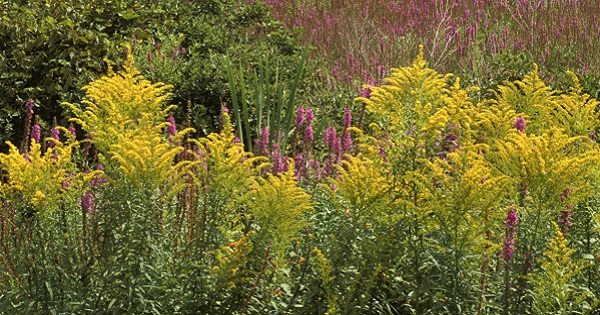
Typical of the Asteraceae family to which they belong, goldenrods are composites. Each little yellow tuft is a densely packed flower head rich in pollen and nectar. Its flower clusters can be plumed, wand-like, axillary or flat-topped. Colors range from a yellow-green as the flower buds, into a rich yellow, and finally bronze at the end of its bloom cycle. Plants can range anywhere from 1-1/2 feet to six feet tall, but four feet is more typical. Leaves can be toothed or smooth-margined, and are most often narrow and lance-shaped.
Pesky Weed or Garden Treasure?
Until recently, goldenrod, which grows in woods, swamps, overgrown fields, salt marshes and even on sand dunes, was generally thought of as a weed. Sadly, most plants that grow abundantly in the wild are often relegated to the weed category. Perhaps Ralph Waldo Emerson came closer to the truth when he wrote that a weed is a plant whose virtues have not yet been discovered. The truth is, many of the “roadside” natives that we unjustly malign as weeds are underestimated when it comes to their aesthetic and ecological value in the natural landscape.
In many areas, goldenrod is one of the last plants to flower before frost, and its abundance of pollen acts as a magnet, drawing many different kinds of pollinating insects. Compared to other flowers, goldenrod is not a big nectar producer, but the sheer number of flowers per plant—over 1,000 on average—counterbalances the low rate of nectar secretion per flower. Its pollen is heavy and sticky so it will cling to its insect visitors for a ride to the next plant, where pollination occurs.
Attracting Beneficial Insects
Native bees rely heavily on this late season bloomer to give them the energy they will need to make it through the long winter. Bumblebee colonies, in particular, store little honey; if they can’t get a steady supply of nectar, they die out. Goldenrod is often the last flower visited by nectar-sipping butterflies before they migrate. Once the flowers are gone, the plants are adorned with seed heads that last well into winter, providing a valuable food source for birds, like chickadees, finches and pine siskins.
Pollen-rich flowers like goldenrod play a significant role in maintaining nature’s system of checks and balances. In addition to their role in pollination, the insects visiting the flowers of the goldenrods act as natural biological controls, helping combat garden pests like slugs, snails and aphids without recourse to chemicals. Regular visitors include pirate bugs, solider beetles, and hoverflies – these are bugs you want in your garden! The larvae of hoverflies feed on aphids; one larva can eat 400 aphids during its short lifetime. Soldier beetles feed on grasshopper eggs as well as the larvae of corn rootworms and cucumber beetles. Pirate bugs feed on thrips, spider mites, and leafhopper nymphs, and are adept at finding harmful insects hidden deep within the goldenrod’s flowers.
Growing Goldenrods
While sunny meadows and former prairie lands carry the majority of the wild species, other goldenrods are quite at home in the partial shade of the woods. Solidago flexicaulis (the zig-zag or broad-leaved goldenrod), S. ulmifolia (the elm-leaved goldenrod), and S. caesia (the blue-stemmed or wreath goldenrod) do well in partially shaded or filtered light. There are goldenrods of bog and fen environments (S. uliginosa, S. ohioensis, S. patula, and S. tenufolia), as well as goldenrods originating in salty seaside areas (S. sempervirens).
Native plants are well adapted to their region. With built-in resilience to temperature and rainfall fluctuations, when planted in the proper situation, they require minimal maintenance. Hardy to Zone 3, goldenrods are drought-resistant and require no fertilizers or herbicides. Although they tolerate a wide variety of soil fertility and soil textures, most species thrive in full sun to very light shade in well-drained soil. 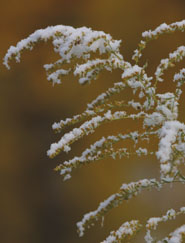
Goldenrods can be propagated by division or by seed. Like other “prairie” plants, the seeds need to be stratified (cold treated) for germination to occur in the spring. Fall sowing allows the changing of the seasons to break the dormancy naturally; if planting in the spring, buy stratified seeds to increase germination chances.
Most wild species propagate by a spreading root system, which can be troublesome in smaller landscaping areas. To avoid crowding out other flowers, plant goldenrods as a border where they have some roaming space. Make the border narrow or leave a path through it for easy picking of flowers and weeding. For smaller spaces, the less greedy, clump-forming goldenrods are preferable to the rhizomatous varieties.
Stiff goldenrod, S. rigida, is a clump forming goldenrod with rounded gray-green leaves. Its flowers are not as showy as some of the others, but the leaves add contrast to the garden. Under ideal conditions, S. rigida can grow to a height of five feet, but cutting it back by one half during the growth season reduces the overall height and makes for more compact growth. Have patience; prairie plants in general spend their first year or two making roots. Your plot or border will not come into its full glory until the third year.
If planting a larger area, mow the new patch when it is about three to four inches high with the blade set high enough to cut the flower heads off the weeds to prevent their reseeding while not harming the young goldenrod plants. If you recognize the weeds, you can also control them by hand weeding. In rural areas, burning the patch in early spring is a great way to control weeds. All prairie plants were grown in a grassland environment and had to survive natural brush fires every few years. Fire was actually a beneficial agent; the flames returned nutrients to the soil and removed the litter. In the modern environment, burning is even more valuable because it helps control exotic, non-native weeds, like wild onions and dandelions, which tend to appear earlier in the spring than the prairie plants.
Some goldenrods are susceptible to powdery mildew, identified by gray patches on the leaves. Full sun, good drainage and ample air circulation (dividing or thinning out clumps increases air flow) reduces the likelihood of disease. The same techniques work to inhibit rust, which appears as bronze spots mainly on stems and the undersides of leaves. Goldenrod gall, a smooth spindle-shaped swelling on the plant’s stem caused by a tiny insect parasite, is harmless. In their search for winter food, downy woodpeckers will chisel their way into the gall and make short work of the insect larvae inside.
Making a Comeback
Goldenrod was a common element of author Willa Cather’s “sea of wind-blown grasses” – the huge tallgrass prairies that covered much of the American plains in pioneer days. Recently, these native prairie perennials are enjoying a long-overdue comeback. A growing awareness of the value of native plants has been translated into urban gardens, bright with goldenrod and its companion plants in the wild – blazing star (Liatris spicata), coreopsis (Coreopsis sp.), purple coneflower (Echinacea purpurea), butterfly weed (Asclepias tuberosa), Indian blanket (Gaillardia aristata) and black-eyed Susan (Rudbeckia sp.). The yellow hues of goldenrod mixed with the varied bronzes, russets, oranges and purples of the fall prairie are a stunning sight to behold.
Be forewarned that many of the goldenrods, being highly specific to the conditions of their native site, are not good performers out of their element. Consult a field guide or your local nursery can advise which varieties are best suited for your climate and growing conditions. But no matter which variety you choose, the profusion of tightly clustered yellow flowers of this wildflower will do double-duty in the garden – adding a splash of vibrant fall color while extending a fragrant invitation to pollinators and other beneficial insects.
Oh, and don't worry about allergies. Seasonal sneezing is not caused by the insect-pollinated goldenrod, but by the wind-pollinated ragweed, which blooms at the same time!
Jo Ann Abell writes and gardens at her home in Middletown, Maryland, USA.
|