|
How to Choose Safe and Healthy Cooking Pots
by Wendy Priesnitz
What kind of pots and pans live in your kitchen cupboards? Ideally, your cooking utensils should be made of an inert substance that does not peel, chip, crack, craze, vaporize, dissolve or harbor bacteria. Plus, it should be a good conductor of heat in order to cook food uniformly, and it should be easy to clean thoroughly. And it would be great if it was also aesthetically attractive!
There are many types of cookware available, but no one substance seems to fit those ideal criteria.
Aluminum
Take aluminum, for example. It’s a great heat conductor, lightweight, inexpensive and easy to clean. However, some aluminum is dissolved into food when you are cooking acidic foods like fruits and tomatoes or anything containing vinegar. Even if there is little risk from exposure to the levels of aluminum released into food from cooking, we are exposed to aluminum cumulatively from many other environmental sources. In addition, salty water or food can pit aluminum cookware, making older pots a possible source of trace amounts of substances like arsenic and fluorides.
The more expensive anodized aluminum cookware is a safer alternative. The electro-chemical anodizing process locks in the cookware’s aluminum so that it can’t leach into food.
Porcelain-Enamel Coating
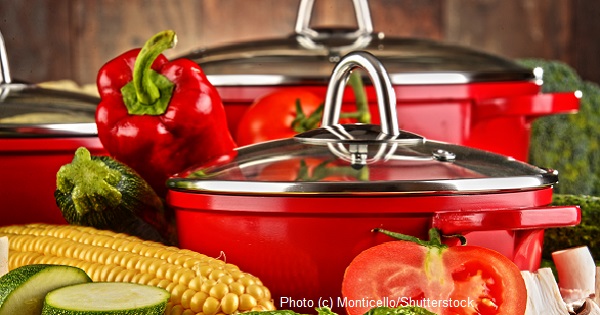
An alternative is aluminum or steel coated with porcelain-enamel. As long as the coating remains in good condition, the surface of these pots is durable, with no metal leaching into the food. Good quality cookware will have an extremely hard finish that is fused to the metal and won’t scratch, rust, fade or peel. However, some lower-priced cookware, which resembles porcelain-enamel, has an easily-damaged baked enamel finish.
Ironware
Ironware may be a good choice for some cooks, although cast iron is heavy and you need to be careful to prevent rusting. Clean your seasoned cast ironware by scrubbing it with table salt...it acts as an abrasive and absorbs grease. Cast iron cookware releases some iron into food – one of the few instances where metal leaching into food from cooking utensils is considered desirable. Although the iron is not easily absorbed by the body, it interacts with foods and provides some beneficial dietary iron. Ironware also saves a bit of energy, since it retains heat after the element is turned off.
Stainless Steel
Many health-conscious people swear by stainless steel cookware. But while stainless steel is relatively inert compared to other metals, the metals present in the alloy can be released into food in extremely low quantities. These metals can include nickel, molybdenum, titanium, aluminum, and carbon steel.
Researchers differ on the health effects of these metals leaching from stainless cookware. Most say that while these quantities are not hazardous to the average person, they may affect those with sensitivities. A 1995 study found that stainless steel pans contributed markedly to the levels of nickel in cooked food. In contrast, another study, also released in 1995, found only minor increases in nickel concentrations in acid foodstuffs when new stainless steel pans were used.
Copper
Aside from the slim possibility of leaching metals, new research suggests that copper may be a better choice for cookware than stainless steel. According to a team of researchers from the University of Southampton in England, using copper pots may lower the risk of infection from potentially deadly bacteria such as E. coli 0157.
“Stainless steel is used throughout the world because of its perceived hygienic properties...But a closer look reveals scratches and marks that, on a microscopic scale, are more like valleys. It is very easy for pathogens to get into these crevices, and rubbing a cloth or brush across the surface may not be sufficient to get them out,” says Bill Keevil, the microbiologist who headed up the study.
Keevil and his team found that, at room temperature, E. coli 0157 survived for 34 days on stainless steel and only four hours on copper.
Some health experts, however, warn of high levels of cooper leaching that can occur when acidic foods are prepared in copper utensils, which can cause chemical toxicity and illness. Copper is both a toxic heavy metal and a mineral that is essential to good health. Symptoms of copper toxicity include trouble concentrating, tender calf muscles, unexplained nausea, irritability, hyperactivity, constant fatigue, and chronic joint pain.
Scientists and nutritionists agree that most diets contain enough copper to prevent a deficiency and not enough to cause toxicity. The capacity of healthy human livers to excrete copper is considerable and few cases of chronic copper poisoning have been reported.
So if you favor copper pots for their excellent heat conductivity, be sure the cooking surfaces are lined with tin or stainless steel.
Ceramic and Glass
Pottery (ceramic) and glass cookware, as well as metal with an enamel coating, are easily cleaned and can be heated to fairly high temperatures. Ceramic and enamelware cookware is glazed to resist wear and corrosion. The only real health concern about using glassware or enamelware comes from minor components used in making, glazing, or decorating them, such as pigments, lead, or cadmium. If you purchase conventional cookware from a reputable cookware store, it should be safe, since these substances are highly regulated by governments. Any product containing more than trace amounts must be labeled as decorative and not suitable for use with food. However, if you bring in glazed ceramic cookware from abroad, it may not meet our permitted levels for lead and cadmium, so caution is advised.
Once ceramic, glass or enamel cookware get chips, cracks, or crazing on the surface, it should no longer be used for cooking or serving food.
Whatever your choice of cookware, keep it scrubbed scrupulously clean with soap and water, do not use harsh scouring pads or cleaners, and follow manufacturers’ care instructions. New pots are definitely better than old ones, with the possible exception of cast iron.
And finally, if in doubt about whether or not to use it for cooking, plant flowers in that lovely looking pot that you can’t bear to part with!
A Word About Non-Stick Cookware
Even though non-stick cookware is preferred by many people who wish to decrease levels of fat in their diets, I can't recommend it, mostly due to health and environmental concerns about perfluoroalkyl compounds (PFCs), a family of chemicals used to bond the nonstick coating to the pan. PFCs have been shown to cause cancer, low birth weight, and a suppressed immune system in laboratory animals exposed to high doses. Studies have shown them to be present at low levels in the bloodstream of nine out of ten Americans, in breastmilk, and in the blood of most newborns. A 2010 study published in the Archives of Pediatrics & Adolescent Medicine has found that they may raise cholesterol levels in children. The research found that children with the highest blood levels of these compounds had higher levels of total cholesterol and low-density lipoprotein – the so-called "bad" cholesterol – compared to children with low readings.
However, the U.S. Environmental Protection Agency (EPA) has asked eight American companies, including DuPont, maker of Teflon-brand nonstick cookware, to work towards the elimination of PFCs, including PFOA, which they have finally labeled a likely carcinogen, by 2015. Even if PFCs are phased out, there are concerns about toxic fumes being released from non-stick cookware if the pots are over-heated. According to DuPont, cookware with Teflon coating has a recommended maximum use temperature of 500 degrees Fahrenheit and that significant decomposition of the coating will occur only when temperatures exceed 660 degrees Fahrenheit. In 2003, the Environmental Working Group (EWG) reported that nonstick coatings "could reach 700 degrees Fahrenheit in as little as three to five minutes, releasing fifteen toxic gases and chemicals, including two carcinogens." The EWG says that toxic fumes from non-stick cookware is known to kill pet birds at much lower temperatures.
A study conducted in Veneto Italy, and published as a peer-reviewed article in 2018 in the Journal of Clinical Endocrinology and Metabolism, shows that young men exposed to PFOA and the related PFOS (perhaps in utero) have a range of reproductive problems. These chemicals, which are also used in waterproofing products and firefighting foam, can bind with testosterone receptors inside human cells and disrupt the normal function of the hormone, probably resulting in lower sperm counts.
Wendy Priesnitz is the Editor of Natural Life Magazine and a journalist with 40 years of experience. She has also authored 13 books. This article was first published in Natural Life Magazine in 2001 and most recently updated in 2018.
|