When the Grass Stops Growing Out of the Wall
Learning Straw-Clay Building
By Wendy Priesnitz
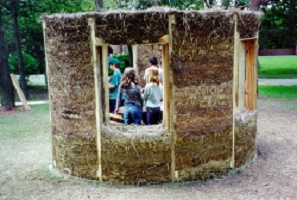 It was a cloudy June morning in north Toronto, Canada. A couple of dozen kids dressed in green garbage bags were gathered in a shady park pouring muddy water over piles of straw like dressing onto a salad, then tossing the straw around until both kids and clay were coated with the clay slip. A creative way to dampen pre-summer break energy? A devious plot to sell laundry detergent? It was a cloudy June morning in north Toronto, Canada. A couple of dozen kids dressed in green garbage bags were gathered in a shady park pouring muddy water over piles of straw like dressing onto a salad, then tossing the straw around until both kids and clay were coated with the clay slip. A creative way to dampen pre-summer break energy? A devious plot to sell laundry detergent?
Actually, I was watching the construction of what may be Canada’s first straw-clay building, a ten-foot diameter structure that builder Dan Boileau hopes will launch this ancient, natural building technique into this country.
Once the kids had finished mixing the straw and clay together, they stuffed it by handfuls into two-foot high by one-foot thick plywood vertical forms around the perimeter of a round stick frame structure. The mixture was compacted and poked tightly into the corners of the forms.
Many of the young builders appeared to enjoy this compacting process the most, some of them taking off their shoes and socks, climbing inside the forms, and delightedly stomping the straw and clay into submission. Later, the forms were removed and re-nailed higher up the wall so the process could begin again.
Boileau took a break from mixing clay slip and supervising his construction crew to describe the process. In a month or two, when the wall has dried – “when the grass stops growing out of the wall” is how he will know it’s ready – clay plaster will be added both inside and out. The result will look like adobe.
The structure is located on the grounds of the Bloorview MacMillan Centre’s Bloorview site in Toronto, Ontario. The Bloorview MacMillan Centre’s mandate is to enable kids with disabilities. The building will be a small, contemplative space for clients of the centre and others from the community to use for story telling and dream journeys. It will be a focal point of an integrated, outdoor, summer arts experience called the Cosmic Bird Feeder. For four week periods during the summer, artists and musicians provide a sanctuary for the imagination and creative energy of both special needs and able-bodied kids.
The young construction workers were grade three students from Allan Howard Waldorf School in Toronto, who spent the year studying the concept of “home”. Before beginning to mix, stuff and compact, they ceremonially buried tiny clay houses they had made in the walls of the building.
Boileau is a straw-clay enthusiast who has helped build such structures in other countries, including a 4,500 square foot house in the United States. He says that straw-clay (a term that is used interchangeably with “light clay” to distinguish it from heavier forms of earth construction like adobe) is a building material with unique properties.
It is a very low-impact and efficient material, site-made of unprocessed earth and waste agricultural fiber. It is hard, durable, sculptable, recyclable, and non-toxic. It is both a reasonably good insulator and a thermal storage medium. It has excellent breatheability, handles water vapor well in a cold climate, and it is resistant to rot, vermin and fire.
In various forms, straw-clay mixtures have a long history of successful use in buildings in many parts of the world, notably Northern Europe. Boileau knows about straw-clay structures in northern Europe that are over 1,000 years old. He feels it is far superior to straw bale, although it does use more straw.
A former Toronto resident who left a high powered business career for a new, simpler life in northern Ontario, he and partner Paul MacNab run Nor-Shore Timberframers in Thessalon, Ontario. He learned the straw-clay technique from former Sudbury resident Robert Laporte, having built many houses with him in the United States and Europe. Laporte now owns The Econest Building Company in Santa Fe, New Mexico, is the major proponent of this type of construction in the U.S., and is responsible for getting the State of New Mexico to write straw-clay wall construction into its building code.
Boileau wants to use this construction method in Canada, but has found that local building inspectors in this country are not even interested in considering it.
That’s too bad, because increasing numbers of homeowners in other countries are rediscovering the many advantages of structures built with natural materials like wood, straw and clay.
Wendy Priesnitz is the Editor of Natural Life Magazine and a journalist with 40 years of experience. She has also authored 13 books.
|